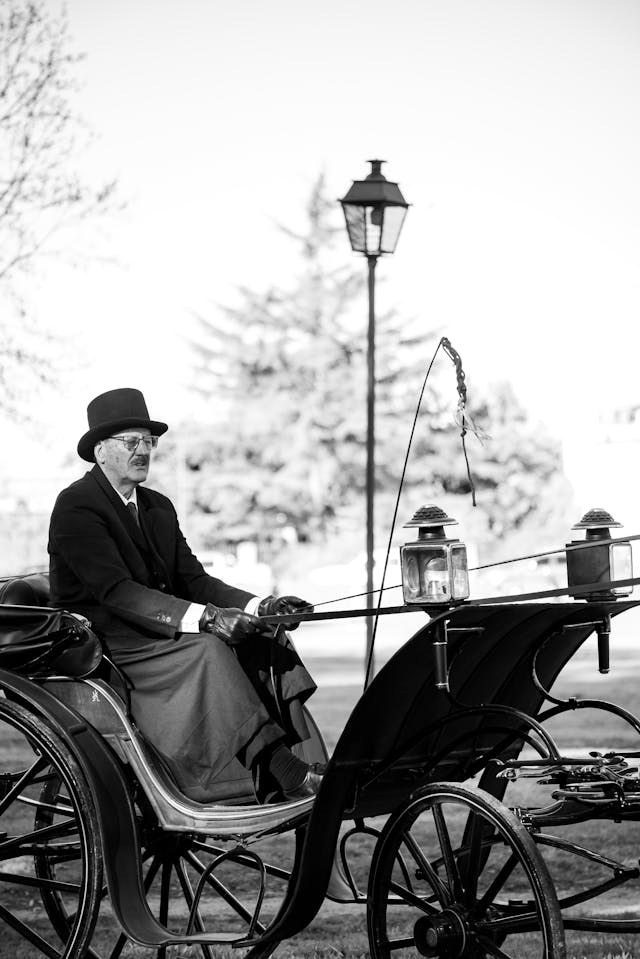
Drop lash driving whips are a specialised type of carriage driving whip designed to provide precise, controlled communication between driver and horse. While they share many similarities with traditional driving whips, the defining feature is the drop lash, which changes both how the whip feels and how it is used.
For many drivers, particularly in traditional and pleasure driving, a drop lash whip offers a more refined and natural way to apply aids.
A drop lash driving whip is a long whip where the lash hangs more loosely from the end of the shaft, rather than extending straight out.
Compared to traditional driving whips: Drop lash driving whips tend to have shorter lashes, typically around 40 cm to 80 cm. Shaft lengths are usually between 120 cm and 220 cm, depending on the type of driving.
This design allows the lash to fall naturally and makes it easier to apply light, accurate contact without excessive movement.
In carriage driving, the whip replaces the leg aids used when riding under saddle. It allows the driver to communicate clearly with the horse while maintaining rein contact and balance.
A drop lash whip is particularly useful because it allows for:
Because of this, drop lash whips are often used in:
The whip is not used forcefully, but as a refinement of the driver’s aids.
In driving circles, the whip is often referred to as the driver’s “magic wand”. This reflects the way it is used, not as something applied with strength, but as a tool for subtle communication.
A well-balanced driving whip allows the driver to:
Often, the lightest touch or even the movement of the whip through the air is enough for a trained horse to understand what is being asked.

A well-trained driving horse learns to respond to the whip when it is applied to specific areas of the body.
Typical contact points include:
The whip should always be used with precision and control, never as a blunt or forceful aid.
When not actively in use, a driving whip is usually held:
The grip should be light but secure, allowing the whip to feel like an extension of the arm rather than something heavy or awkward.
When applying an aid:
A well-balanced whip makes this much easier, allowing for controlled, accurate use.
As with all driving aids, timing is critical.
The whip should always support, not replace, the driver’s primary aids:
Consistency is important. When used calmly and regularly, the whip becomes a familiar part of communication rather than something associated with tension.
When selecting a drop lash driving whip, there are a few key factors to consider.
Length
The whip should be long enough that the lash can comfortably reach the horse’s shoulder without the driver needing to lean forward.
Balance
A good whip should feel steady and controlled in the hand, even at longer lengths.
Lash design
The drop lash should move freely and allow for soft, accurate contact.
Grip and comfort
A secure, comfortable handle is essential, particularly for longer driving sessions.
Drop lash driving whips are designed for precision, control and subtle communication. Their shorter lash and balanced design allow drivers to apply accurate aids with minimal movement, making them a popular choice for both traditional and modern carriage driving.
When used correctly, the whip is not a tool of force, but a means of communication — helping to create a calm, responsive and well-trained driving horse.
