If your horse’s girth keeps sliding backwards when you ride, the problem may be caused by your horse’s body shape, the position of their natural girth groove, or a girth that isn’t suited to their conformation. On some horses, particularly those with an athletic or wedge-shaped build, a conventional girth can gradually move backwards even when the saddle appears to remain in the correct position.
It’s a frustrating problem, especially if you’ve already tried tightening the girth or changing its position. However, understanding why the girth moves is much more useful than simply trying to hold it in place.
At Pink Equine, we’ve encountered this problem through our free horse girth consultation service, and in some cases, selecting a girth specifically designed for the horse’s conformation has made a considerable difference.
A horse’s girth naturally tends to settle into the area where the body provides the most stable position. This is commonly called the girth groove.
On many horses, this area is relatively close to the elbows. However, not every horse has the same body shape or girth groove position.
Some athletic horses have a deeper chest, a relatively narrow abdomen and a body profile that rises towards the hindquarters. This is sometimes described as a wedge-shaped conformation.
Depending on the position of the girth groove and the direction of the girth straps, this shape can encourage a conventional girth to move backwards as the horse moves.
The important point is that the girth may be following the horse’s natural contours rather than simply being too loose.
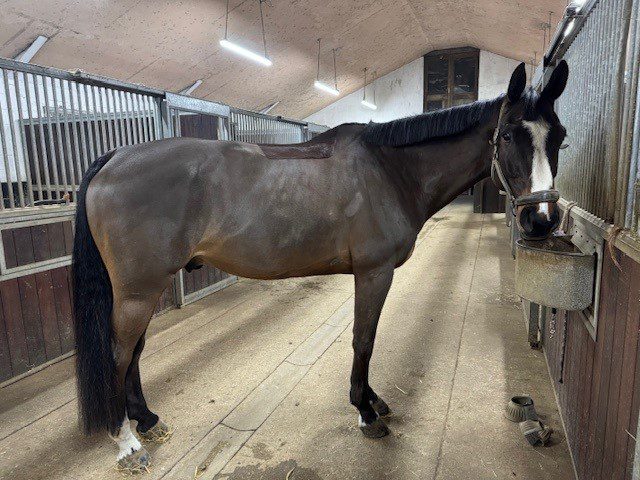
An athletic horse with a relatively deep chest and a body profile that changes towards the abdomen. Conformation is one factor to consider when investigating backwards girth movement.
Before changing your girth, it’s worth establishing exactly what is moving.
There are three situations to consider:
These situations can look similar when you’re riding, but they don’t necessarily have the same solution.
One useful approach is to take a photograph of your horse standing squarely with the saddle and girth correctly positioned before riding. Compare it with another photograph taken immediately afterwards, before adjusting anything.
Look at the distance between the girth and the elbow, the saddle’s position relative to the shoulder, and whether the girth straps have changed angle.
These observations can help establish whether the girth is moving independently or whether the saddle is moving with it.
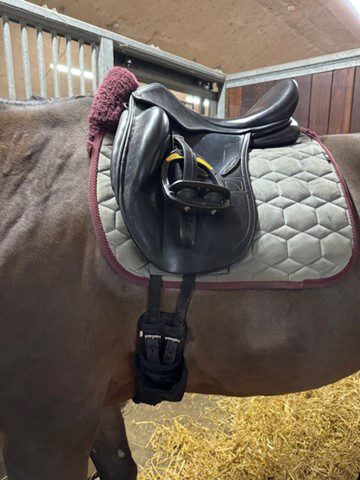
Checking the relationship between the saddle, girth straps and girth position can help identify the source of backwards movement.
Although conformation is an important factor, it isn’t the only possible explanation.
Different anatomical girths are designed to accommodate different body shapes. A girth that works beautifully on one horse may be unsuitable for another.
For example, a girth designed to accommodate a forward girth groove may not be the best choice for a horse experiencing backwards movement.
This is why simply purchasing an “anatomical girth” doesn’t necessarily solve the problem. The actual shape and intended purpose matter.
The position of the saddle’s girth straps, also called billets, can influence where the girth sits.
If the straps pull backwards towards the horse’s natural girthing area, they may contribute to the girth settling further back than intended.
However, billet position is part of the saddle’s design. Any changes should be discussed with a qualified saddle fitter rather than made simply to counteract movement.
A girth that is too short or too long can place the buckles in an unsuitable position, potentially affecting comfort and how the girth sits.
For short girths, the buckles should sit sufficiently high to avoid interfering with the horse’s elbows, while remaining appropriately positioned relative to the saddle pad and girth straps.
Our guide to measuring a horse for a girth explains how to check the correct length.
Muscle development, weight changes and alterations in condition can affect how a girth fits.
A girth that previously stayed in place may begin moving if the horse’s body shape changes, even when the saddle and girth themselves haven’t been replaced.
The most effective approach is to identify the cause rather than immediately buying a tighter or more heavily shaped girth.
Start by checking the following:
Simply tightening the girth further is not necessarily the answer. Excessive tightness can create additional pressure without correcting the underlying reason for the movement.
If the horse shows persistent discomfort, pain or behavioural changes, the cause should be investigated with the appropriate saddle-fitting or veterinary professional.
For some athletic or wedge-shaped horses, the Mattes Athletico girth may be a suitable option.
Unlike a conventional straight girth, the Athletico has a specific anatomical shape designed to accommodate horses whose conformation can encourage backwards movement.
However, it isn’t the right solution for every horse. The position of the girth groove, the saddle’s girth straps and the individual horse’s proportions all need to be considered.
We’ve explained this in more detail in our article Choosing the Right Girth for Athletic and Wedge-Shaped Horses.
One of our customers, Susan, contacted us about girth slippage and sensitivity. After reviewing photographs of her horse’s conformation and existing tack, we recommended a Mattes Athletico Girth.
Following her first dressage lesson with the new girth, she sent us this lovely message:
“It fits beautifully and I had a dressage lesson in it this morning. No slippage, no ear pinning or tail swishing and he went beautifully in it!! Very very happy, thank you so much for all of your help and advice!”
This was particularly encouraging because Susan reported not only that the girth stayed in place during her lesson, but also that her horse appeared more comfortable.
Of course, one customer’s experience doesn’t mean the same girth will suit every horse. What it demonstrates is the value of considering the horse’s individual shape rather than choosing a girth based on its general description.
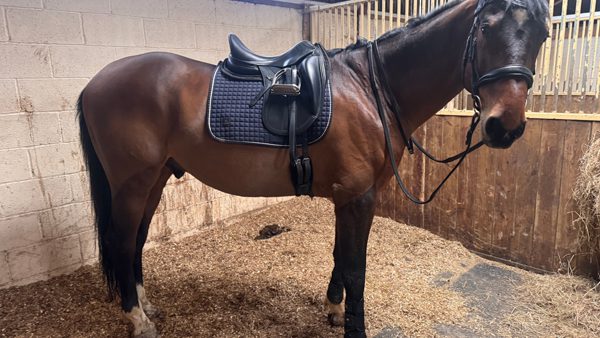
Susan’s horse wearing the original girth before our consultation. Following our recommendation of a Mattes Athletico, Susan reported no slippage during her first dressage lesson.
If your horse’s girth keeps sliding backwards, don’t assume that you simply need a tighter girth or a different saddle.
First establish whether the girth is moving independently, whether the saddle is also moving, and how your horse’s natural girth groove relates to the position of the girth straps.
Sometimes a change in girth shape can make a significant difference. In other cases, the saddle fit or another aspect of the horse’s tack needs attention.
At Pink Equine, we offer a free Mattes girth consultation, where we look at photographs of your horse, existing girth and saddle to help identify the most appropriate girth shape and size.
If you prefer to speak to someone, feel free to call us on 01386 833050 or message us on WhatsApp. We’re happy to walk you through it. 📲 Message us on WhatsApp
