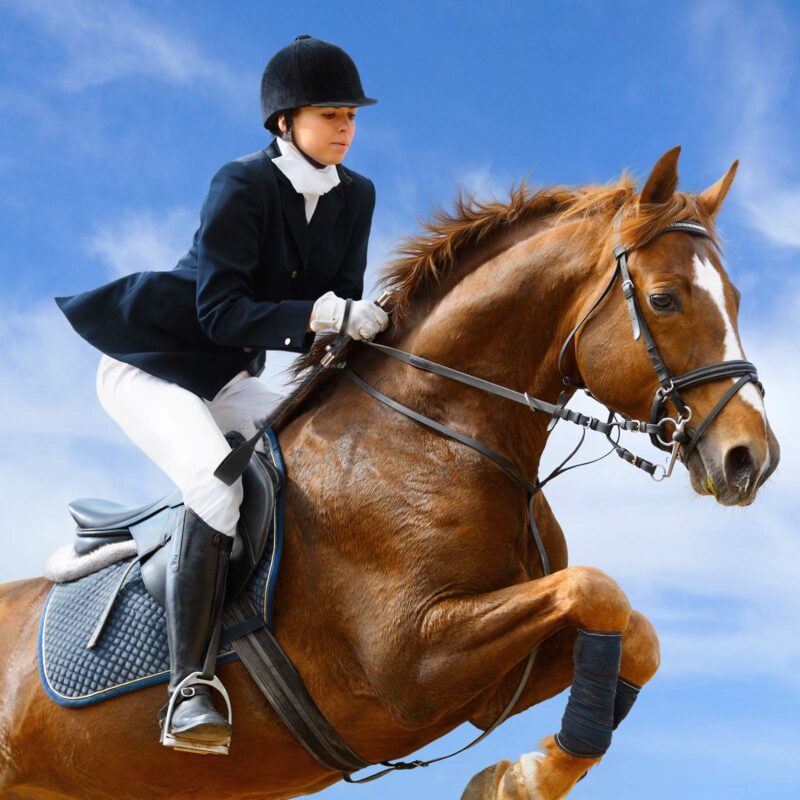
This is a guide on how to use a riding crop. A riding crop is a helpful tool, but only when used with clarity, fairness and good timing. Its purpose is never to punish a horse. Instead, it reinforces your leg aid when your horse needs a clearer reminder or a little encouragement to stay focused.
This guide walks through how to hold a riding crop correctly, when to use it, how to keep your horse confident and relaxed, and how to avoid the common mistakes that lead to confusion rather than communication.
Riding crops are just one option within a broader range of riding and training aids. Understanding the main types of horse whips available helps clarify when a crop is the most suitable choice, and when a different whip style may be more appropriate.
A crop supports your leg. That’s all. It should never replace your leg or seat, and it should never come as a surprise to the horse. Used correctly, it creates a very simple sequence:
Over time, the horse learns to respond from the leg alone, meaning the crop becomes a quiet backup rather than something you rely on.
If you’re new to riding crops or unsure how they differ from other whips, our guide on what is a riding crop and how to use one explains their purpose, design, and correct application in more detail.
Hold the crop on the inside hand (the direction of the bend), with the handle resting in your palm and the shaft pointing down your thigh. Your fingers close around the reins and the handle together, without tightening your grip or altering your rein contact.
Key points:
If you find the crop twists in your hand or feels heavy, choose a model with a grip that suits you (rubber, leather, gel, or ergonomic handles all feel different).
Correct crop use relies heavily on timing and clarity. A well-timed, light aid reinforces the rider’s leg, while poor timing can create confusion. This is explored further in horse whip aids explained, which focuses on technique rather than force.
Timing is everything. A riding crop should always follow a leg aid — never come instead of it — and it should be used at the exact moment the horse fails to react.
Use a crop to:
A single, light tap is usually enough. More force does not create better results, it usually creates tension, hesitation or defensiveness.
Many of the principles behind crop use apply across all riding whips. Our article on how to use a horse whip correctly explains how to apply aids consistently and fairly, regardless of whip type.

The correct point of contact for a riding crop is just behind your leg, never in front of the saddle or near the shoulder.
This matters because:
Horses react to clarity, not force. A calm rider who uses the crop predictably will build trust rather than anxiety. Here’s how to keep your horse confident:
A crop should feel like a reminder, not a reprimand.
These are the errors that create confusion or resistance. Most riders make at least one of these without noticing:
| Mistake | Why It Causes Problems |
|---|---|
| Using the crop before the leg | The horse can’t learn to respond from the leg alone. |
| Tapping repeatedly | The aid becomes background noise instead of a clear message. |
| Using the crop near the shoulder | This gives a completely different cue and may cause rushing or sideways steps. |
| Holding the crop too tightly | Creates tension in the hand and stiffens the rein contact. |
Small errors in position or timing can quickly undermine clear communication. If a crop isn’t having the desired effect, it may be due to a simple mistake. Our guide to common riding whip mistakes looks at frequent issues and how to correct them.
The principles are the same everywhere, but the application varies slightly:
No matter the discipline, fairness and timing remain the golden rule.
A riding crop is at its best when it becomes almost unnecessary — a silent reassurance that helps your horse understand your leg aids clearly. With soft hands, good timing and consistent technique, you’ll get a horse that responds lightly, confidently and without tension.
Used correctly, a crop strengthens the partnership rather than controlling it.
Using a riding crop correctly depends on more than just technique. Understanding how different whips are designed, when they are appropriate, and how they fit within discipline rules helps ensure aids remain fair and effective. Our complete guide to horse riding whips brings this together, covering whip types, correct use, sizing, and competition considerations in one place.
If you’re looking to compare different riding crops, browsing the category can help you find options that suit your discipline, hand size, and riding style.
