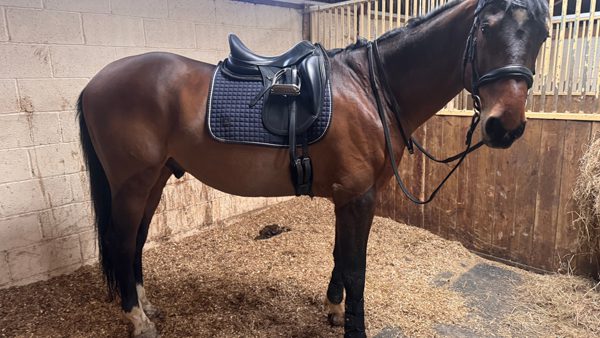
If your horse’s girth keeps creeping forwards, the saddle moves towards the shoulders, or you repeatedly find rubbing or soreness behind the elbows, the problem may not simply be the girth itself.
It could be the position of your horse’s girth groove.
The horse girth groove is one of the most important things we look at when helping a rider choose a girth. Yet many horse owners have never been shown where it is or considered how much influence it can have on girth and saddle stability.
Understanding your horse’s girth groove can explain why a straight girth works perfectly well for some horses but continually causes problems for others.
The horse girth groove is the natural area underneath and around the horse’s barrel where the girth wants to settle.
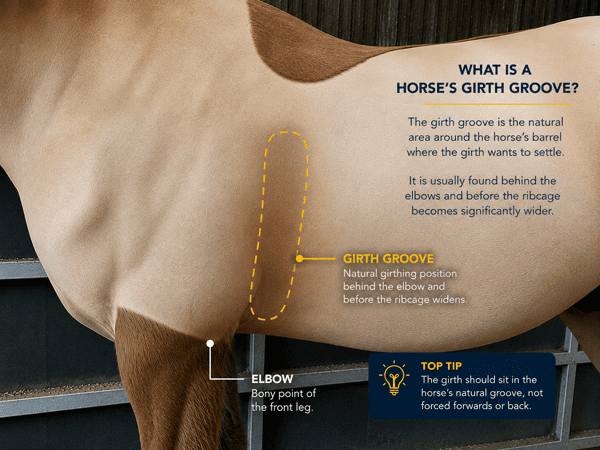
It is normally found behind the horse’s elbows and before the ribcage becomes significantly wider.
The important word here is natural.
You can initially position a girth slightly further forwards or backwards, but once the horse starts moving, the shape of the ribcage and the tension through the girth encourage it towards its natural resting position.
That position is the horse’s girth groove.
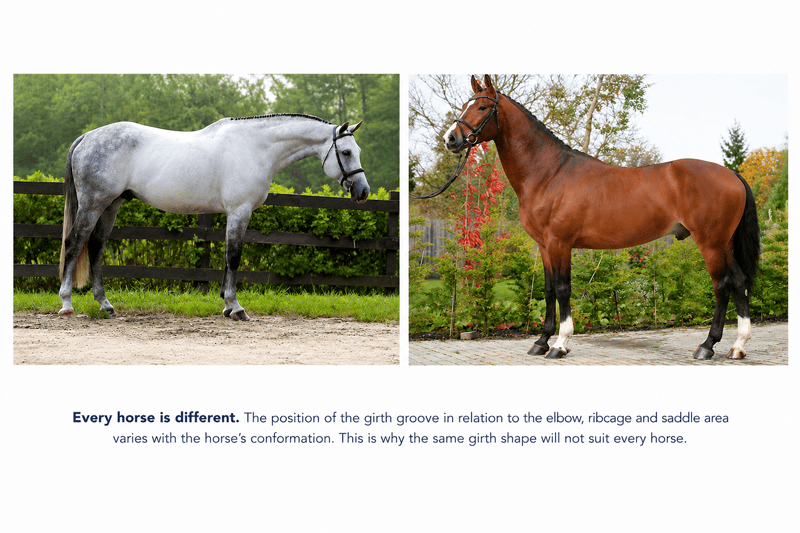
And it isn’t in exactly the same place on every horse.
The girth connects the saddle to the horse.
That sounds obvious, but it means the position the girth wants to occupy can directly influence the position of the saddle.
Ideally, the saddle should sit correctly behind the shoulder and the girth straps should descend relatively straight towards the horse’s natural girth groove.
When those two positions correspond reasonably well, the forces acting through the girth are relatively neutral and there is less tendency for the girth to pull the saddle forwards or backwards.
Problems can begin when they don’t.
For example, imagine that the saddle is correctly positioned behind the shoulder, but the horse’s natural girth groove is considerably further forward.
Once the girth is fastened, the girth straps may angle forwards towards the groove.
As the horse moves, the girth naturally wants to settle further forward. Because it is attached to the saddle, that forward pull can encourage the saddle to move with it.
This is one reason why repeatedly pushing a girth backwards doesn’t necessarily solve the problem.
You are trying to make the girth sit somewhere the horse’s conformation doesn’t naturally want it to remain.
A forward girth groove simply means that the horse’s natural girthing position is relatively close to the elbows and further forward in relation to the ideal position of the saddle.
It is particularly common in horses with combinations of characteristics such as:
You certainly don’t need all of these characteristics for a horse to have a forward girth groove.
Two horses of the same breed, height and general type can still have noticeably different girthing positions.
This is why we prefer to look at the individual horse rather than recommend a particular girth simply because somebody owns a cob, warmblood, Thoroughbred or native pony.
One of the easiest ways is simply to look at your horse from the side.
Stand the horse square on reasonably level ground and look at the underside of the barrel immediately behind the front legs.
Ask yourself:
Where is the narrowest point before the ribcage begins to widen?
Then compare that position with where the saddle and girth straps sit when the saddle is correctly positioned.
You can often see the relationship quite clearly.
If the girth straps fall naturally towards the girth groove, there is relatively little conflict between the two positions.
If the girth groove is significantly further forward, the girth straps may have to angle forwards to reach it.
Another useful check is to look at the girth after riding.
Where has it actually settled?
That can sometimes tell you more than its position immediately after tacking up.
A forward or poorly accommodated girth groove doesn’t always produce one obvious symptom.
Instead, riders may notice:
These symptoms don’t automatically mean the girth groove is responsible. Saddle fit, girth length, asymmetry, rider balance and other factors can all contribute to movement or discomfort.
But the girth groove is an important part of the picture and one that is surprisingly easy to overlook.
Rubbing immediately behind the elbow is something we pay particular attention to.
If a horse has a very forward girth groove, a conventional straight girth may naturally migrate forwards until its front edge becomes crowded against the elbow area.
Movement of the horse’s foreleg then repeatedly brings the elbow and surrounding skin into contact with the girth.
Simply tightening the girth more isn’t necessarily the answer.
In fact, if the fundamental problem is the relationship between the horse’s shape and the girth, additional tension may increase pressure without correcting the underlying geometry.
A more appropriate girth shape may provide additional room around the elbow while still allowing the girth to occupy the position dictated by the horse’s conformation.
This is where shaped girths become important.
A straight girth assumes that the horse’s girth groove and the saddle’s girthing position are reasonably well aligned.
On many horses they aren’t.
Different anatomical girth shapes are designed to accommodate different conformations.
For example, a horse with a forward girth groove and a significantly wider ribcage behind it may benefit from a crescent-shaped girth.
Rather than trying to force the entire girth backwards, the shape allows the centre of the girth to follow the horse’s barrel while providing more appropriate positioning around the elbow area.
Other conformations require different solutions.
This is why the word anatomical on its own doesn’t tell you whether a girth will suit your horse.
An anatomical girth isn’t automatically the right girth.
The shape has to correspond with the horse’s anatomy.
It is also important not to treat the girth as an alternative to correct saddle fitting.
If a saddle doesn’t fit properly, changing the girth isn’t going to magically correct it.
Likewise, a correctly fitted saddle can still be influenced by a girth that continually pulls towards a natural groove considerably further forward.
The saddle, girthing arrangement, girth and horse’s conformation form one interconnected system.
This is why saddle movement doesn’t always mean there is something fundamentally wrong with the saddle itself.
Sometimes the missing piece is understanding what is happening underneath the horse.
One of the biggest mistakes when buying an anatomical girth is choosing the shape because it looks comfortable or because somebody else recommended it.
The first question should be:
What are we actually trying to accommodate?
A horse with a forward girth groove may require a different shape from a horse whose saddle tends to move backwards.
A broad, round horse may require something different again.
And a horse with a perfectly well-positioned girth groove may not need a strongly shaped girth at all.
The starting point should always be the horse.
For a broader explanation of girth shape, sizing, materials and common girthing problems, see our complete guide to choosing the right horse girth.
This is one of the principles behind our girth consultations.
When somebody tells us that their saddle moves, their horse rubs behind the elbow or their existing girth constantly slides forwards, knowing the brand of girth they’re currently using isn’t enough.
We want to see the horse.
We look at the shape of the ribcage, the position of the girth groove, the shoulder, the elbow area and the relationship between the girthing position and the saddle.
Those details help us understand why the existing girth may be causing a problem before deciding what shape might work better.
After carrying out more than 200 girth consultations over the last 18 months, involving horses of very different shapes, breeds and disciplines, one thing has become very clear:
There isn’t one “best” girth shape for every horse. There is a girth shape that is more appropriate for a particular horse’s conformation and the problem you’re trying to solve.
Understanding the girth groove is the first step towards finding it.
If you’re unsure where your horse’s girth groove sits, or you’re dealing with rubbing, girth movement or a saddle that keeps moving forwards, our free girth consultation allows us to look at your horse’s individual conformation before recommending a girth.
Photographs are particularly useful because they allow us to see the relationship between the shoulder, elbow, ribcage, saddle and natural girthing position rather than guessing from breed or size alone.
If you prefer to speak to someone, feel free to call us on 01386 833050 or message us on WhatsApp – we’re happy to walk you through it.
