Choosing the right horse girth is far more important than many riders realise. A well-fitting girth helps keep the saddle stable, allows your horse to move freely, and contributes to their comfort and performance. Get it wrong, however, and the consequences can include saddle movement, rubbing, pressure points, restricted shoulder movement, or a horse that becomes unhappy every time the girth is tightened.
One of the biggest misconceptions we come across is the idea that there is a single best horse girth. The truth is, there isn’t. The best girth is the one that suits your horse’s conformation, the saddle you’re using, the discipline you ride, and, if there’s a problem, addresses the cause rather than simply masking the symptoms.
At Pink Equine, we’ve helped hundreds of riders whose horses have experienced everything from slipping saddles and girth rubbing to sensitivity, awkward conformation and poor saddle stability. Those consultations have taught us that choosing the right girth isn’t about buying the most expensive model or following the latest trend. It’s about understanding why a particular horse needs a particular type of girth.
Every horse is different. Conformation, saddle type, discipline and even the way a horse moves can all influence which girth will work best. That’s why we don’t believe in one-size-fits-all recommendations. Every horse should be assessed individually before deciding which girth shape, material and design is most appropriate.
This article explains how we assess a horse before recommending a girth. We’ll look at sizing, girth shapes, materials, common fitting problems and the features that really matter, helping you understand not just which girth to choose, but why.
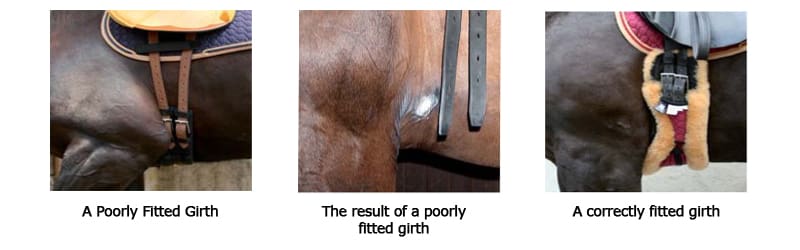
Throughout the article you’ll also find links to more detailed resources covering specific issues such as slipping saddles, sensitive horses, forward girth grooves and other common fitting challenges, allowing you to explore the topics most relevant to your horse.
If, after reading this article, you’re still unsure which girth is right for your horse, we also offer a free personalised girth consultation. It’s based on the same assessment process we use every day to help riders find the right solution with confidence, rather than relying on guesswork.
A horse girth does much more than simply hold the saddle in place. It plays a vital role in saddle stability, pressure distribution and your horse’s comfort. When correctly fitted, a girth helps keep the saddle secure while allowing your horse to move freely through the shoulder.
A girth doesn’t stop a saddle slipping. The right girth helps stabilise a correctly fitted saddle.
When it’s the wrong shape, size or design, it can contribute to saddle movement, rubbing, pressure points and even changes in your horse’s way of going.
A girth attaches the saddle to the horse using the billets (the leather straps hanging beneath an English saddle). Most English saddles have two or three billets on each side, while Western saddles use a cinch system. Although the fastening systems differ, the objective is exactly the same: to secure the saddle without creating unnecessary pressure or restricting the horse’s movement.
One of the biggest misconceptions is that the tighter a girth is, the more secure the saddle will be. In reality, saddle stability depends on far more than girth tension. The horse’s conformation, saddle fit, natural girth groove and shape of the girth all play an important role. Overtightening a poorly fitting girth rarely solves the problem and can often make your horse less comfortable.
A well-chosen girth should work with your horse’s conformation, distribute pressure evenly and allow unrestricted movement without compromising saddle stability. Throughout this article, we’ll explain how different girth shapes, materials and designs influence comfort and performance, helping you understand what makes one girth suitable for one horse and completely unsuitable for another.
Choosing the right horse girth isn’t about finding the most expensive model or simply buying the latest design. It’s about understanding your horse. Before we recommend any girth, we always assess the horse first because no two horses are built exactly the same. Their conformation, natural girth groove, saddle and the discipline they’re ridden in all influence which girth is likely to provide the best fit.
One of the principles we work by at Pink Equine is simple: we choose the girth to suit the horse, not the horse to suit the girth. That’s why there is no single ‘best horse girth’. The right choice depends entirely on the individual horse standing in front of you.
We begin by looking at the horse’s conformation. Horses with a well-defined natural girth groove often have very few girthing issues, whereas round horses, horses with forward girth grooves or those with more challenging conformation can be prone to saddle movement, rubbing, pinching or uneven pressure. In these cases, choosing the correct girth shape can make a significant difference to both comfort and saddle stability.
Different girth designs have been developed to solve different problems. Different girth shapes have been developed to solve different fitting challenges. Some are designed to improve elbow clearance, others to accommodate a forward girth groove or improve pressure distribution. Understanding why a horse needs a particular shape is far more important than assuming one design suits every horse.
Your riding discipline also plays an important role. Dressage saddles, particularly monoflap designs, require short girths to reduce bulk beneath the rider’s leg, while jumping and general-purpose saddles typically use longer girths. Jumping and cross-country riders may also benefit from a stud or belly guard girth for additional protection. We’ll look at these options in more detail in our article on the best girths for jumping.
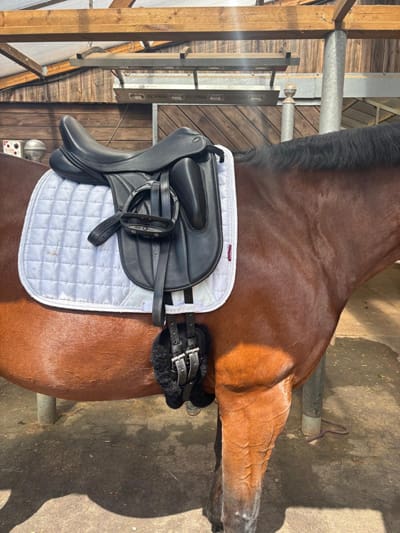
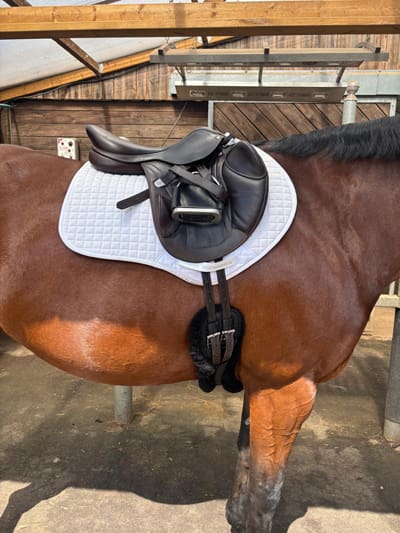
Finally, remember that a girth should never be considered in isolation. Saddle fit, billet arrangement, balance and even the saddle pad you’re using all influence how the girth performs. A correctly chosen girth complements a well-fitting saddle; it cannot compensate for a saddle that doesn’t fit the horse properly.
If you’re unsure which girth shape is most suitable for your horse, our free personalised girth consultation follows exactly the same assessment process we use every day to recommend the most appropriate solution for each individual horse.
Most riders don’t start looking for a new girth because they want one. They start looking because something isn’t working. Their saddle slips, their horse becomes girthy, hair starts rubbing away, white hairs appear, or their horse simply isn’t moving as freely as it once did.
The important thing to remember is that these are symptoms, not diagnoses. While the girth is often part of the solution, the underlying cause may be your horse’s conformation, saddle fit, girth shape or, occasionally, something entirely different. That’s why we always assess the whole picture before recommending a particular girth.
A saddle that slips forwards, backwards or sideways is one of the most common problems riders experience. While the wrong girth can certainly contribute, saddle movement is often influenced by the horse’s conformation, natural girth groove, saddle fit and the shape of the girth itself. Understanding why the saddle is moving is the key to finding the right solution rather than simply tightening the girth.
Learn more in our guides to the best girths for a slipping saddle and the best girths to stop a saddle slipping forward.
Rubbing behind the elbow, pressure points and girth galls are usually signs that something isn’t working as it should. The cause may be an incorrectly shaped girth, poor pressure distribution, unsuitable materials or simply a girth that doesn’t suit your horse’s conformation. Choosing the correct shape and material is often just as important as choosing the correct size.
Read more in our article on girth galls and how to prevent them.
Some horses naturally have a forward girth groove, while others have a rounder barrel that provides very little to help stabilise the saddle. These horses often need a specialised girth shape to work with their conformation rather than against it. Anatomical, asymmetric and crescent girths have all been developed to solve different fitting challenges, but choosing the right design depends entirely on the individual horse.
Find out more in our guides to the best girths for forward girth grooves and the best girths for round horses.
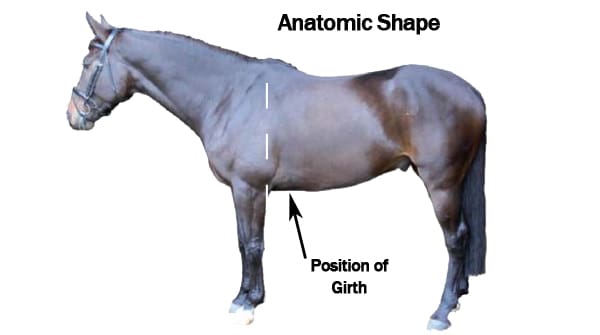
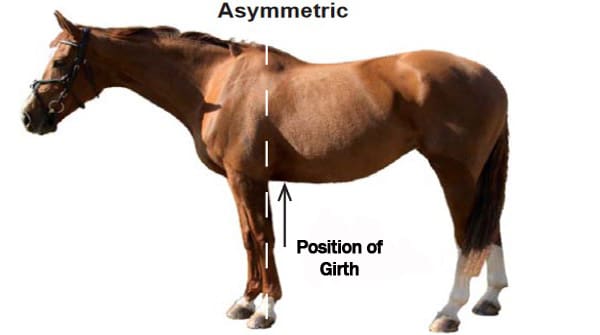
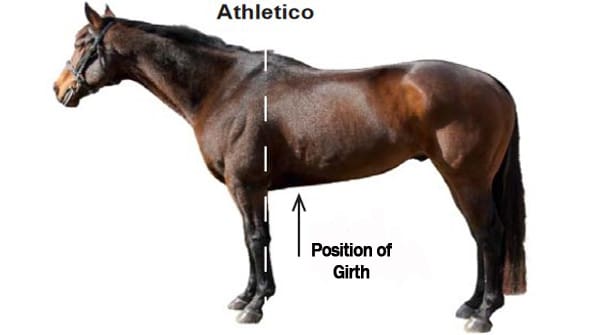
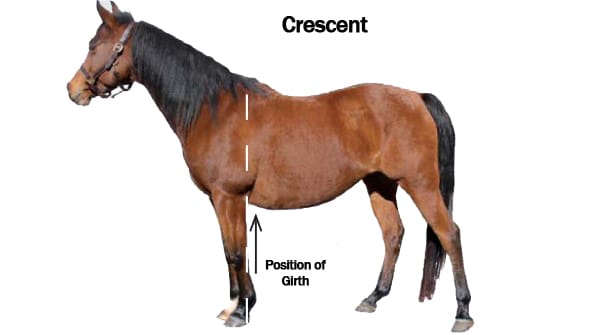
Some horses are naturally more sensitive than others, particularly behind the elbow where the girth sits. Others develop sensitivity because of pressure, rubbing or previous discomfort. Horses are remarkably good at adapting to discomfort, and subtle behavioural changes often appear long before obvious signs such as hair loss or sores. If your horse becomes reluctant to be girthed, shortens its stride or changes its behaviour when being tacked up, it’s worth investigating the cause rather than assuming they’re simply being difficult.
Our article on the best girths for sensitive horses explains the most common causes and how to choose the right solution.
Every horse is different, which is why we don’t believe in one-size-fits-all recommendations. Two horses can appear to have exactly the same problem, yet the cause and the most appropriate solution can be completely different.
Our free girth consultation gives us the opportunity to look at the individual horse, its conformation, saddle, current girth and the specific problem the rider is experiencing before making a recommendation. Throughout our girth guides you’ll find examples from our consultation files showing how this works in practice.
One involved a large Irish event horse in the United States that was developing girth sores despite already being ridden in a fleece-covered girth. Rather than simply recommending something softer, we looked at where the problem was occurring, the horse’s conformation and the position and shape of the existing girth. The owner subsequently reported that the girth we recommended fitted perfectly and that the sores had stopped. You can see the photographs and read the full consultation, including what we identified and why we recommended a different girth shape, in our guide to choosing the best girth for a sensitive horse.
Other consultation cases throughout our guides look at very different problems, including slipping saddles, forward girth grooves, limited elbow clearance and horses whose shape makes conventional straight girths difficult to fit. The important point isn’t that one particular girth solves every problem. It’s that understanding why the problem is occurring gives you a much better chance of finding the right solution.
Getting the correct size is every bit as important as choosing the correct girth shape. Even the best-designed girth can create problems if it’s too long or too short. Incorrect sizing can affect buckle position, pressure distribution and, ultimately, your horse’s comfort.
One thing many riders don’t realise is that girths aren’t all measured in the same way. Different manufacturers use different measuring methods, and short and long girths are measured differently. That’s why we don’t recommend simply buying the same size as your current girth or measuring an old girth laid out on the floor.
At Pink Equine, we’ve developed a measuring process that we use for every Mattes and Pink Equine girth we supply. It’s the same method we use during our free consultation service and has consistently helped us recommend the correct size for many customers and their horses.
Short girths are used with long-billet saddles, including most dressage and monoflap saddles.
For the girths we supply, we recommend:
Long girths are generally used with short-billet saddles.
For the girths we supply, we recommend:
Rather than trying to cover every measuring method and every saddle type here, we’ve created dedicated articles showing exactly how to measure for short and long girths, together with photographs, correct buckle position and the most common sizing mistakes.
You can learn more in our articles:
If you’re still unsure, our free personalised girth consultation includes sizing as well as shape, fit and conformation. We’ll assess your horse, saddle and current setup to recommend the correct girth, rather than relying on a sizing chart alone.
One of the biggest misconceptions when buying a horse girth is that choosing the correct length is enough. In reality, the shape of the girth is often just as important as its size. Horses come in many different shapes and conformations, so it makes sense that a single girth design won’t suit every horse.
At Pink Equine, we don’t start by asking which brand or style of girth a customer wants. We start by looking at the horse. Its conformation, natural girth groove, shoulder freedom, saddle fit and any problems the rider is experiencing all influence which girth shape is likely to work best.
Many riders simply buy the first girth that fits their saddle, but a correctly sized girth isn’t necessarily the right shaped girth. Choosing the wrong shape can contribute to saddle movement, pressure points, rubbing and restricted shoulder movement, while the correct shape can improve comfort, stability and freedom of movement.
Manufacturers have developed different girth shapes to solve different fitting challenges. Some are designed to provide greater clearance behind the elbow, others improve pressure distribution, while some help accommodate horses with a forward girth groove or improve saddle stability on more challenging conformations. The important thing isn’t whether one shape is better than another, but whether it’s the right shape for your individual horse.
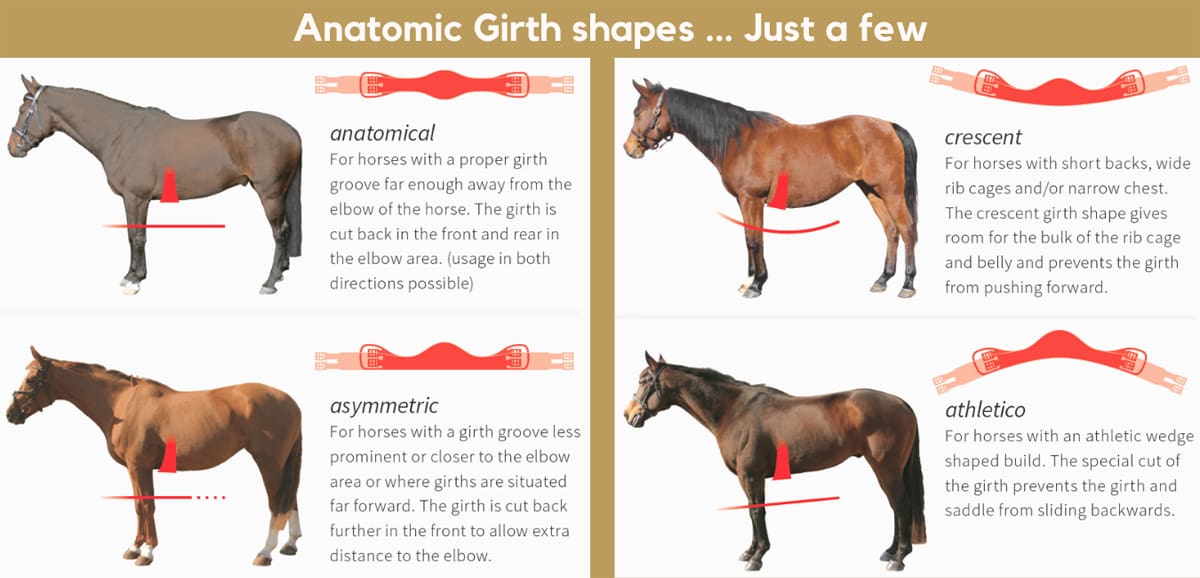
The illustration above shows just some of the different girth shapes available. Each has been developed to address particular fitting challenges, which is why we always assess the horse before recommending a specific design.
We’ll explore the advantages and disadvantages of each girth shape in much more detail in our dedicated articles, including:
Remember, there isn’t a single “best” girth shape. The right choice depends entirely on your horse’s conformation, saddle and the problem you’re trying to solve. That’s why every recommendation we make starts with the horse, not the product.
Choosing the right material is another important part of selecting the right horse girth. Different materials vary in their comfort, breathability, durability and ease of maintenance. However, it’s important to remember that no material can compensate for the wrong girth shape. Once you’ve chosen the correct shape and size, selecting the most appropriate material becomes much easier.
The best material depends on your horse’s individual needs, the work they’re doing and your own preferences for maintenance and longevity.
Leather has long been one of the most popular choices for horse girths because it’s durable, breathable and naturally moulds to the horse over time. A well-made leather girth offers excellent longevity and a classic appearance, although it does require regular cleaning and conditioning to keep it supple and performing at its best.
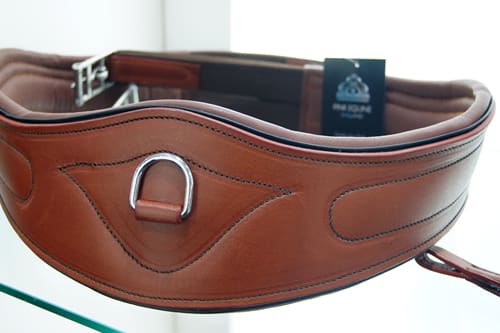
Synthetic leather girths have improved considerably over the years and are often lightweight, easy to clean and more affordable than traditional leather. However, quality varies significantly between manufacturers. Some synthetic materials can feel less breathable or less supportive than premium leather, so it’s worth paying attention to the overall construction as well as the material itself.
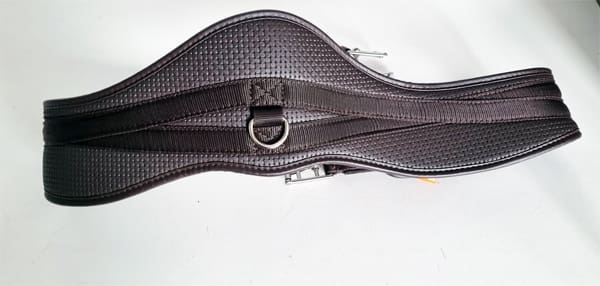
Neoprene is popular because it’s flexible, durable and simple to clean, making it a common choice for everyday riding. However, compared with natural materials, it can retain more heat and moisture, which may increase the likelihood of rubbing or skin irritation in some horses, particularly during longer rides or in warmer conditions.
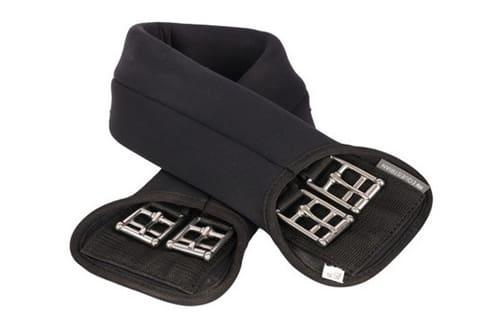
Memory foam is designed to help distribute pressure and improve comfort. The effectiveness of memory foam, however, depends just as much on the overall construction of the girth as the foam itself. A well-designed girth should provide stability as well as cushioning, rather than relying solely on the padding.
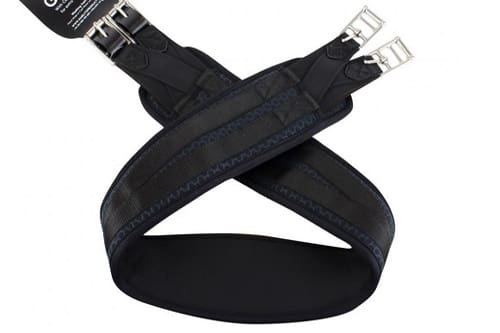
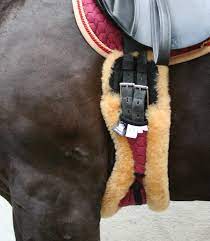
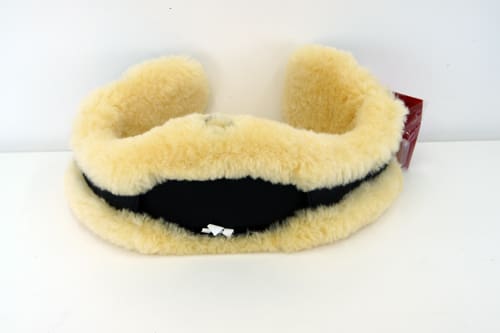
Natural sheepskin is an excellent choice for horses with sensitive skin or those prone to rubbing. It offers outstanding cushioning, excellent breathability and natural moisture-wicking properties while helping to reduce friction against the horse’s skin.
It’s worth noting that not all fleece-lined girths are the same. Genuine sheepskin is the natural hide with the wool still attached and specially processed for equestrian use. This differs significantly from synthetic fleece or imitation wool materials, which may look similar but don’t always offer the same levels of breathability, pressure distribution or durability.
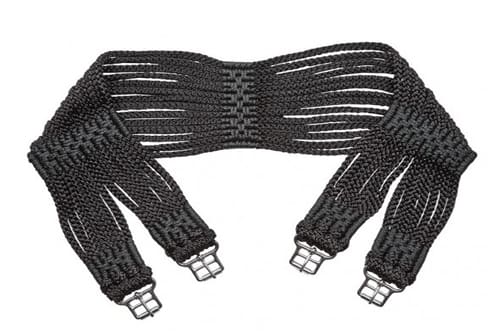
String girths have been used successfully for many years, particularly in endurance riding and other disciplines where airflow is important. Their open construction allows excellent ventilation, but, like any girth, correct sizing and fit are essential. An incorrectly fitted string girth may pinch or create uneven pressure.
Every material has its advantages, and no single option is right for every horse. The key is understanding your horse’s individual needs before deciding which material is most appropriate.
If you’d like to learn more, we’ve covered each material in greater detail in our dedicated articles, including Leather Horse Girths, Neoprene Horse Girths, Synthetic Horse Girths, Sheepskin Horse Girths and Choosing the Right Girth Material (coming soon).
A well-maintained girth not only lasts longer, it also helps keep your horse comfortable. Sweat, grease, dirt and hair can all build up over time, affecting both the condition of the girth and your horse’s skin. Regular cleaning also gives you the opportunity to check for wear before it becomes a safety issue.
Leather girths should be cleaned regularly to remove sweat and dirt, then conditioned to keep the leather supple and help prevent it from drying out or cracking. Always allow leather to dry naturally and avoid placing it next to direct heat sources, which can damage the fibres.
Pay particular attention to the buckles, elastic and stitching, as these areas experience the greatest amount of stress during use.
Read more: How to Care for a Leather Girth (coming soon).
Natural sheepskin offers excellent comfort and breathability, but it does require the correct care to maintain its performance. We recommend using a detergent specifically designed for genuine sheepskin, as these help preserve the natural lanolin within the hide, keeping both the leather and the wool soft and supple.
Avoid using ordinary household detergents, which can strip away the natural oils and shorten the life of the sheepskin. Regularly remove hair and dirt, and allow the sheepskin to dry naturally after washing before gently brushing the wool back into shape.
Read more: How to Clean a Sheepskin Horse Girth (coming soon).
Whatever material your girth is made from, inspect it regularly for loose stitching, damaged elastic, worn buckles or cracks in the leather. A girth is a critical piece of safety equipment, and replacing worn components before they fail is always preferable to risking an accident.
For a complete guide to cleaning routines, recommended products and maintenance schedules, see our article on How to Clean and Care for Your Horse Girth (coming soon).
If you’ve read this far, you’ll probably have realised that choosing the right horse girth isn’t about buying the most expensive model or following the latest trend. It’s about understanding your horse, identifying any problems, choosing the correct shape, selecting the right size and then deciding which material best suits your horse’s needs.
That’s exactly the approach we take at Pink Equine. Every recommendation starts with the horse, not the product.
Over the years we’ve helped numerous riders whose horses have experienced everything from saddle slipping and girth galls to rubbing, pressure points and challenging conformations. Those consultations have taught us that there isn’t a single girth that’s right for every horse, but there are products that consistently deliver outstanding results when matched to the right horse.
That’s why we’ve deliberately chosen to specialise in just two carefully selected ranges.
When a horse needs the exceptional comfort of genuine sheepskin or requires one of the most comprehensive ranges of anatomical shapes available, our recommendation is often a Mattes girth. Their wide choice of shapes allows us to match the girth to the horse’s conformation rather than asking the horse to adapt to the girth.
Learn more: Mattes Girth Guide – Which Style?
Not every horse needs a sheepskin girth. For many horses, a beautifully made leather girth is the ideal choice, provided it’s the correct shape and size. That’s why we developed our own Pink Equine leather girths, combining premium Italian leather, thoughtful design and exceptional craftsmanship to provide outstanding comfort and durability.
Rather than recommending one brand over another, our aim is always to recommend the solution that best suits the individual horse standing in front of us.
Every horse is different, which is why we offer a free personalised girth consultation. We’ll assess your horse’s conformation, saddle, current girth and any problems you’re experiencing before recommending the most suitable solution. Once you’ve received your new girth, we’ll also follow up to make sure it’s performing exactly as expected because our recommendation doesn’t end when your order is placed.
If you prefer to speak to someone, call us on 01386 833050 or send us a WhatsApp message. We’re always happy to help.
Complete the Free Consultation Form
📲 Message us on WhatsApp
Here are answers to some of the questions we’re asked most often during our free girth consultations.
Many horses show subtle signs long before obvious rubbing or sores appear. Saddle movement, reluctance to be girthed, shortened stride, uneven sweat marks, rubbing behind the elbow or changes in behaviour can all indicate that your current girth isn’t the best match for your horse. The important thing is to identify why the problem is occurring before changing girths.
Yes, but it’s rarely the only cause. Saddle movement is often influenced by your horse’s conformation, saddle fit, natural girth groove and the shape of the girth. A correctly chosen girth helps stabilise a well-fitting saddle, but it can’t compensate for a saddle that doesn’t fit your horse properly.
Not necessarily. The most expensive girth isn’t always the best choice. The right shape, correct size and appropriate material are usually far more important than price. A well-chosen girth that suits your horse will almost always perform better than a premium girth that’s the wrong shape.
Not every horse needs sheepskin. Genuine sheepskin can be an excellent choice for horses with sensitive skin, those prone to rubbing or horses that benefit from improved cushioning and breathability. However, many horses are perfectly comfortable in a well-designed leather girth that’s the correct shape and size.
Inspect your girth regularly for worn stitching, damaged elastic, cracked leather or signs of excessive wear. A quality girth can last for many years if it’s properly cared for, but safety should always come before extending the life of worn equipment.
Yes. Horses are remarkably good at adapting to discomfort, and behavioural changes often appear long before you notice obvious signs such as rubbing, hair loss or girth galls. A horse that’s uncomfortable in its girth may become reluctant to be tacked up, pin its ears, swish its tail, bite when being girthed, shorten its stride, resist moving forwards or simply seem less willing to work.
Of course, these behaviours can have many different causes, so it’s important not to assume the girth is always to blame. However, if your horse’s behaviour changes and you can’t identify another obvious reason, it’s worth assessing your saddle, girth and overall tack setup to rule out discomfort before looking elsewhere.
Every horse is different, which is why we always recommend assessing the horse before choosing a girth. Your horse’s conformation, saddle, discipline and any problems you’re experiencing all influence the best solution. If you’re unsure, our free personalised girth consultation can help you choose the most appropriate girth for your horse.