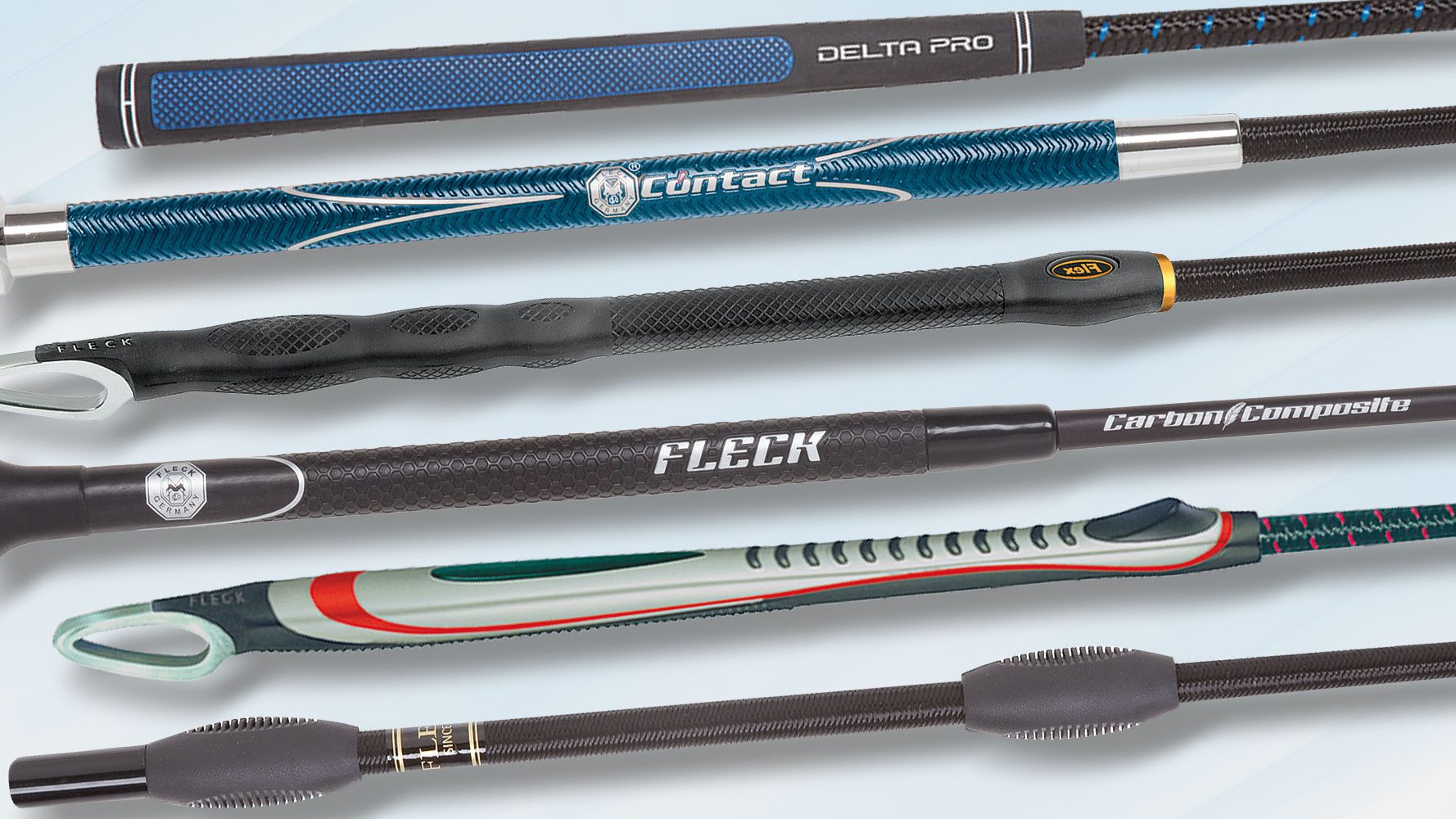
Choosing the right whip length makes a big difference to how effective, safe and comfortable your riding feels. Too short and you lose precision. Too long and it becomes difficult to control or may break competition rules.
This guide explains the correct whip lengths for every discipline, dressage, jumping, hacking, groundwork, lunging and general schooling, as well as BD, BS and FEI legal limits. Whether you’re a beginner or moving up to affiliated competitions, this gives you everything you need to choose the right horse riding whip length confidently.
When choosing the correct whip length, it also helps to understand the different types of horse whips available, as each is designed for a specific purpose and discipline. From longer schooling and lunge whips used from the ground, to shorter competition-legal options for ridden work, the size and style of whip should always match how and where it will be used.
The length of a whip determines:
* How easily you can reach behind your leg
* How subtle your aids can be
* How balanced the whip feels
* How quickly you can react
* Whether you stay within the rules of your discipline
Different riding styles require different levels of reach and precision. That’s why each type of whip has its own typical size range.
Whip length is particularly important in competition, where rules vary by discipline. For example, dressage whip length regulations differ from those applied under showjumping whip rules for 2025, meaning riders must consider both size and compliance before competing.
Below are the most widely used lengths in the equestrian world, based on accepted industry norms and leading brands such as Fleck.

Used for: Hacking, Schooling, Flatwork, Beginner Lessons. Best for: riders who want one whip suitable for most situations. Common length: 80cm.
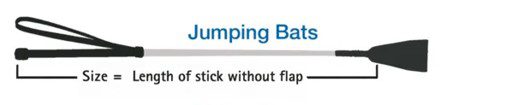
Shorter for safety and manoeuvrability. Used for: Showjumping, Gridwork, Tight Turns, Jump Offs. The British Showjumping legal limit is 70cm.

Long enough to reach behind your leg without moving the hand. Used for: Flatwork, Transitions, Lateral Work, Building Engagement. Most common sizes: 100–110cm for general home schooling, 120cm maximum in BD warm-up (horses), 100cm maximum for ponies, FEI warm-up limit: 120cm.

For work done off the horse, whip length plays a very different role. Groundwork and lunge whips are designed to extend the rider’s aids from a distance, helping with clear communication and spatial awareness during training sessions.
Groundwork whips such as the Touchier and Piaffe Whip, are mainly used for groundwork and to assist with communication between the trainer working on the ground and the horse. Typically they have a longer shaft and a shorter lash, They are perfect for helping teach a horse advanced movements such as Piaffe. Also used for In-hand work, basic training, and to improve communication and lateral control. Common lengths are between 160–180cm.

The lunge whip is an extension of the trainers arm and used for groundwork training. The shaft is long and the lash is normally the same length as the shaft, providing additional reach, especially useful for circle work, to encourage forward movement, support and reinforcement. Great for lunging, long-reining and early stage training prior to backing a horse. The typical length of a lunge whip is between 180–230cm in respect of the shaft and with a lash often equal in length to the shaft.

These vary by discipline and can be split into four categories:
Drop lash whips: made up of 120–220cm shaft and 80 – 100cm lash
Driving whips (carriage): made up of 120–200cm shaft and up to 120cm lash
Hungarian style whip: made up of 140-200cm shaft and up to 120cm lash
Trotting whips: made up of a shaft 105–160cm with a tiny lash
The most suitable horse whip sizes change with the type of work you’re doing. Below are our recommendations for each situation.
Dressage (at home): A 100cm – 110cm should provide enough reach without feeling heavy and cumbersome in the hand allowing you to perfect dressage paces without the whip getting in your way.
Dressage (competition warm-up): if you need to warm up your horse before a dressage competition, then carry on using the whip length that you are comfortable with, but note that you can increase the length up to a maximum of 120cm for horses, but only 100cm for ponies (BD & FEI legal limits).
Showjumping: The limit is 70cm for competitions, but the size of whip will vary according to your reach. A jumping bat should be short enough that you can give a light tap on the shoulder without changing your position or over-reaching. The right length is the one that feels comfortable in your hand when you’re holding the reins and allows you to use it easily without needing big movements. Jumping bats vary in length from 45cm – 70cm.
Hacking / General Riding: For general riding, a whip between 80 cm and 120 cm (31–48 inches) is a good guide for most horses and riders. The key is choosing a length that allows you to reach the horse’s shoulder and croup without altering your position in the saddle. For ponies, a slightly shorter whip around 80-90 cm is usually more suitable.
Young or Sensitive Horses: For a young horse under saddle, a shorter, more stable riding crop or a mid-length whip (around 90 cm) is usually the better choice. It stays steady in your hand, avoids excess movement and allows you to give precise, quiet aids. This kind of consistency is important when a young horse is first learning what the whip means.
Groundwork: Choose a whip that is long enough to act as a natural extension of your arm, but always take the horse’s size and the type of work into account. A range between 140-180cm. For groundwork, a whip with a shorter lash is usually the best choice because it stays controlled at close range and allows for precise, well-timed communication. It’s ideal in restricted spaces or when you’re working on details like yielding, stepping under, or improving straightness.
Longer groundwork whips can be helpful for beginners because their slower, more fluid action gives you a little extra time to coordinate your aids and body position. They also create more visual clarity for the horse when teaching basic cues. However, as your skills develop, a shorter lash often offers greater accuracy and prevents unintentional tapping.
Whichever length you choose, the whip should feel balanced, easy to hold, and stable enough that it doesn’t flap or bounce. Consistency in your aids is far more important than the length itself.
Lunging whips: Vary in length between 180cm and 250cm as well as a lash that is normally about the same length as the shaft. The whip and lash should be long enough to reach the horse’s hindquarters or outside shoulder without forcing the circle to become too small. As a general guide, the lash should be roughly the same length as the whip itself so you can make contact when needed while still maintaining a natural arm position. Effective use of the lunge whip is a skill in its own right, and good technique allows you to communicate clearly and get the most out of your training sessions.
For beginners, a slightly shorter whip and lash can be easier to manage. Longer lashes require more coordination, and it’s very easy for them to tangle, touch the horse accidentally or disrupt the rhythm of the circle before you’ve built confidence and control. Starting with a more manageable length helps you learn correct timing and body position before moving on to a full-length lunge whip setup.
Legal whip lengths vary depending on the discipline, and each organisation sets its own limits for both warm-up and competition. The guide below summarises the key rules for the major governing bodies, so you can see at a glance what is and isn’t allowed.
| Discipline | Warm-Up | In Test / Competition | Notes |
|---|---|---|---|
| British Dressage (BD) | Horses: max 120cm Ponies: max 100cm |
❌ No whip (except freestyle/exceptions) | Warm-up only |
| FEI Dressage | Max 120cm | ❌ No whip | Warm-up only |
| British Showjumping (BS) | Max 70cm | Max 70cm | Soft keeper required |
| FEI Jumping | Max 75cm | Max 75cm | Soft keeper required |
A surprising number of riders measure their whips incorrectly, and it’s something competition stewards are extremely strict about. This is especially important now that British Dressage has reduced the pony whip limit to 100 cm. Even if a whip is advertised at a certain length, you should always check it yourself — some manufacturers do not include the lash in their stated measurement, and several riders have been disqualified for carrying whips that were technically over the legal limit.
For dressage whips:
Measure from the end of the handle to the very end of the lash, fully stretched out. If your whip is only a fraction over the permitted length, you can carefully trim the lash to bring it back within the rules.
For showjumping:
Measure from the end of the handle, along the shaft, to the end of the keeper or flap. The keeper is always included in the overall measurement.
For accuracy, we recommend using a metal tape measure, as this gives the most reliable reading and avoids the stretch that can occur with soft sewing tapes.
Horse riding whips can be a very useful aid when they’re used correctly, but they do take practice. Not only do you need to coordinate your reins and leg aids, the whip adds another layer of complexity, and if the length or balance isn’t right, it can make things harder rather than easier. These are some common signs that your whip may not be the best fit for you and that you might benefit from a different length or balance:
If any of these sound familiar, changing the length or selecting a better-balanced whip can make an immediate difference.
Whip length isn’t only about discipline, a rider’s height, strength and coordination also play a part. Choosing a whip that suits your build helps you stay balanced and give clearer, more consistent aids.
Beginners: A slightly shorter whip is easier to manage and keeps everything stable as you learn coordination: 75–85 cm riding whip.
Smaller adults or children: Shorter whips help with balance and prevent over-reaching, 70–80 cm riding whip, 40–55 cm jumping bat, 90–100 cm dressage whip.
Taller riders: Taller riders can usually handle a little more length comfortably, 90 cm+ general riding whips, 110–130 cm dressage whips (for home use).
Long dressage whips (130–150 cm): Dressage whips are available in lengths up to 150 cm, but these are not intended for ridden work. Long whips above 130 cm are designed for, in-hand dressage work, long-reining, teaching advanced movements from the ground, refining bend, engagement and expression while working in-hand.
They provide reach and clarity in groundwork but are too long, too flexible and too slow in action to be practical or safe when riding.
Riders with a weaker grip or reduced strength: A shorter whip often feels lighter, easier to stabilise and less likely to wobble. Choose the shortest length that still allows you to reach behind the leg smoothly.
* Match the whip length to the discipline first, then your height.
* Be aware of competition limits, especially BS and BD.
* Choose the shortest whip that still allows clear, soft aids.
* Avoid “extra long” dressage whips unless you genuinely need them.
* Make sure the whip feels balanced in your hand.
* If the whip pulls downward at the tip, it’s too long or too heavy.
Choosing the right horse whip length becomes much easier once you understand the typical size ranges and the rules of your discipline. Whether you’re schooling at home, jumping, riding dressage, or working in-hand, the correct length helps you give clearer aids, improves safety, and ensures you stay within competition regulations. Exploring the full range of horse whips available can also help you compare styles and lengths side by side before making a decision.
However, whip length is only one part of choosing the right option. Style, discipline, and intended use all matter just as much, especially when riding under specific rules or training goals. If you’d like a broader overview beyond sizing alone, our horse riding whip guide brings everything together, explaining how different whip styles are used across everyday riding, competition, and schooling.
