When riders talk about a whip feeling “right,” they are usually talking about balance. Not weight. Not brand. Not price…. Balance.
Two whips of the same length and similar weight can feel completely different in the hand. One feels precise and responsive. The other feels slow, slightly awkward, or harder to control. The difference is whip balance.
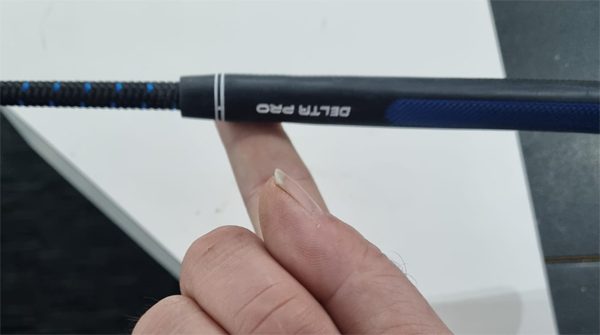
Whip balance refers to how weight is distributed along the shaft and where the balance point sits. The balance point is the place where the whip would rest evenly on your finger. On a well-balanced whip, the balance point sits closer to the handle, the shaft feels controlled and recovery between aids is quick.
On a tip-heavy whip, the balance point sits further forward, the tip carries more momentum, recovery feels slower. Even small differences in weight distribution change how a whip performs.
A 110g whip can feel heavier than a 125g whip. Why? Because total weight is static, but balance affects movement. When you apply an aid, you must, move the whip, stop the whip, reposition the whip.
If the mass is concentrated towards the end, it resists stopping. That resistance is what riders interpret as “heaviness.” A balanced whip stops exactly when you stop your hand. That precision directly affects accuracy.
Dressage riding is about timing. If your whip continues moving after your hand stops, lags slightly behind your aid, requires extra wrist correction, your timing shifts. That shift might be subtle, but horses feel subtle.
A whip with a well-positioned balance point allows, faster recovery, cleaner transitions, more discreet reinforcement. It becomes an extension of the leg rather than a swinging object.
Construction influences balance significantly. A fibreglass core is durable, slightly more flexible, can feel tip heavy in longer lengths. A carbon composite core, is lighter, stiffer with a faster recovery and often a better balance to weight ratio.
Carbon composite shafts reduce forward weight and improve control, especially in longer 110cm–120cm dressage whips. But even within the same material, balance varies depending on how the whip is constructed.
Length and Balance Are Connected. Length changes leverage, because as length increases, the balance point naturally moves forward, tip momentum increases and wrist effort increases.
This is why many riders find a 100cm whip easier to control than a 120cm, even if both are well made.
Longer whips can be beautifully balanced for their length, but physics still applies. Choosing the shortest effective length usually improves feel.
An unbalanced whip can quietly disrupt symmetry, riders may, lift one hand slightly higher, rotate the wrist to compensate, grip harder, tighten through the shoulder and over time, that compensation affects contact and posture. A properly balanced whip reduces the need for adjustment. It sits naturally in the hand.
How to Test Whip Balance. A simple check is to hold the whip lightly in one hand, tap gently behind your leg, stop your hand immediately. If the tip continues swinging noticeably, it is forward-weighted. Alternatively balance it across a finger to locate the balance point. The closer that point sits to the handle, the more controlled the whip will feel. Balance is something you feel instantly once you know what to look for.
Does Price Guarantee Better Whip Balance? Not always. Budget whips can be well balanced just as a premium whip can be poorly balanced. However, higher-quality materials and better construction and manufacturer expertise often improve, weight distribution, shaft stiffness and consistency between batches.
In general, better manufacturing control leads to a more consistent balance, nut balance should always be judged by feel, not branding alone.
Whip balance is what determines whether a whip feels precise or awkward. It affects, timing, Wrist effort, recovery speed, rider symmetry and ultimately accuracy of the aid itself.
Total weight matters far less than where that weight sits. If your whip feels slightly slow, heavy, or hard to control, the issue is often not the grams. It is the balance point.
