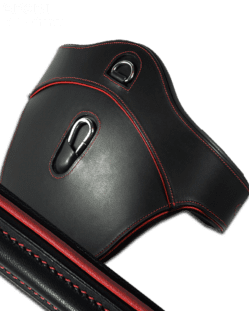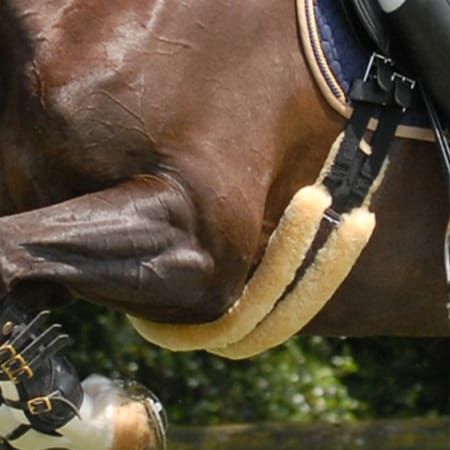
If your horse is sensitive around the girth area, choosing a softer or more heavily padded girth can seem like the obvious solution.
Sometimes it is. But in our experience, girth sensitivity is not always caused by the material of the girth itself.
Rubbing behind the elbow, girth galls, soreness, reluctance to be girthed and even changes in behaviour can also be caused by the position, size or shape of the girth. A beautifully padded girth can still cause problems if it is repeatedly being pulled into an area where the horse has very little room.
The best girth for a sensitive horse is therefore not simply the softest one. It is a girth that suits the individual horse, sits in the correct position and distributes pressure comfortably.
Girth sensitivity can present itself in several different ways.
Some horses have genuinely sensitive skin and are prone to rubbing or chafing. Others may sweat heavily around the girth area or react badly to particular materials.
You may notice:
These signs should not automatically be attributed to the horse simply being “girthy”.
If the behaviour is new, significant or unexplained, it is sensible to rule out pain or an underlying physical problem with the appropriate veterinary or equine professional.
If the problem appears to be associated with the girth itself, the next step is to work out why.
This is one of the first things we look at when somebody contacts us about a horse that is rubbing or becoming sore.
Look at the girth when the horse is fully tacked up rather than simply holding it against the horse in the stable.
Ask yourself:
This matters because the girth does not necessarily stay where we initially position it.
Every horse has a natural girth groove. Once the horse starts moving, the girth will generally try to settle towards that position.
If the horse has a forward girth groove, but the saddle and girth straps position the girth further back, the girth can be pulled forwards during exercise.
That can create pressure and friction behind the elbow, particularly on horses with very little space in this area.
Changing from one soft straight girth to another may therefore make very little difference. The shape of the girth may need to change.
For a broader explanation of girth grooves, horse conformation, sizing and the different girth shapes available, see our complete guide to choosing the right horse girth.
Straight girths work perfectly well for some horses, but horses themselves are not straight underneath.
The shape of the ribcage, sternum, elbows and girth groove varies considerably from one horse to another.
This is why shaped girths exist.
For example, a horse with a rounder ribcage, short back or forward girth groove may benefit from a crescent-shaped girth. This type of shape allows the centre of the girth to sit further forward while providing more room around the elbows.
A close-coupled horse with very little room between the elbow and girth area may instead benefit from an asymmetric girth, which provides greater relief at the front.
The important point is that these shapes are designed to accommodate the horse’s anatomy rather than simply adding more padding between the horse and an incorrectly positioned girth.
There is no single anatomical girth shape that is best for every sensitive horse.
Girth length is another easily overlooked cause of discomfort.
With a short girth, the buckles should sit sufficiently high that they are clear of the horse’s elbow and the sensitive area immediately behind it.
If the girth is too short, the buckles, straps or edges of the girth can sit in an area of considerable movement. This can become particularly noticeable when the horse brings the foreleg backwards.
Equally, simply buying a much longer girth is not automatically the answer. The aim is to position the girth and buckles correctly for the individual horse and saddle.
Our horse girth guide explains girth sizing and positioning in more detail.
Once we are satisfied that the shape, size and position of the girth are appropriate, material becomes much more important.
There isn’t one material that suits every sensitive horse, but there are several things worth considering.
Natural sheepskin is one of our preferred materials for horses that are particularly prone to rubbing.
A good-quality sheepskin lining provides a thick, soft surface between the horse and the girth. The structure of the wool fibres also allows air to circulate and can help manage moisture around the girth area.
That combination of cushioning, airflow and moisture management can be particularly useful for horses that sweat heavily or have previously suffered from friction and rubbing.
However, sheepskin still needs to be used with an appropriately shaped and correctly fitted girth.
Adding a sheepskin cover to a girth that is continually being forced into the horse’s elbow does not address the underlying problem.
Sheepskin also needs to be kept clean. Sweat, grease, loose hair and dirt accumulating in any girth lining can eventually contribute to irritation.
A high-quality leather girth can also be an excellent option for a sensitive horse.
Leather is smooth, durable and relatively easy to keep clean. For horses that do not require a thick fleece lining, a well-designed leather girth with soft padding can provide a comfortable contact surface without unnecessary bulk.
Again, the shape and fit of the girth are just as important as the material from which it is made.
Synthetic girths vary considerably in their construction.
Some horses are perfectly comfortable in them, while others appear more prone to sweating, rubbing or irritation.
Rather than assuming synthetic materials are unsuitable for sensitive horses, look at the individual girth. Consider how soft the material is, where the seams and edges sit, how easily it can be cleaned and whether it becomes hot or retains moisture during exercise.
Once the reason for the sensitivity has been considered, it becomes much easier to narrow down the type of girth that may be suitable.
A crescent girth can be particularly useful for horses with a round ribcage, short back, narrow chest or a forward girth groove.
These horses often have a girth that naturally wants to move forwards. If the girth then crowds the elbow, repeated movement can contribute to rubbing or soreness.
The crescent shape is designed to accommodate the curvature of the ribcage and provide greater freedom around the elbow.
For a horse that is also prone to rubbing or has delicate skin, combining that shape with a removable sheepskin lining can provide both the anatomical shape and soft contact surface we are looking for.
An asymmetric girth is designed for horses where there is relatively little space between the front of the girth and the elbow.
The front of the girth is cut back more significantly to create additional elbow clearance.
This can be particularly useful where rubbing occurs at the front edge of the girth or where the horse’s conformation means a conventional straight girth sits too close to the foreleg.
Neither design is automatically “better” for a sensitive horse. The correct choice depends on the horse’s conformation and where the problem is occurring.
Not every girth rub is caused purely by pressure.
Heat, moisture, dirt and repeated friction can all contribute to skin irritation.
This becomes particularly important during warmer weather, on horses in harder work or with horses that sweat heavily.
After riding, look at the horse as well as the girth.
Is the sweat pattern reasonably even?
Is one particular edge of the girth much wetter or dirtier than the rest?
Is the hair being disturbed in one specific area?
Does the horse consistently develop grease or sweat immediately behind one elbow?
These small clues can tell you a surprising amount about what is happening underneath the girth while the horse is moving.
Keeping the girth clean is equally important. Dried sweat, grease and embedded hair can turn an otherwise comfortable surface into an abrasive one.
We often find that assessing a girth after the horse has been ridden tells us considerably more than looking at the horse standing untacked.
The girth has then had time to find its natural position and you can see where pressure, sweat and movement have actually occurred.
Before removing the saddle, look at:
Then check the horse again once the girth has been removed.
Patterns often become much easier to understand when you assess the whole picture rather than concentrating only on the sore area.
This is a useful example of why we do not automatically assume that a sensitive horse simply needs a softer girth.
The horse was a large Irish event horse based in the United States.
His owner contacted us because he was developing girth sores close to the elbow. She sent photographs of the horse, the affected area and the girth she was currently using.
Importantly, he was already being ridden in a Professional’s Choice fleece-covered girth. So lack of softness was not the obvious problem.
Using the photographs and information supplied through the consultation, we looked at the horse’s conformation, where the existing girth naturally wanted to sit and the position of the sores in relation to the elbow and girth.
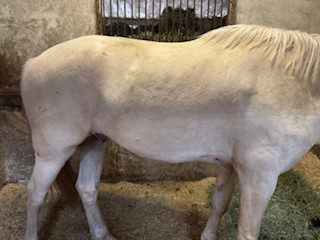
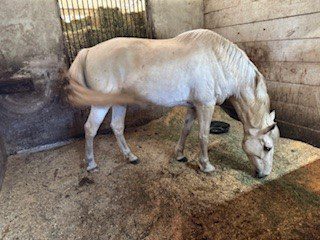

The location suggested that pressure and friction around the elbow area were contributing to the problem.
We therefore wanted to achieve two things.
First, we wanted a girth shape that worked more naturally with the horse’s conformation and provided better clearance around the sensitive area.
Second, because the skin had already been affected, we wanted a soft contact surface that would help reduce friction while also managing heat and moisture.
We recommended a Mattes Long Crescent Slimline Sheepskin Girth.
The recommendation was not simply because it was lined with sheepskin.
The crescent shape was important because it suited the horse’s conformation and allowed the girth to follow its natural position while providing more freedom around the elbow.
We recommended the Slimline construction because its narrower profile provides additional room compared with the standard quilted version, which was useful where elbow clearance was already an issue.
Finally, the removable natural sheepskin lining provided the soft contact surface we wanted for a horse that had already experienced rubbing and girth sores.
After using the new girth, the owner left the following review:
“I am very happy with Pink Equine and my girth. My horse is a big Irish eventer, and was getting girth sores. I could not find a fleece covered girth that would fit him here in the United States. After talking with Pink Equine and sending photos of my horse and his girth galls, I ordered the girth that they suggested. The girth is beautifully made, fits perfectly and does not cause girth sores. Thank you!”
This case illustrates an important point.
The solution was not simply more padding.
It was the combination of the correct shape, elbow clearance, appropriate girth length and a suitable contact material that made the difference.
Another customer contacted us about a sensitive pony that was susceptible to girth galls.
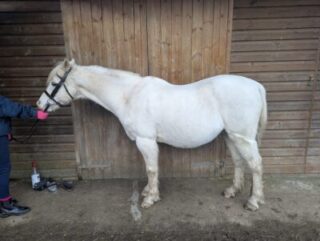

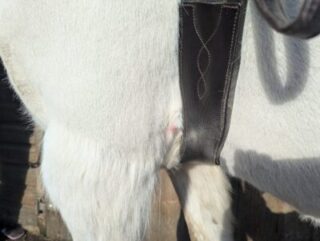
After discussing the pony’s shape and requirements, we recommended a Mattes Long Cotton Crescent Sheepskin Girth and advised the owner how to measure for the correct size.
The owner later contacted us after completing their first 20km endurance ride:
“Thank you to Jonathan at Pink Equine for his advice on the best girth to suit our sensitive pony who was susceptible to girth galls. He recommended Mattes custom crescent pony sheepskin girth, with instructions on how to measure the size we needed. It was made to measure and fit perfectly. Today we completed our first 20km endurance ride with no rubs, something that would not have been possible before!”
An endurance ride is a particularly useful test because the girth is exposed to prolonged movement, heat, sweat and repeated friction.
Again, the important part is not simply that the girth contained sheepskin. The girth also needed to be the correct shape and size for that particular pony.
There is no single girth that we would recommend for every sensitive horse.
Instead, we would look for a girth that:
For some horses, natural sheepskin will be an important part of the solution.
For others, correcting the girth shape or size may make the biggest difference.
And occasionally the girth is not the underlying problem at all.
If your horse is rubbing, developing girth sores or simply does not seem comfortable in its current girth, we are happy to look at the individual horse rather than guess from a description alone.
Our free Mattes girth consultation asks for information about your horse, saddle, current girth and the problem you are experiencing.
Photographs are particularly useful because they allow us to look at the horse’s conformation, girth groove and the position of the existing girth.
If you prefer to speak to someone, feel free to call us on 01386 833050 or message us on WhatsApp – we’re happy to walk you through it.📲 Message us on WhatsApp
Girthiness, sometimes called cinchiness, describes a horse showing discomfort or resistance when the girth is fitted or tightened. This may include pinning the ears, moving away, attempting to bite, kicking, becoming tense or showing reluctance to move forward.
Some horses are naturally more sensitive to touch, but girthiness can also be associated with discomfort, poor saddle or girth fit, skin irritation or other physical problems. A sudden change in behaviour should not simply be dismissed as the horse being difficult.
If a horse that was previously comfortable suddenly becomes sensitive when being girthed, it is worth investigating rather than immediately changing the girth.
Possible causes include soreness, skin irritation, rubbing, changes in body shape, saddle fit or an underlying physical problem. If the change is significant or unexplained, appropriate veterinary or professional advice should be sought.
There is no single best material for every sensitive horse.
Natural sheepskin can be particularly useful where friction, sweat and delicate skin are concerns because it provides cushioning while helping air circulate around the skin.
Soft leather can also work extremely well and is easy to keep clean.
Whatever material you choose, it will not compensate for a girth that is the wrong shape, wrong size or continually being pulled into the horse’s elbow.
Sheepskin can be very effective for horses prone to rubbing because it creates a soft contact surface and helps manage heat and moisture.
However, it is important to establish why the rubbing is occurring. If the girth is being pulled forwards into the elbow because its shape does not suit the horse, simply adding a sheepskin cover may reduce friction without correcting the underlying fit problem.
Soreness behind the elbow is commonly associated with friction or pressure in an area where there is insufficient clearance between the horse’s elbow and girth.
The girth may be too short, the wrong shape, positioned too far forward or being pulled forwards towards the horse’s natural girth groove during exercise.
Looking at the horse fully tacked up after exercise can often reveal much more than examining the girth before riding.
Yes. A girth that does not suit the horse’s conformation may move during exercise or place additional pressure in a particular area.
For example, a straight girth on a round horse with a forward girth groove may continually migrate towards the elbows. In that situation, a shaped girth may provide better clearance and stability.
The buckles of a short or dressage girth should sit sufficiently high that they remain clear of the horse’s elbow and the area of movement immediately behind it.
If the buckles or girth straps sit very low and close to the elbow, the girth may be too short.
Always assess the girth with the horse saddled and correctly girthed rather than measuring the girth in isolation.
A soft girth sleeve can be useful where the horse benefits from additional cushioning or a softer contact surface.
However, a sleeve should not be used to disguise a fitting problem. If the underlying girth is the wrong shape or repeatedly moves into the elbow, changing the girth itself may be more appropriate than simply covering it.
Sheepskin should be kept free from dried sweat, grease, hair and dirt because these can reduce the benefits of the soft fibres and may eventually contribute to rubbing.
Light dirt and loose hair can be removed after riding, with more thorough washing carried out when necessary using a detergent suitable for natural sheepskin. Always follow the manufacturer’s care instructions.
No.
Some horses simply require the correct size in a conventional girth. Others benefit from a shaped design, additional elbow clearance, a different material or a combination of these features.
The aim should always be to understand what is causing the sensitivity rather than choosing a girth simply because it is marketed for sensitive horses.