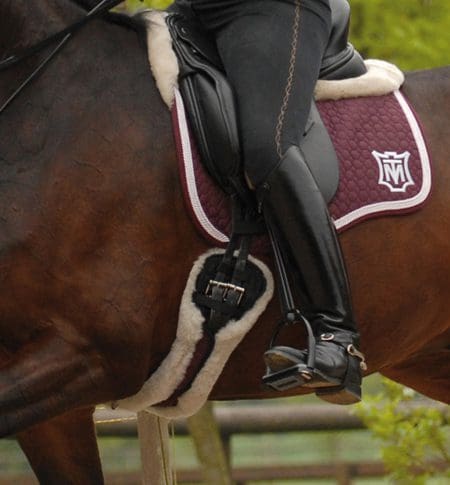
A saddle that repeatedly slips forward, backwards or to one side is frustrating for the rider and can be uncomfortable for the horse.
The natural reaction is often to tighten the girth.
Sometimes a slightly loose girth is part of the problem, but repeatedly tightening it is rarely the complete answer. If the saddle is moving because of saddle fit, horse conformation, girth position or rider asymmetry, increasing girth tension does not correct the underlying cause.
It can also create additional pressure around the sternum and behind the elbows.
One of the first things we look at when somebody contacts us about a slipping saddle is therefore not simply which girth they are using, but which way the saddle is moving and why.
A saddle that slips forwards may need a very different solution from one that consistently moves backwards, while sideways movement can point towards an entirely different set of factors.
In this guide we will look at the most common causes of saddle movement, explain how horse conformation and girth shape can affect stability, and use several real examples from our girth consultations to show how we approach different problems.
Before changing the girth, it is important to establish whether the girth is actually responsible for the movement.
A correctly shaped girth can make a significant difference where the horse’s conformation and natural girth position are contributing to the problem, but it cannot compensate for a saddle that fundamentally does not fit.
Some of the first things worth checking include the following.
A saddle positioned too far forward can sit over the shoulder and may be pushed backwards as the horse moves.
If it is positioned too far back, the girth may continually pull it forwards towards the horse’s natural saddle position.
The saddle should sit behind the shoulder blade in the correct position for the individual horse and saddle.
A saddle that is too wide, too narrow, too long or unevenly flocked can be unstable regardless of which girth is fitted.
Movement can also develop when a previously well-fitting saddle no longer suits the horse because its weight, muscle development or topline has changed.
If there is any doubt about saddle fit, a qualified saddle fitter should be involved.
A girth that is genuinely too loose can obviously allow movement.
But overtightening is not a reliable solution to a saddle that continually slips.
The girth should be secure enough to stabilise the saddle without relying on excessive tension to hold an unsuitable setup in place.
Persistent sideways movement can sometimes be influenced by the rider.
An uneven seat, collapsed hip, unequal stirrup lengths or consistently loading one side of the saddle can encourage lateral movement.
This is particularly worth considering when a saddle repeatedly slips to the same side.
Horses are not perfectly symmetrical.
Differences in shoulder development, topline or musculature can affect how evenly a saddle sits. Young horses, horses returning to work and horses changing condition through the season may also alter shape surprisingly quickly.
These are situations where saddle fitting, training and sometimes an adjustable correction pad may need to be considered alongside the girth.
Once obvious saddle-fit and rider issues have been considered, the direction in which the saddle moves can give us useful clues.
Broadly speaking:
When looking for the best girths for slipping saddles, the most important thing is to understand which way the saddle is moving and why. There is no single “anti-slip girth” that is right for every horse.
The girth needs to work with the horse’s shape and natural girth groove. A horse whose saddle slips forwards may need a completely different girth shape from one whose saddle consistently moves backwards.
The girth needs to work with the horse’s shape and natural girth groove.
For a wider explanation of how conformation, girth grooves and different girth shapes interact, see our complete guide to choosing the right horse girth.
Forward saddle movement is one of the most common problems we are asked about.
In many cases, the important clue is not the saddle itself but the relationship between the horse’s girth groove and the position of the girth straps.
If the horse’s natural girth groove lies further forward than the saddle, the girth will tend to migrate towards that groove during exercise.
As it moves forwards, it can pull the saddle with it.
On a round horse or pony, this can be even more pronounced because there may be relatively little definition in the girthing area to resist the movement.
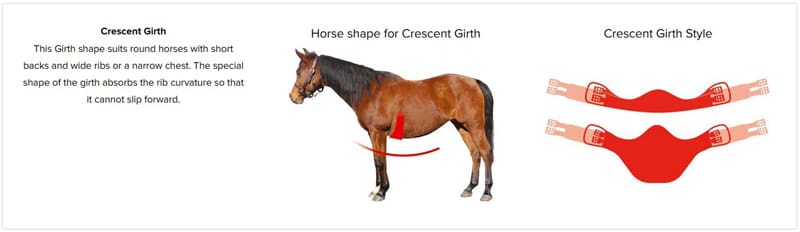
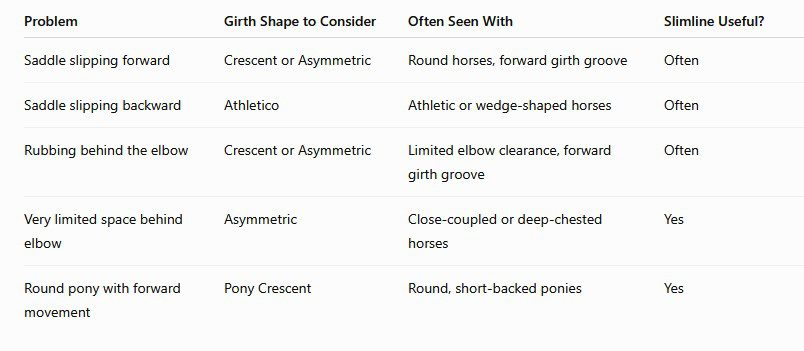
A crescent girth is designed for horses where the centre of the girth naturally needs to sit further forward while the sides curve backwards to create elbow clearance.
This shape can be particularly useful for:
The aim is not to force the girth to remain further back.
Instead, the crescent shape accommodates the position the girth naturally wants to occupy while allowing more room around the elbows.
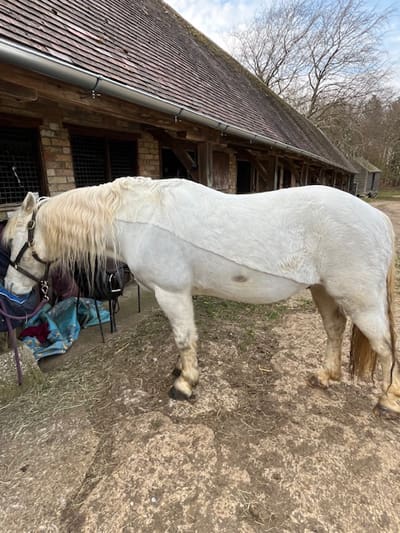
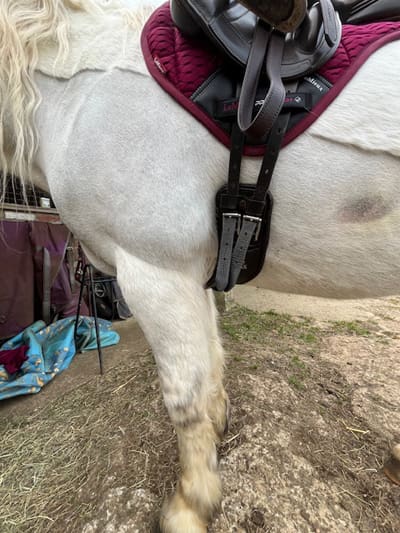
Kate contacted us after trying several different girths, including LeMieux and Fairfax models, because her pony’s girth continued to move forwards.
The problem became more noticeable when the pony gained weight, and the photographs showed that the existing girth was sitting very close to the elbows.
This is an important detail because simply fitting a softer girth would not change where the girth wanted to settle.
Looking at the pony’s rounder shape and forward girth position, we recommended a Mattes Short Slimline Crescent Girth.
The crescent shape allowed the girth to follow the pony’s natural girth position while creating more space around the elbow. The Slimline construction also gave additional clearance because it is narrower than the standard quilted version.
After changing the girth, Kate reported that the forward movement and rubbing had stopped.
This is a good example of why saddle stability is often improved by working with the horse’s conformation rather than simply tightening a conventional straight girth.
We experienced a similar issue with one of our own ponies.
He had a round body shape and forward girth groove, and the saddle and girth tended to move forwards during work.
We changed him to the Mattes Special Pony Crescent Girth, which is designed around the same principle but proportioned for smaller horses and ponies.
Once the girth was able to sit naturally around his ribcage without being forced backwards, the saddle became noticeably more stable.
Not every horse whose girth moves forward is best suited to a crescent shape.
Some horses have a relatively forward girth groove but are also very close-coupled, with little space between the elbow and girth area.
In these horses, providing sufficient clearance at the front of the girth becomes particularly important.
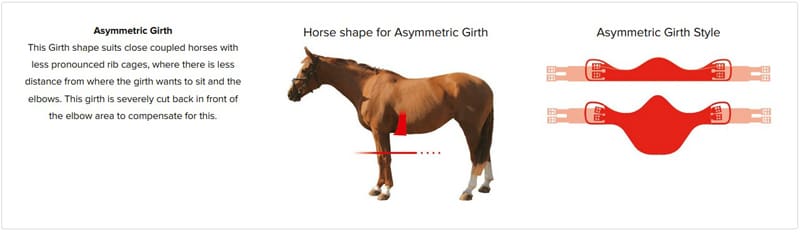
An asymmetric girth has a more pronounced cut-back at the front.
This allows additional room behind the elbow while still enabling the girth to settle into the horse’s natural girth groove.
We commonly consider this shape for horses with:
The difference between a Crescent and an Asymmetric girth can sometimes appear subtle when looking at the products themselves, but on the horse they address slightly different conformational problems.
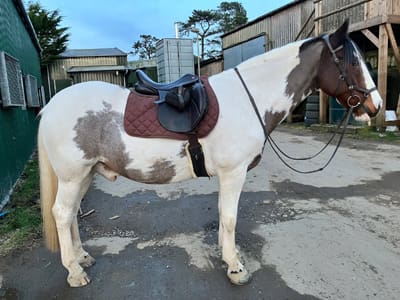
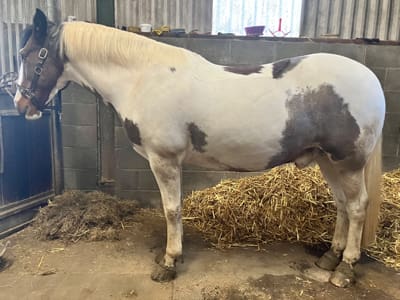
Zoe contacted us after experiencing both girth rubbing and forward saddle movement despite trying several different girths.
Looking at the photographs, the important feature was the limited amount of space available around the elbow and the way the existing girth was being drawn forwards.
In this case, we recommended a Mattes Long Asymmetric Slimline Girth.
The more pronounced front cut-back provided the additional elbow clearance we wanted, while the Slimline construction reduced unnecessary width through an already restricted area.
Zoe subsequently reported that repositioning the girth in this way resolved the problem.
Again, the solution came from identifying where the girth needed to sit, rather than simply choosing a more padded or tighter girth.
A saddle that consistently moves backwards presents a different problem.
On some athletic horses, the underline of the body narrows as it travels backwards from the girth area.
A conventional girth can therefore gradually migrate backwards during exercise. Because the girth is connected to the saddle, it can take the saddle with it.
These horses often look quite different from the rounder horses we associate with forward movement.
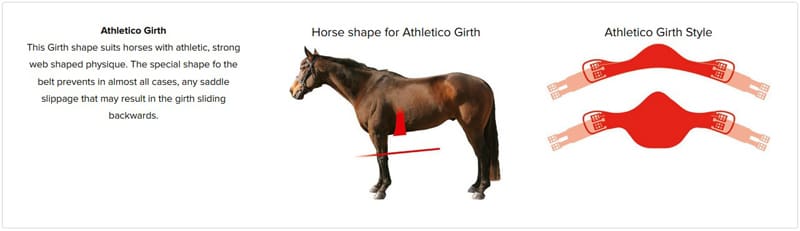
The Athletico girth is designed for horses where the girthing area narrows towards the rear and the girth has a tendency to slide backwards.
This may include:
The shape is effectively the opposite of the problem addressed by a crescent girth.
Instead of accommodating a girth that wants to travel forwards, the Athletico is shaped to help the girth remain in the more forward girthing area rather than sliding back towards the narrower part of the body.
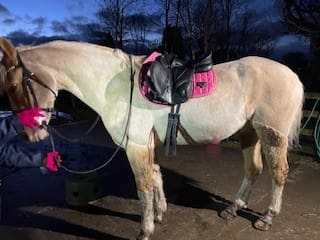
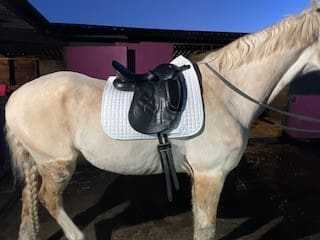
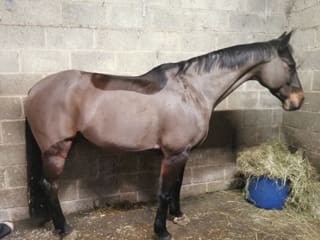
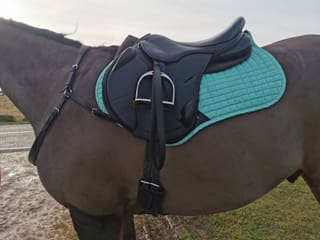
Laura and Shannon contacted us about horses experiencing persistent backward saddle movement.
Both had already tried alternative girths and saddle adjustments without resolving the problem.
From the photographs, the common feature was the way the horses’ body shape encouraged the girth to migrate backwards during exercise.
We recommended a Mattes Short Slimline Athletico Girth.
By using a shape designed specifically for this type of conformation, the girth was better able to remain in the correct position instead of continually travelling backwards and taking the saddle with it.
In Laura’s case, the change also resolved the girth sores that had accompanied the movement.
This is why identifying the direction of movement is so useful. A girth designed for a horse whose saddle moves forwards would make little sense for a horse experiencing the opposite problem.
Sideways saddle movement deserves slightly more caution.
A different girth may help in some cases, particularly if the existing girth is pulling unevenly because of the horse’s conformation, but lateral movement is more likely to involve several factors.
These can include:
If a saddle persistently moves to the same side, particularly if the problem is new, it is worth looking at the whole horse-and-rider combination rather than assuming the girth is responsible.
There are many products marketed as anti-slip girths.
Some use textured materials or additional grip, and these can certainly help in appropriate circumstances.
But grip alone does not correct a mismatch between the horse’s conformation and the position of the girth.
If a straight girth is continually being pulled forwards because the horse has a forward girth groove, adding a grippier surface is still asking the girth to sit somewhere the horse’s anatomy does not naturally support.
Likewise, a highly padded girth cannot prevent backward movement if its shape encourages it to slide towards the narrower part of the horse’s body.
This is why we generally look at shape first and materials second.
Our guide to choosing the right horse girth explains the relationship between horse conformation, girth grooves and girth shape in more detail.
Material can contribute to comfort, friction and pressure distribution, but it should not be relied upon to correct the wrong girth shape.
Natural sheepskin, for example, can be particularly useful where a horse is also experiencing rubbing or sensitivity because it provides a soft contact surface and helps manage moisture.
Leather provides a smooth, durable surface and can allow a relatively slim construction.
For horses where elbow clearance is restricted, we often use Mattes Slimline girths because their padded leather construction is approximately 2cm narrower than the equivalent cotton-quilted model.
That difference can be useful when there is very little room between the girth and elbow.
A horse’s shape is not static.
Weight gain or loss, increasing fitness, time off work, age and changes in muscle development can all alter the way a saddle sits.
A saddle that fitted correctly several months ago may therefore begin to tip, rock or become less stable even though nothing about the saddle itself has changed.
In these situations, the answer is not necessarily another girth.
A shimmable saddle pad or half pad can sometimes help where the saddle requires a relatively small and temporary adjustment.
The Mattes Correction System uses removable felt shims positioned in pockets within the pad. These can be adjusted at the front, middle or rear to alter the balance beneath the saddle.
This can be useful for:
It is important, however, to distinguish between fine-tuning a generally suitable saddle and trying to correct a fundamentally unsuitable one.
A correction pad should not be used as a substitute for professional saddle fitting where the saddle itself does not fit.
When somebody contacts us about a saddle that will not stay in place, photographs are particularly useful.
We normally want to understand:
Where possible, photographs taken after the horse has been ridden are especially useful because the girth and saddle have had time to find the positions they naturally want to occupy.
That often tells us considerably more than looking at a girth before exercise.
There is no single best girth for every slipping saddle.
The most appropriate solution depends on why the saddle is moving.
And if the saddle itself does not fit correctly, changing the girth is unlikely to solve the problem.
The aim should always be to identify the cause of the movement first and then choose the most appropriate solution.
If your saddle is slipping and you are unsure whether the girth is contributing to the problem, our free Mattes girth consultation allows us to look at your horse, current girth and saddle setup before recommending a particular shape.
Photographs are particularly helpful because they allow us to assess the horse’s conformation, girth groove, elbow clearance and the position of the existing girth.
If you prefer to speak to someone, feel free to call us on 01386 833050 or message us on WhatsApp – we’re happy to walk you through it.📲 Message us on WhatsApp
A saddle can move for several reasons, including incorrect saddle fit or placement, horse conformation, changes in muscle or weight, rider asymmetry and the position or shape of the girth.
The direction of movement can provide useful clues, but the whole saddle, horse and rider combination should be considered.
Not necessarily.
If the girth is genuinely too loose, correcting the tension may help. But if the saddle is moving because the saddle does not fit, the horse’s girth groove is pulling the girth in a particular direction, or the rider is loading one side unevenly, overtightening will not correct the underlying problem.
That depends on the horse’s conformation.
A Crescent girth is often useful for round horses and ponies where the girth naturally moves forwards.
An Asymmetric girth may be better where the girth groove is also forward but there is particularly limited clearance behind the elbow.
The photographs of the individual horse are often what allow us to distinguish between the two.
On athletic or wedge-shaped horses, the girth can sometimes migrate backwards towards the narrower part of the body and pull the saddle with it.
An Athletico-shaped girth is designed for this type of conformation and may help the girth remain in the more forward girthing position.
Persistent sideways slipping can be associated with saddle fit, uneven flocking, horse asymmetry or rider imbalance.
A girth can contribute, but lateral movement should not automatically be treated as a girth problem.
Yes.
The girth naturally tends to settle towards the horse’s girth groove during exercise. If that position does not align well with the saddle’s girth straps, the resulting pull can contribute to forward or backward saddle movement.
Sometimes, if the movement is caused by relatively small changes in the horse’s condition or muscle development.
A shimmable correction pad can alter saddle balance temporarily, but it should not be used to disguise a saddle that fundamentally does not fit.
Sheepskin can improve comfort and reduce friction against sensitive skin, but it is not an anti-slip solution in itself.
If the girth is the wrong shape for the horse, adding sheepskin will not change the direction in which the girth naturally wants to move.
The choice depends mainly on the horse’s conformation, natural girth groove, available elbow clearance and the direction in which the girth and saddle are moving.
A Crescent generally suits rounder horses where the girth moves forwards, an Asymmetric provides greater front elbow relief, and an Athletico is designed for horses where the girth tends to move backwards.
If it is not obvious from looking at the horse, photographs taken with the horse saddled and girthed can usually provide much more information.
