Round or barrel-shaped horses can be more challenging to fit with a girth and saddle, not because there is anything wrong with their conformation, but because a broad, rounded ribcage provides less natural definition for the tack to sit against.
This can affect where the girth settles, how much room there is behind the elbows and how stable the saddle feels once the horse starts moving.
However, being round or barrel-shaped does not automatically mean that a horse needs a particular girth shape.
Two equally round horses can have different girth grooves, different amounts of elbow clearance and very different fitting requirements.
The first step is therefore to understand the horse’s conformation before trying to solve any problem with the girth.
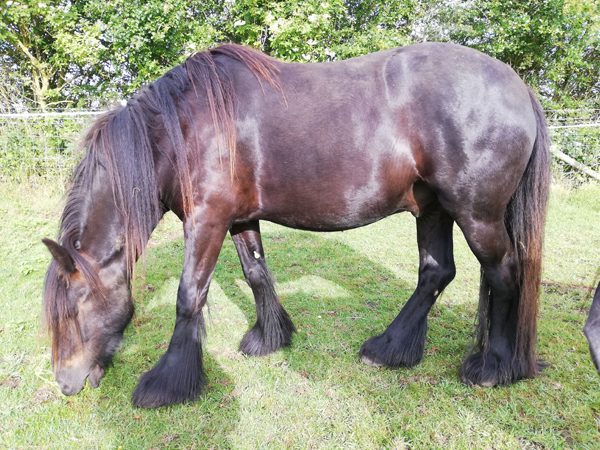
A round or barrel-shaped horse has a broad, well-sprung ribcage and relatively little narrowing through the middle of the body.
The sides of the ribcage tend to appear fuller and more curved than on a narrower or more angular horse.
This type of conformation is common in many cobs, native breeds, ponies and some warmblood or leisure horses, but it is not limited to any particular breed.
It is also important to distinguish between natural conformation and excess weight.
A fit horse can still be naturally barrel-shaped, while an overweight horse may appear rounder than its underlying conformation would otherwise suggest.
The important thing is to assess the overall structure of the horse rather than assuming that every round horse simply needs to lose weight.
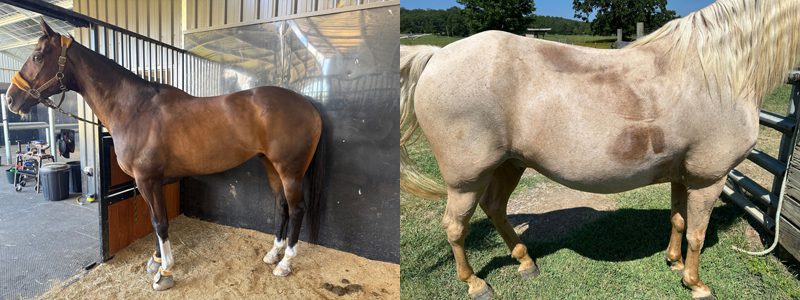
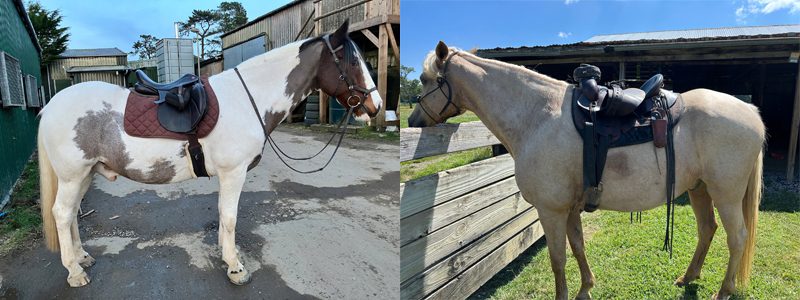
Different horses, different body shapes. The horse on the left has a more athletic, defined outline, while the horse on the right has a broader, more barrel-shaped ribcage. Roundness describes conformation and does not simply mean that a horse is overweight.
Stand the horse square on reasonably level ground and look at it from the side and, if possible, from the front or rear.
A round or barrel-shaped horse may show several of the following features:
Not every round horse will show all of these characteristics, and the overall conformation is more important than any one feature.
It is also useful to look at the horse both untacked and with the saddle fitted, because the way the girth and saddle relate to the body can reveal details that are not obvious from conformation alone.
A rounded ribcage can give the girth less natural definition to sit against.
On a more angular horse, the shape of the chest and ribcage may provide a more obvious girthing area. On a barrel-shaped horse, the body can be much smoother and more curved.
This means the girth may be more influenced by other features such as:
The horse’s roundness is therefore only one part of the fitting picture.
This is why we would not look at a round horse and immediately recommend a particular girth shape without considering the rest of its conformation.
No.
This is an important distinction because the two are often discussed as though they mean the same thing.
Round or barrel-shaped describes the overall shape of the horse’s ribcage.
The girth groove describes the position where the girth naturally tends to settle.
A round horse may also have a forward girth groove, and the two features do often occur together, but one does not automatically prove the other.
Some round horses have a relatively neutral girth groove, while others have a groove that lies much closer to the elbows.
If the girth consistently moves forward after exercise, the position of the girth groove becomes much more important than the fact that the horse is round.
We explain this in detail in What Is a Forward Girth Groove?.
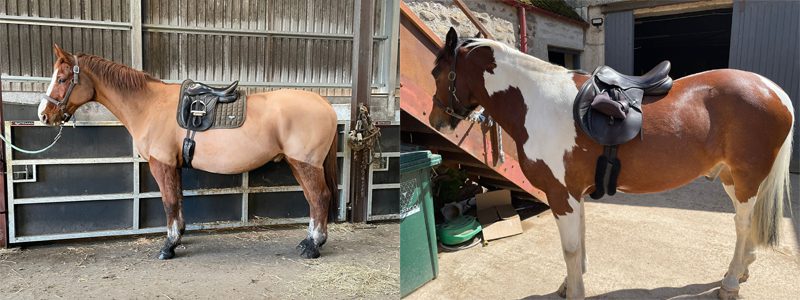
Two round horses can have different natural girthing positions, which is why body shape alone does not determine the correct girth.
A broad, rounded body can sometimes provide less natural resistance to movement than a more angular shape.
This is one reason some riders with round horses report that the saddle feels less stable or is more prone to moving during exercise.
The movement may be forwards, backwards or sideways depending on the individual horse and saddle.
However, a slipping saddle should never automatically be blamed on the girth or the horse’s roundness.
The saddle needs to fit the horse correctly first.
A girth cannot compensate for a saddle that is too wide, too narrow, poorly balanced or otherwise unsuitable.
Once saddle fit has been established, it then becomes reasonable to look at whether the girth shape and the horse’s conformation are helping or hindering stability.
This is where the relationship between the correctly fitted saddle, the billets, the horse’s girth groove and the girth itself becomes important.
The specific causes of forward, backward and sideways saddle movement are different, so we deal with those separately in our more detailed saddle-slipping guides.
It can.
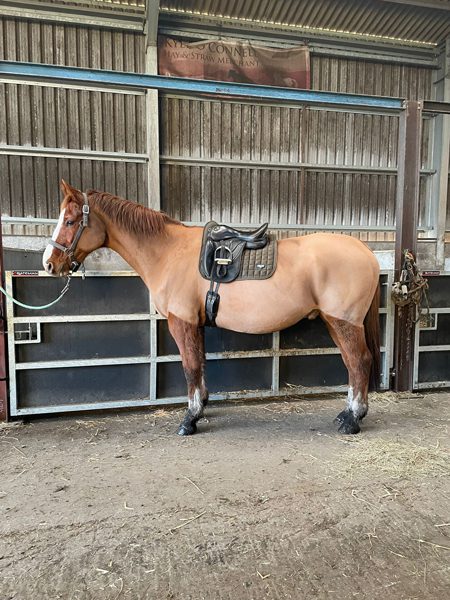
Because the ribcage is broad and rounded, the girth may have less of a defined channel in which to remain.
Its final position will often be influenced by the natural girth groove and the way the body narrows or widens around the chest and abdomen.
Some round horses encourage the girth to move forwards towards the elbows, while others remain surprisingly stable.
This is why it is useful to look at where the girth ends up after the horse has been ridden, rather than judging the fit only when first tacked up.
If the girth repeatedly moves forwards or backwards, that movement deserves its own assessment rather than being treated simply as a consequence of the horse being round.
We cover those problems separately in:
Some do, but not all.
A horse can be very round through the ribcage and still have reasonable space behind the elbow.
Another horse may be round, short-backed and close-coupled, leaving very little space for the girth.
This distinction matters because elbow clearance can influence which girth shapes and widths are suitable.
Where the girthing area lies very close to the elbow, even a small amount of forward movement can result in the girth sitting in an area of considerable movement.
This can contribute to rubbing, pinching or sensitivity.
That is why we assess elbow clearance separately from body shape rather than assuming all round horses have the same requirement.
Our guide to how a horse girth should fit explains how to assess elbow clearance properly, including why the horse should be checked in motion and after exercise.
Roundness alone does not tell us how much space is available behind the elbow.
No.
A horse can be naturally broad and barrel-shaped while being in appropriate condition.
Likewise, a horse with a naturally narrower frame can become overweight without becoming truly barrel-shaped in the conformational sense.
That said, additional weight can make a round horse even fuller through the abdomen and reduce definition around the girthing area.
This can sometimes influence both girth position and saddle stability.
It is therefore useful to think about two separate things:
Both can influence the way tack fits, but they are not the same thing.
Yes.
The horse’s skeleton and basic conformation remain the same, but changes in weight, muscle and abdominal tone can alter the contours of the body.
A girth that fitted well when a horse was carrying more condition may sit differently once the horse becomes leaner and fitter.
The reverse can also occur. Seasonal weight gain may make the girthing area rounder and cause equipment that was previously stable to behave differently.
This is particularly relevant for:
If the horse’s shape has changed noticeably, it is worth reassessing both saddle and girth fit rather than assuming the existing setup will continue to behave exactly as before.
Not automatically.
A wider girth can distribute pressure over a larger surface area, but only if there is enough room for that width to sit comfortably.
On a round horse with good elbow clearance, additional width may be perfectly suitable.
On a horse that is also short-backed or close-coupled, a wide girth may take up too much of the limited space behind the elbow.
This is another reason why we do not choose girth width based on roundness alone.
The girth needs to fit the available space as well as the shape of the ribcage.
No, not simply because the horse is round.
A correctly tightened girth is obviously necessary for saddle stability, but overtightening is not a reliable solution to movement caused by conformation or saddle fit.
If the saddle or girth is moving because the equipment is not working with the horse’s shape, increasing the tension does not change that shape.
It may simply increase pressure.
We also do not rely on the traditional two-finger method as proof of correct girth fit. As discussed in our girth fitting guide, it is better regarded as a rough tightness check than a complete fitting test.
No.
If the horse is comfortable, the girth remains in a suitable position, the saddle is stable and there is good elbow clearance, there may be no reason to change from a straight girth.
A shaped girth becomes more relevant when the round conformation is combined with another feature or problem, such as:
The shape of the girth should therefore be chosen according to the complete horse, not simply because the horse is round.
This is the same principle we discuss in our guide to anatomical girths: anatomical shaping is only useful when the shape actually matches the horse’s conformation.
Yes, in some cases.
Crescent-shaped girths are commonly associated with round or barrel-shaped horses because they can work particularly well when roundness is combined with a forward girth groove.
The centre of the girth sits further forwards while the sides curve backwards, allowing the girth to follow the horse’s natural girthing area while providing room around the elbows.
However, round horse does not automatically mean Crescent girth.
A horse with a forward groove but very limited space behind the elbow may require a different shape.
Another round horse may have no significant girthing problem and remain perfectly comfortable in a conventional girth.
This is why we look at the ribcage, girth groove, elbow clearance and any actual movement before recommending a specific design.
This is where roundness becomes only one part of the fitting decision.
A round horse can also be close-coupled, with very little distance between the girthing area and the elbow.
In that situation, creating adequate front clearance may become more important than the roundness itself.
This does not automatically tell us which girth should be used, but it does tell us that the available space needs to be assessed carefully.
The key point is that two horses can look equally round from a distance but have very different fitting requirements once the girth groove and elbow clearance are considered.
Round horses are a good example of why tack should not be assessed only while the horse is standing still.
Before riding, look at:
Then ride normally.
Before loosening the girth afterwards, check again:
These observations often reveal more than simply looking at the horse’s body shape.
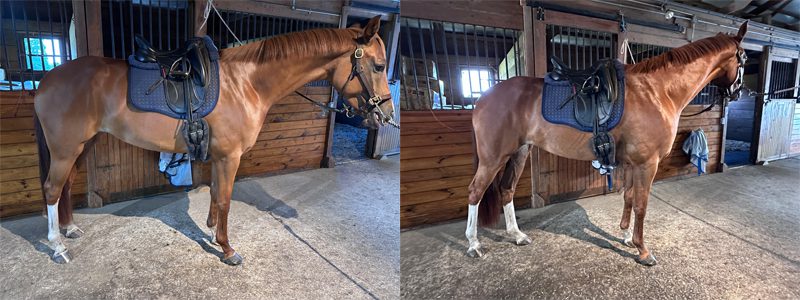
Comparing the horse before and after exercise can show whether the conformation is actually contributing to movement.
A round or barrel-shaped horse does not automatically need a special girth.
Instead, the girth should:
If the horse is comfortable and everything remains stable, there may be no reason to change the current setup.
If a problem develops, the next step is to identify what is actually happening rather than simply choosing a girth marketed for round horses.
A girth that moves forwards, a saddle that slips forwards and a saddle that rolls sideways may all occur on a round horse, but they are not the same problem and should not automatically receive the same solution.
If you are unsure how your horse’s conformation is affecting girth fit, our free girth consultation allows us to look at the individual horse rather than making a recommendation from a description alone.
We look at the horse’s overall conformation, natural girth groove, elbow clearance, current girth, saddle setup and any problems you are experiencing.
Side-on photographs without tack, with the horse saddled and, where possible, immediately after riding are particularly useful.
Where saddle movement is involved, we always recommend that the saddle itself is correctly fitted first. Once that has been established, we can help assess whether the girth shape is appropriate for the horse and the saddle’s girthing arrangement.
If you prefer to speak to someone, feel free to call us on 01386 833050 or message us on WhatsApp. We’re happy to talk through what you are seeing.
A barrel-shaped horse has a broad, well-sprung ribcage with relatively little narrowing through the middle of the body. This is a conformational description and does not automatically mean that the horse is overweight.
They can be, because a broad, rounded ribcage can provide less natural resistance to saddle movement. However, correct saddle fit remains the first priority and a different girth cannot compensate for an unsuitable saddle.
No. Roundness describes the shape of the ribcage, while the girth groove describes where the girth naturally settles. The two often occur together, but they are separate features.
There is no single best girth for every round horse. The correct choice depends on the horse’s girth groove, elbow clearance, available space and whether the girth or saddle is actually moving.
No. Crescent girths can be useful where a round ribcage is combined with a forward girth groove, but other round horses may need a different shape or may not require a shaped girth at all.
Round conformation can contribute to reduced lateral stability, but saddle rolling can also be associated with saddle fit, horse asymmetry and rider balance. It should not automatically be treated as a girth problem.
No, not simply because the horse is round. The girth should be correctly tightened, but overtightening does not correct inappropriate saddle fit or a mismatch between the horse’s conformation and the girth shape.
Yes. Changes in condition can alter the contours of the horse’s ribcage and abdomen, which can change where the girth settles and how stable the saddle feels.
Yes. Barrel-shaped describes underlying conformation. A horse can be lean, fit and muscular while still having a naturally broad, rounded ribcage.
