A forward girth groove is a natural girthing position that sits closer to the horse’s elbows than the position of the saddle may initially suggest.
It is a conformational characteristic rather than a fault, but it can become important when choosing a girth because the girth will usually try to settle into the position dictated by the shape of the horse’s ribcage.
This is why some owners find that they position the girth several inches behind the elbow when tacking up, only to discover after riding that it has moved forwards again.
The girth is not necessarily “slipping” in the conventional sense. It may simply be finding the horse’s natural girth groove.
For some horses this causes no problem at all. For others, particularly where there is limited space behind the elbow or the saddle sits noticeably further back, a forward girth groove can contribute to rubbing, girth movement or saddle instability.
The important thing is to understand why the girth is moving before trying to prevent it.
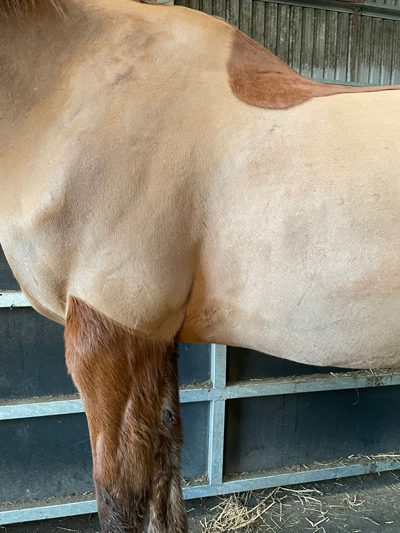
The girth groove is the area underneath the horse where the girth naturally tends to settle.
Its position is influenced by the shape of the ribcage, sternum, chest and abdomen.
On some horses, the girth groove lies relatively centrally beneath the saddle. On others it sits much further forwards towards the elbows.
Some more athletic or wedge-shaped horses show the opposite tendency, with the girth moving backwards.
Every horse is different, which is why a girth should not be judged solely by where we would ideally like it to sit when the horse is standing still.
We look at the wider subject in more detail in our guide to what a horse’s girth groove is and why it matters.
One of the easiest clues is to look at where the girth repeatedly ends up after exercise.
If you position the girth further back when tacking up but it consistently moves forwards towards the elbows once the horse starts working, the horse may have a forward girth groove.
Other signs can include:
None of these signs proves the diagnosis on its own, but together they can give a very clear picture.
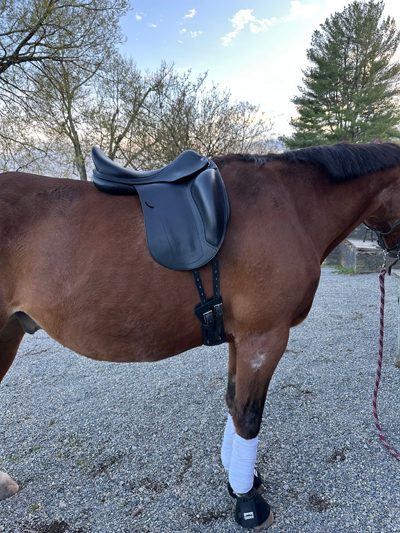
A girth tends to move towards the narrowest or most naturally defined part of the horse’s girthing area.
If that position lies further forwards than the saddle’s billets, the girth may gradually move towards the elbows as the horse works.
This is especially noticeable on horses whose ribcage becomes wider behind the girth area. A straight girth positioned further back may effectively be sitting on a slope, encouraging it to move forwards towards the narrower point.
Trying to repeatedly reposition the girth further back does not change the underlying conformation.
Likewise, tightening the girth more firmly may reduce movement temporarily, but it does not alter the reason the girth is trying to move forwards in the first place.
This is why we generally prefer to work with the horse’s natural girthing position rather than trying to force the girth to remain somewhere the horse’s shape does not support.
A forward girth groove is often associated with rounder or barrel-shaped horses and ponies, particularly where the ribcage is broad and the chest narrows closer to the forelegs.
We also commonly see it in:
However, it is important not to stereotype.
A horse does not have to be overweight, round or a particular breed to have a forward girth groove.
The groove is determined by the individual horse’s anatomy and conformation.
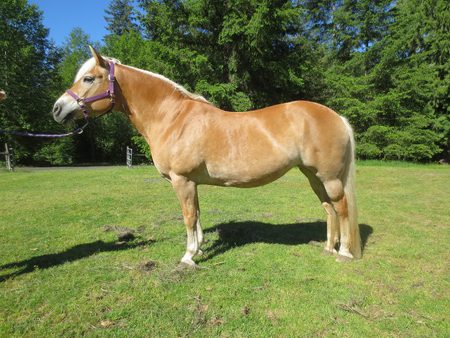
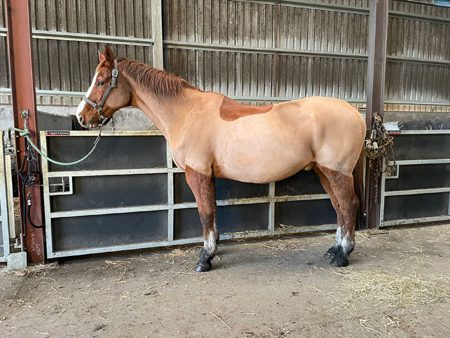
Two horses can both have a forward girth groove while having very different overall conformation.
No.
A forward girth groove is simply one variation in normal horse conformation.
It becomes relevant when the position the girth naturally wants to occupy does not align particularly well with the saddle and girthing arrangement.
Some horses with very forward grooves are completely comfortable and stable in conventional equipment.
Others have additional conformational features, such as a round ribcage or very little elbow clearance, that make girth selection more important.
For that reason, the presence of a forward girth groove should be treated as one part of the whole horse, not as a problem that automatically needs correcting.
It can contribute to it.
If the natural girth groove lies close behind the elbow, the girth may move into an area where there is relatively little space for the foreleg to move backwards.
Repeated movement between the elbow, skin and front edge of the girth can then contribute to:
However, a forward girth groove is not the only possible cause of rubbing.
Girth length, girth width, material, cleanliness, sweat, the amount of elbow clearance and the horse’s individual sensitivity can all contribute.
This is why we would not automatically assume that changing to a softer girth will solve the problem.
If rubbing is the main concern, our guide to choosing a girth for a sensitive horse looks at shape, fit, material and real consultation examples in more detail.
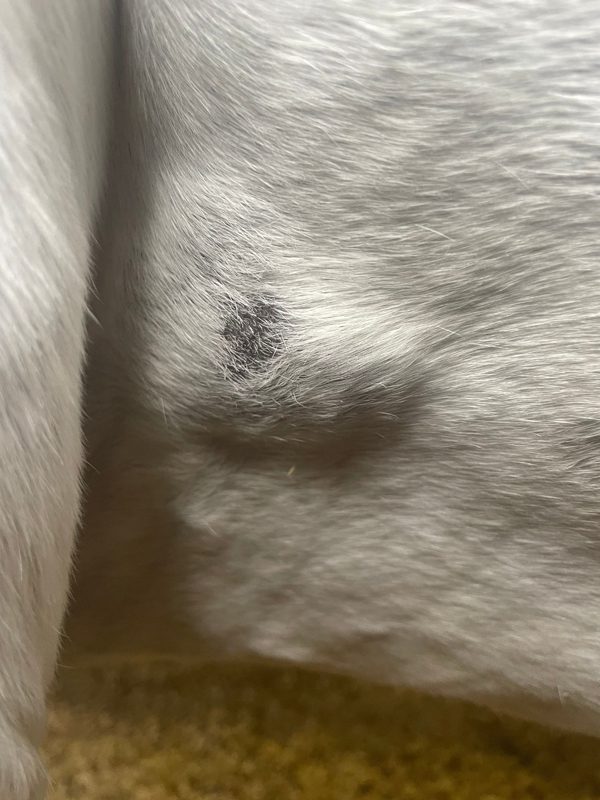
Yes, it can contribute to forward saddle movement.
If the horse’s natural girth groove lies significantly in front of the saddle’s girthing position, the girth may move forwards as the horse works.
Because the girth is connected to the saddle through the billets, that forward pull can also influence the saddle.
But this needs an important qualification.
A saddle that repeatedly moves forwards should not automatically be treated as a girth problem.
The saddle should be correctly fitted to the horse first.
A different girth cannot compensate for a saddle that is too wide, too narrow, incorrectly balanced or otherwise unsuitable for the horse.
Once saddle fit has been established, we can then look at whether the horse’s conformation, girth groove, billet position and girth shape are working together or against one another.
This is also why we are careful about the boundary between saddle fitting and girth fitting. We are not saddle fitters. Our area of expertise is helping to determine which girth shape is most appropriate once the saddle itself is correctly fitted.
If saddle movement is the main issue, our guide to the best girths for slipping saddles looks at forward, backward and sideways movement using real consultation cases.
Yes.
The saddle billets determine where the downward pull from the saddle begins, while the horse’s body determines where the girth naturally wants to settle.
If those two positions are noticeably different, the girth may sit at an angle rather than hanging vertically beneath the saddle.
That does not automatically mean the saddle or girth is wrong, but it does mean the complete arrangement should be considered rather than looking at the girth in isolation.
Different saddles also use different billet configurations, and saddle fitters may sometimes use alternative girthing arrangements to influence saddle stability.
That falls within the saddle fitter’s area of expertise.
From a girth-fitting perspective, our concern is whether the girth can sit comfortably in the horse’s natural position without being forced into the elbow or creating unwanted pressure.
Not simply because it is moving forwards.
A genuinely loose girth obviously needs to be tightened appropriately, but overtightening does not correct a conformational mismatch.
If the girth is migrating forwards because that is where the horse’s natural girth groove lies, increasing the tension may simply hold the girth more tightly against the same forward position.
This can potentially increase pressure without solving the reason for the movement.
The better question is:
Why is the girth moving forwards, and is the current girth shape allowing it to sit comfortably once it gets there?
We also do not rely on the traditional two-finger test as proof of correct girth fit. As we explain in our guide to how a horse girth should fit, two fingers provide only a rough indication of tension and tell us very little about position, elbow clearance or movement.
This depends on the rest of the horse’s conformation.
This is one of the most important points in the article because a forward girth groove does not automatically mean that every horse needs the same girth.
A Crescent girth is often considered for horses with a forward girth groove combined with a rounder ribcage.
The centre of the girth sits further forwards while the sides curve backwards, allowing the girth to follow the horse’s natural girthing area while creating additional room around the elbows.
This can be particularly useful for:
An Asymmetric girth may be more appropriate where the horse also has particularly limited space behind the elbow.
The more pronounced cut-back at the front provides additional clearance in an area where the horse has very little room.
We often consider this shape where the horse is close-coupled or where rubbing is concentrated around the front edge of the girth.
The difference between the two designs is important.
Two horses can both have forward girth grooves and still need different girth shapes.
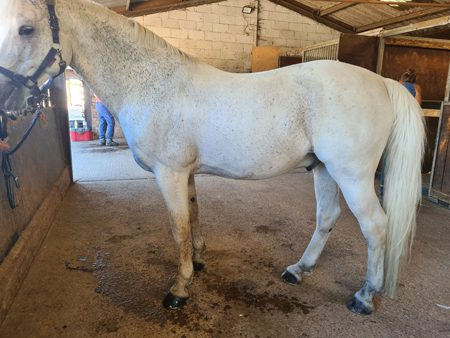
In the first image we recommended we recommended a crescent shaped girth. The horse has a round ribcage with a forward girth groove. The Crescent shape allows the girth to sit in the natural forward position while curving back to provide more room behind the elbow. In the second image an Asymmetric girth was recommended after considering the horse’s overall conformation and available elbow clearance.
Similar problem, different conformation. Both horses have a forward girthing tendency, but the shape of the ribcage and available space behind the elbow also need to be considered when choosing the girth shape.
No.
If the horse is comfortable, the saddle is stable, there is adequate elbow clearance and the existing girth remains in a suitable position, there may be no reason to change it.
An anatomical or shaped girth becomes useful when the horse’s conformation creates a fitting problem that a straight girth does not accommodate well.
The word “anatomical” itself is not enough.
The shape still needs to correspond with the horse.
Our guide to what an anatomical girth is explains the different shapes and why they should not all be treated as interchangeable.
The horse’s underlying skeletal conformation does not suddenly change, but the way the girthing area appears and behaves can change over time.
Weight gain, weight loss, increasing fitness, changes in abdominal muscle and changes in overall condition can all alter the contours of the horse’s body.
A horse that becomes rounder through the abdomen may show more pronounced forward girth movement than when leaner and fitter.
Likewise, a horse developing more muscle through training may change shape enough for an existing saddle or girthing arrangement to behave differently.
This is one reason why equipment that worked well for several years can sometimes begin to move even though nothing has apparently changed.
This can happen.
A forward girth groove is only one feature of the horse’s conformation and does not determine every aspect of saddle movement.
Saddle fit, saddle balance, the horse’s topline, rider balance, billet arrangement and other conformational characteristics can all influence the direction in which a saddle moves.
If the saddle is moving backwards despite a forward girth groove, this is a good example of why the complete setup needs to be assessed rather than assuming the girth groove alone provides the answer.
Again, saddle fit should be checked first.
You can learn a great deal from a few simple observations.
Stand the horse square on level ground and look side-on at the relationship between the ribcage, sternum and elbow.
Look for where the body naturally narrows beneath the horse.
Do not deliberately force the girth backwards because you are checking it.
Look at where the girth sits in relation to the elbow and where the saddle billets meet the girth.
Ride normally rather than trying to manufacture a particular result.
After riding, look again before loosening the girth or removing the saddle.
Has the girth moved forwards?
Is it now closer to the elbow?
Has the saddle moved with it?
Has the girth found exactly the same position it tends to occupy after every ride?
Check for rubbed hair, concentrated grease, uneven sweat patterns, sensitivity or skin irritation around the front edge of the girth.
These observations can help distinguish between a forward girth groove that is simply a conformational feature and one that is contributing to a genuine fitting problem.
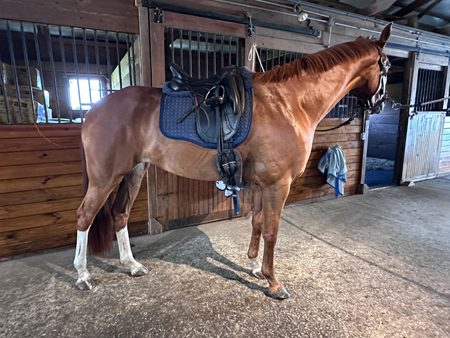
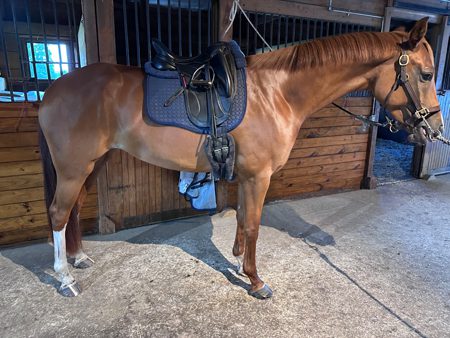
Comparing the same horse before and after exercise can reveal where the girth naturally settles once the horse is moving.
A forward girth groove is one of the conformational features we regularly see when owners contact us because a girth is moving forwards, rubbing behind the elbow or contributing to forward saddle movement.
However, the recommendation is not always the same.
One horse may have a round ribcage and enough elbow room for a Crescent girth to work particularly well.
Another may have a similarly forward girth groove but very little space behind the elbow, making an Asymmetric shape more appropriate.
And occasionally the photographs suggest that the saddle itself needs to be checked before changing the girth at all.
That variation is important.
Identifying the forward girth groove is the start of the fitting process, not the diagnosis of which girth the horse needs.
First, don’t assume that anything is wrong.
If your horse is comfortable, the girth is stable and the saddle remains correctly positioned, a forward girth groove may simply be part of the horse’s normal conformation.
If there is a problem, work through it logically:
The aim is not to stop the horse having a forward girth groove.
The aim is to choose equipment that works with the horse’s natural anatomy.
If you are unsure what you are seeing, our free girth consultation allows us to look at your horse’s conformation, current girth and saddle setup before making a recommendation.
Side-on photographs without tack, with the horse saddled and, where possible, immediately after riding are particularly useful because they allow us to see where the girth naturally settles.
We do not provide saddle fitting advice, and where the saddle itself appears to require attention we will always recommend speaking to a qualified saddle fitter.
Once the saddle is correctly fitted, we can help determine which girth shape is most appropriate for the horse and the way the saddle is girthed.
If you prefer to speak to someone, feel free to call us on 01386 833050 or message us on WhatsApp. We’re happy to talk through what you are seeing.
A forward girth groove is a natural girthing area that lies relatively close to the horse’s elbows. During exercise, the girth may move forwards towards this position even if it was originally placed further back.
One of the clearest signs is a girth that consistently moves forwards towards the elbows during exercise and settles in the same position after riding. Looking at the horse side-on without tack can also help identify where the body naturally narrows beneath the ribcage.
No. It is a conformational characteristic rather than a fault. It only becomes a fitting concern if it contributes to rubbing, limited elbow clearance, girth movement or saddle instability.
It can contribute. As the girth moves towards the forward girth groove, it can exert forward pull through the saddle billets. However, saddle fit should always be checked first because a girth cannot compensate for an incorrectly fitted saddle.
It can contribute if the forward girth position leaves insufficient room behind the elbow and creates repeated friction. Girth galls can also have other causes, including girth length, width, material, sweat and cleanliness.
No, not simply to prevent forward movement. If the girth is moving because of the horse’s conformation, overtightening does not change the natural girth groove and may increase pressure.
There is no single best shape for every horse. A Crescent girth may suit a round horse with a forward groove, while an Asymmetric girth may be more appropriate where the horse also has particularly limited elbow clearance.
No. The recommendation depends on the whole horse, including ribcage shape, elbow clearance, saddle position and whether the current girth is actually causing a problem.
The underlying conformation remains, but changes in weight, muscle and condition can alter the contours of the girthing area and make forward movement more or less pronounced.
Yes. Although forward girth grooves are often associated with round horses and ponies, horses of many different body types can have one.
