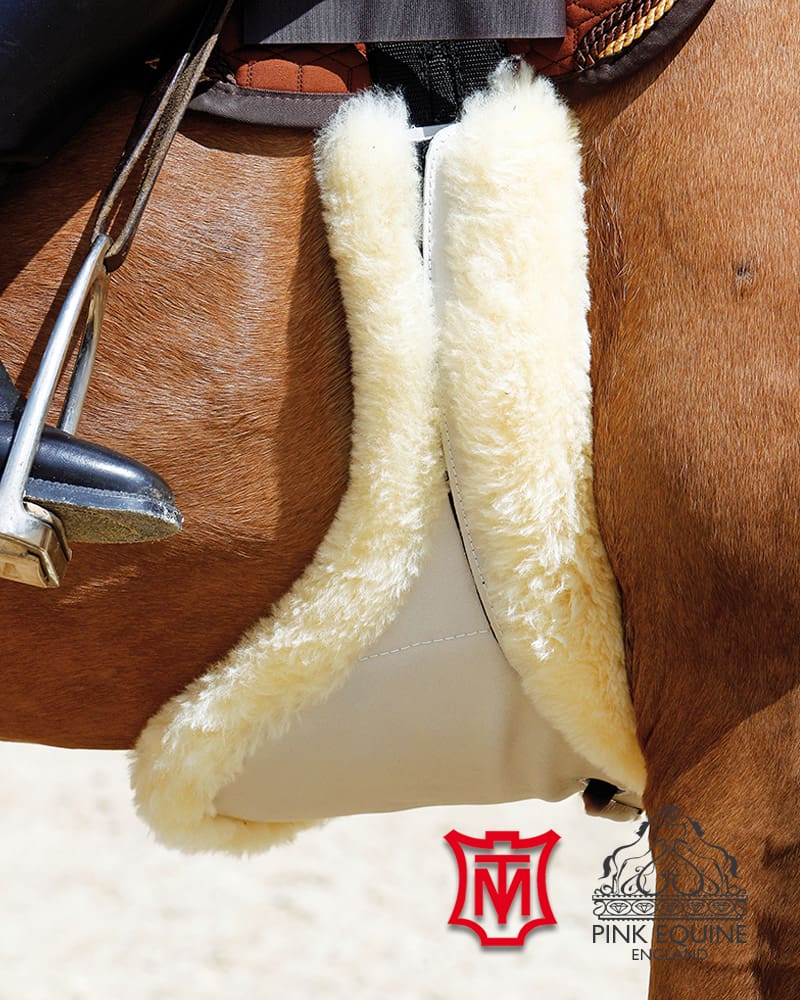
An anatomical girth is shaped to follow the contours of the horse rather than simply passing in a straight line underneath the body.
Depending on the design, an anatomical girth can provide additional room around the elbows, accommodate a forward or backward girth groove, and help the girth settle more naturally around the horse’s ribcage.
But “anatomical” does not describe one particular shape, and an anatomical girth is not automatically better for every horse.
A horse with plenty of elbow clearance, a straightforward girth groove and no problems with rubbing or saddle movement may be perfectly comfortable in a correctly fitted straight girth.
For other horses, however, choosing a girth shape that better reflects their conformation can make a significant difference.
The important question therefore is not simply “Should I buy an anatomical girth?”
It is “Which girth shape best suits my horse?”
In this guide we will explain what anatomical actually means, how the different girth shapes work, why pressure distribution matters and how to recognise which design may be appropriate for your horse.
An anatomical girth is a girth whose shape has been designed around the anatomy and conformation of the horse.
A traditional straight girth runs relatively directly from one side of the saddle to the other. An anatomical girth introduces shaping so that different parts of the girth can sit in positions better suited to the horse’s body.
That shaping may provide more clearance behind the elbows, allow the centre of the girth to sit further forwards, help prevent the girth migrating backwards or accommodate the curvature of a rounder ribcage.
This is why two girths can both legitimately be described as anatomical while looking quite different from one another.
Anatomical is therefore better thought of as a design principle rather than a single girth shape.
The saddle determines where the girth straps begin, but the horse’s body strongly influences where the girth itself naturally wants to sit.
Every horse has a natural girth groove. On some horses this aligns conveniently with the position of the saddle and girth straps.
On others, the girth groove may sit further forwards or backwards.
Once the horse starts moving, the girth will naturally try to settle towards that position.
If the girth shape does not accommodate this, the girth may:
An appropriately shaped anatomical girth aims to work with these differences rather than forcing the horse to accommodate a completely straight design.
For a broader explanation of girth grooves, conformation, materials and sizing, see our complete guide to choosing the right horse girth.
Any girth creates pressure around the horse’s body when tightened.
The aim is not to eliminate pressure, because the girth needs sufficient tension to stabilise the saddle, but to distribute that pressure as evenly and comfortably as possible.
Problems can occur where the shape of the girth does not correspond well with the horse’s body.
For example, if a straight girth is being pulled forwards towards the natural girth groove, the front edge of the girth may carry more pressure than the rear. If there is very little space behind the elbow, this can also create localised pressure and friction as the horse moves.
A correctly chosen anatomical girth can accommodate these differences in conformation, allowing the girth to sit in a position that better follows the shape of the horse.
This can help spread the load over a more appropriate area rather than concentrating pressure along a particular edge.
This does not mean that every anatomical girth reduces pressure for every horse. The shape still has to be appropriate for the individual horse.
No.
This is an important distinction because the word “anatomical” is sometimes treated as though it automatically means more comfortable or technically superior.
A horse with straightforward conformation, a well-defined girth groove, good elbow clearance and no history of rubbing or saddle movement may have no reason to move away from a correctly fitted straight girth.
An anatomical girth becomes particularly useful when the horse’s conformation creates a specific fitting problem that a straight girth does not accommodate well.
Typical examples include:
The aim is not to choose the most anatomical-looking girth. It is to choose the shape that matches the horse.
There are several different approaches to anatomical girth design.
The names used by manufacturers vary, but the important thing is to understand what each shape is trying to achieve.
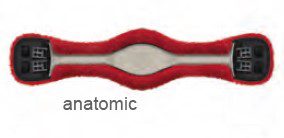
A standard anatomical girth generally has shaping around the front and rear edges to provide more room around the elbows while retaining a relatively neutral centre section.
This style can suit horses with fairly straightforward conformation where the natural girth groove already aligns reasonably well with the saddle.
It can be a good option where the horse does not require the more specialised shaping of a Crescent, Asymmetric or Athletico girth but benefits from some additional elbow clearance.
This is probably the closest to what many riders imagine when they hear the term “anatomical girth”.
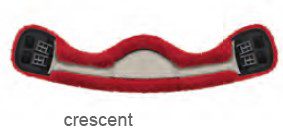
A Crescent girth is designed for horses where the natural girth groove sits further forwards.
These horses are often round through the ribcage, short-backed or wider through the middle with a narrower chest.
A straight girth on this type of horse may repeatedly migrate forwards towards the elbows.
The crescent shape allows the centre of the girth to sit further forwards while the sides curve backwards, creating additional room behind the elbows.
This can be particularly useful for:
Rather than trying to prevent the girth moving into its natural position, the shape accommodates that position.
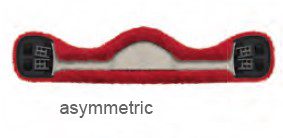
An Asymmetric girth also provides additional room at the front but has a more pronounced cut-back behind the elbow.
We generally consider this type of shape where the horse is close-coupled and there is particularly limited space between the elbow and the position where the girth needs to sit.
It can be useful for horses with:
A Crescent and an Asymmetric girth may initially appear to address similar problems, but the amount and position of the shaping is different.
Photographs of the horse are often what allow us to decide which of the two is more appropriate.
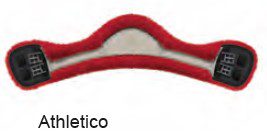
An Athletico girth addresses almost the opposite problem.
Some athletic or wedge-shaped horses become narrower as the body travels backwards from the girth area.
A conventional girth may therefore gradually migrate backwards during exercise.
Because the girth is attached to the saddle, it can also pull the saddle backwards.
The Athletico shape is designed to help the girth remain in the more forward girthing area rather than continually travelling towards the narrower part of the body.
This can suit:
If your main problem is a saddle being pulled forwards or backwards, our guide to the best girths for slipping saddles looks at these different movement patterns in much more detail using real consultation examples.
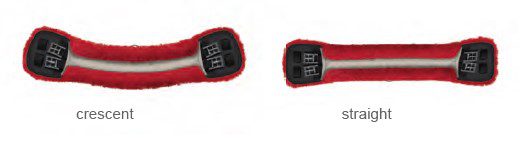
Some ponies present the same basic conformation as a larger horse needing a Crescent girth, but with much less room available around the elbow and girthing area.
A Special Pony Crescent follows the same general principle while being proportioned specifically for smaller horses and ponies.
This can be especially useful on very round ponies where a conventional short girth quickly crowds the elbow.
The easiest way to start is to look at the horse rather than the girth catalogue.
Stand the horse square on reasonably level ground and look at the relationship between:
Then look again with the horse fully tacked up.
Where does the girth naturally settle?
Is it being pulled forwards?
Does it sit very close to the elbow?
Does the horse become noticeably narrower behind the girth area?
Does the girth move after the horse has been ridden?
These observations usually tell us much more than simply looking at the shape of the girth itself.
One of the most useful things you can do when assessing girth fit is to look at the horse before removing the saddle after exercise.
By this point, both the girth and saddle have had time to settle into the positions they naturally want to occupy.
Check:
Then remove the girth and look again for any concentrated areas of heat, tenderness, rubbed hair or skin irritation.
This is the same process we use when assessing photographs sent through our girth consultations.
It can, but only where girth shape is part of the reason for the sensitivity.
For example, a horse may repeatedly develop rubbing behind the elbow because a straight girth is being pulled forwards towards a forward girth groove.
In that situation, a more suitable anatomical shape may provide additional clearance and reduce the repeated friction in that area.
However, sensitivity can also be associated with material, heat, sweat, skin problems, saddle fit or underlying physical discomfort.
Changing to an anatomical girth should therefore not be treated as a universal solution.
If rubbing, girth galls or sensitivity are the main problem, see our guide to choosing a girth for a sensitive horse, where we look at shape, material, fit and real consultation examples in more detail.
Sometimes.
If the saddle movement is being caused or encouraged by the girth migrating forwards or backwards, changing the girth shape can improve stability.
For example, a Crescent girth may help where a forward girth groove is pulling the girth and saddle forwards, while an Athletico shape may be appropriate where the girth is migrating backwards.
But a girth cannot correct a saddle that fundamentally does not fit.
Persistent sideways movement can also involve horse asymmetry, rider balance or uneven saddle fit and needs to be assessed more broadly.
Our guide to slipping saddles explains the different causes and girth shapes in more detail.
Yes, but shape and material are separate decisions.
An anatomical girth can be made from leather, synthetic materials, quilted fabric or have a removable sheepskin lining.
The material influences factors such as:
Natural sheepskin can be particularly useful for horses prone to friction or rubbing, while a slim padded leather construction can provide more clearance where space behind the elbow is limited.
But neither material can compensate for choosing the wrong anatomical shape.
The priority should normally be:
correct shape → correct size and position → appropriate material.
The basic principles are the same as for any correctly fitted girth.
The girth should sit symmetrically, allow adequate clearance around the elbows and position the buckles away from sensitive areas.
With an anatomical girth, however, correct positioning is particularly important because the shaped sections need to sit in the areas they were designed to accommodate.
If the girth is too short, too long or fitted backwards, the shaping may not align with the horse’s anatomy and the potential benefit can be lost.
For detailed measuring instructions for both short and long girths, see our horse girth sizing and fitting guide.
Yes.
An anatomical girth is not automatically forgiving simply because it has more shaping.
If the curves and cut-backs do not correspond with the horse’s conformation, they can place pressure in the wrong areas or encourage the girth to sit incorrectly.
For example:
This is why we would not recommend choosing a girth simply because the description says “anatomical”.
The horse’s conformation should determine the shape.
| Horse or Girthing Problem | Girth Shape to Consider | What the Shape Is Designed to Do |
|---|---|---|
| Straightforward conformation with good elbow clearance | Standard Anatomical | Provides general shaping and elbow relief |
| Round horse or forward girth groove | Crescent | Allows the centre of the girth to sit further forwards while creating elbow clearance |
| Forward girth groove with very limited elbow space | Asymmetric | Provides greater cut-back and clearance at the front |
| Athletic or wedge-shaped horse with girth moving backwards | Athletico | Helps the girth remain in the more forward girthing area |
| Very round or short-backed pony | Special Pony Crescent | Applies the Crescent principle in proportions suited to smaller ponies |
This table is a starting point rather than a diagnosis. Horses do not always fit neatly into one category, and photographs often reveal details that are difficult to describe in words.
For the right horse, the right anatomical girth can be a significant improvement over a straight girth.
For another horse, it may provide no meaningful advantage at all.
The benefit comes from matching the shape to the individual horse’s anatomy, not from the word “anatomical” on the product description.
A well-chosen girth should:
That is ultimately more important than whether the girth is straight, Crescent, Asymmetric, Athletico or any other named design.
If you are unsure which anatomical girth shape suits your horse, our free girth consultation allows us to look at the individual horse before making a recommendation.
We ask for information about your horse, saddle, current girth and any problems you are experiencing. Photographs are particularly useful because they allow us to assess the horse’s conformation, girth groove, elbow clearance and the position of the existing girth.
If you prefer to speak to someone, feel free to call us on 01386 833050 or message us on WhatsApp – we’re happy to walk you through it.📲 Message us on WhatsApp
An anatomical girth is shaped to accommodate the horse’s anatomy rather than running completely straight underneath the body.
The shaping may provide additional elbow clearance, accommodate the horse’s natural girth groove or help prevent the girth migrating forwards or backwards.
A straight girth has relatively little shaping and follows a direct line beneath the horse.
An anatomical girth uses curves or cut-back sections to accommodate particular areas of the horse’s body.
Neither is automatically better. The correct choice depends on the horse’s conformation.
No.
A horse with straightforward conformation, plenty of elbow clearance and no problems with rubbing or saddle movement may be perfectly comfortable in a correctly fitted straight girth.
Look at the horse’s ribcage, natural girth groove, available elbow clearance and the direction in which the current girth moves during exercise.
A round horse with a forward groove may suit a Crescent, while a close-coupled horse needing greater front clearance may suit an Asymmetric. An athletic horse whose girth moves backwards may require a different shape such as an Athletico.
It can help where girth movement is contributing to the saddle movement.
It will not correct fundamental saddle-fit problems, rider imbalance or every form of sideways slipping.
Yes, if the rubbing is being caused or aggravated by the girth sitting too close to the elbow.
A shape that provides appropriate clearance may reduce pressure and friction in this area. However, rubbing can have other causes, including material, sweat, dirt or an underlying physical problem.
Not automatically.
A sensitive horse benefits from a correctly fitted girth first. Anatomical shaping can help if conformation or girth position is contributing to the sensitivity, while material and lining may also need to be considered.
Neither is universally better.
Leather provides a smooth, durable surface and can allow a relatively slim construction. Natural sheepskin provides cushioning and can help manage heat and moisture.
The correct anatomical shape remains more important than choosing one material over another.
It should sit evenly, provide adequate elbow clearance and position the shaped sections of the girth where they were designed to sit.
Correct length is therefore particularly important with anatomical designs.
Yes.
If the shaping does not match the horse’s conformation, the girth may place pressure in inappropriate areas or encourage unwanted movement.
The term “anatomical” should never be treated as a guarantee of correct fit.
