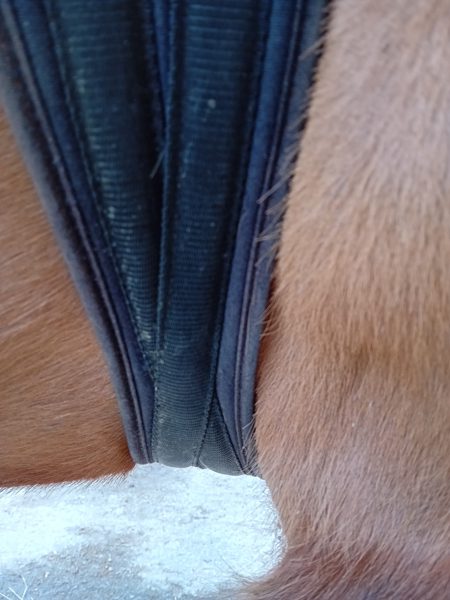
How tight should a horse’s girth be? is a question we are often asked. A horse’s girth should be tight enough to keep the saddle securely in place during riding, but not so tight that it causes unnecessary pressure or discomfort.
It is a common misconception that tightening a girth as much as possible makes the saddle safer. In reality, excessive tightening can create pressure without necessarily addressing the reason a saddle is moving.
The correct girth tension is the minimum needed to keep a properly fitted saddle secure, not the maximum tightness the rider can achieve.
Knowing how to achieve that balance is important for both your horse’s comfort and your safety.
Many riders are taught that they should be able to fit two fingers between the girth and the horse’s body.
Although this can provide a rough indication, it is not a particularly reliable way of determining correct girth tension.
Finger sizes vary, as do girth materials, padding and elasticity. Where you place your fingers also makes a difference. A girth may feel quite different near the buckles compared with underneath the horse’s chest.
Rather than relying entirely on the two-finger rule, consider whether the girth is sitting correctly, the saddle is stable and your horse appears comfortable.
Remember that girth tightness and girth fit are two different things. Our guide to how a horse’s girth should fit explains the other factors you should check.
We recommend tightening a girth gradually rather than pulling it up tightly in one go.
Some horses expand their ribcages or tense their abdominal muscles while being girthed, which can make the girth feel looser once they relax. This is another reason why gradual tightening and rechecking are preferable to pulling the girth tight immediately.
There is no single measurement that tells you a girth is too tight, but there are warning signs worth investigating.
These signs do not necessarily prove that excessive girth tension is the cause. An incorrectly shaped girth, poorly fitting saddle, skin sensitivity or an underlying medical problem can produce similar reactions.
If your horse develops sudden or significant discomfort, it is important to investigate the cause rather than simply changing the girth.
A girth that is too loose may allow the saddle to become unstable, particularly when mounting, turning or riding on uneven ground.
You might notice the saddle moving sideways, lifting or shifting position during exercise.
However, a slipping saddle does not automatically mean the girth is too loose.
If the girth is already appropriately secure, further tightening may simply increase pressure without solving the problem.
The saddle’s fit, the position of the girth straps and the horse’s natural girth groove can all influence saddle stability.
It is often suggested that a tight girth prevents a horse from breathing properly. The relationship is more complicated than that.
Research into girth tension has identified changes in pressure distribution and aspects of ribcage movement, but studies have not consistently demonstrated that tighter girths reduce a horse’s ability to ventilate during exercise.
Nevertheless, excessive pressure is unnecessary and should be avoided. A girth should provide adequate stability without being tightened more than required.
The objective is to support a secure saddle while allowing the horse to move comfortably.
Yes. Elastic can make a girth easier to fasten, but it can also make it harder to judge how much tension is being applied.
This is particularly worth considering with girths that have elastic at only one end, where uneven adjustment may contribute to differences in tension between the two sides.
Elastic is not necessarily a problem in itself. Its suitability depends on the construction of the girth, the amount of stretch and how it is fitted.
Whatever type of girth you use, avoid assuming that because you can tighten it another hole, you should.
Some horses pin their ears, turn to bite, swish their tails or attempt to kick when the girth is tightened.
These behaviours should not automatically be dismissed as bad manners.
Possible causes include skin irritation, previous painful experiences, saddle discomfort, musculoskeletal pain, gastric ulcers or an unsuitable girth.
In some cases, the girth may be the problem. In others, changing it will make little difference until the underlying cause has been addressed.
We explore this in more detail in our article Why Is My Horse Girthy?
This is something we would encourage riders to investigate.
If you find yourself repeatedly tightening the girth to prevent the saddle moving, there may be a fitting problem rather than simply insufficient tension.
For example, a horse with a forward girth groove may naturally pull the girth towards the elbows, while the saddle sits further back. Tightening the girth harder does not necessarily correct this relationship.
Similarly, a straight girth may not suit a horse with a particularly round ribcage, prominent elbows or an unusual girth groove.
In these situations, the shape of the girth can be just as important as its tightness.
Our guides to forward girth grooves and girth and elbow clearance explain why different horses may need different girth designs.
It is also worth checking that the girth is the correct length. Our guide to measuring a horse for a girth explains how to check this.
If your saddle moves despite the girth being securely fastened, or your horse appears uncomfortable when being girthed, we may be able to help you identify whether the girth’s size, shape or position is contributing to the problem.
At Pink Equine, we offer a free girth consultation. By looking at photographs of your horse saddled and girthed, we can assess the girth’s position, buckle height, elbow clearance and how its shape relates to your horse’s conformation.
There is no obligation to purchase anything.
If you prefer to speak to someone, feel free to call us on 01386 833050 or message us on WhatsApp – we’re happy to walk you through it. 📲 Message us on WhatsApp
