If your horse pins its ears, swishes its tail, turns to bite, moves away or becomes tense when the girth is tightened, it is often described as being girthy.
It is easy to assume that the girth itself must be the problem, but that is not always the case. A girthy horse may be reacting to discomfort from the saddle, skin irritation, musculoskeletal pain, gastric ulcers or even a previous painful experience.
The girth could be the cause, but before changing equipment it is important to consider the other possibilities first.
A girthy horse is one that shows signs of discomfort or irritation when the girth is fitted or tightened.
Common signs can include:
Some horses react as soon as the girth is placed around them, while others only show a reaction when it is tightened.
The important point is that the behaviour is telling you the horse is uncomfortable with something. The next step is working out what that something is.
If a horse that has previously been comfortable with girthing suddenly starts reacting, we would take that change seriously.
Something may have changed physically or with the horse’s equipment.
Possible causes can include pain, saddle fit, skin irritation, rubbing, an underlying medical condition or discomfort associated with the girth itself.
If the reaction is new, significant or becoming progressively worse, veterinary advice is a sensible first step rather than simply changing the girth.
Gastric ulcers are often mentioned when a horse becomes girthy, and they can certainly be associated with changes in behaviour around the girth area.
However, girthiness on its own does not mean that a horse has ulcers.
There can be many other reasons for exactly the same behaviour, which is why it is important not to make assumptions based on girthiness alone.
If ulcers or another gastrointestinal problem are suspected, this is something to discuss with your vet rather than trying to diagnose from behaviour alone.
Yes.
When the girth is tightened, the saddle is pulled more firmly against the horse’s back and ribcage. If the saddle is uncomfortable or poorly fitted, the horse may begin to associate girthing with that discomfort.
A qualified saddle fitter should be able to assess whether the saddle itself may be contributing to the problem.
This is particularly important if the horse is also showing changes in performance, reluctance to move forward, sensitivity around the back or other signs of discomfort when ridden.
Before looking at the girth itself, check the skin carefully.
Look for:
Even relatively minor irritation can make a horse understandably reluctant to have pressure applied over the same area again.
If there is already rubbing or a sore, our guide to horse girth galls and sores explains some of the common causes and what to look for.
For horses with particularly sensitive skin, we also look at materials and comfort in our guide to the best girth for sensitive horses.
Yes, this can happen.
If a horse has previously experienced pain when being girthed, it may begin to anticipate that discomfort even after the original problem has improved.
For example, a horse that has suffered from a sore girth area may react as soon as the girth is picked up because it has learned to associate the process with pain.
However, we would be cautious about assuming the problem is purely behavioural until physical causes have been properly investigated.
Once pain has been ruled out, tightening the girth gradually and calmly rather than pulling it tight all at once may help reduce tension around the process.
Once other potential causes have been investigated, it may become clear that the girth itself is contributing to the horse’s discomfort.
If that is the case, the next question is not simply “which girth should I buy?” but rather “why is the current girth causing a problem?”
There are several possibilities.
If the girth sits very close behind the elbow, repeated contact as the horse moves can cause rubbing and irritation.
Our guide to horse girth rub behind the elbow explains why this happens and what to check.
Some horses naturally have very little room between the elbow and the position where the girth wants to sit.
In these cases, girth shape can become particularly important.
Our guide to horse girth and elbow clearance explains how to assess this area.
Every horse has a natural girth groove.
On some horses this groove sits further forward than the position of the saddle’s girth straps, causing the girth to migrate towards the elbow as the horse moves.
If this is happening, our guide to what a forward girth groove is explains the problem in more detail.
An incorrectly sized girth can place buckles, edges or shaped sections in the wrong position, which may increase pressure or friction.
Our guide to how a horse girth should fit explains what to look for when checking girth length and positioning.
Not every horse is suited to a straight girth.
Round horses, narrow-chested horses, horses with forward girth grooves and horses with limited elbow clearance may all require different girth shapes.
The important thing is matching the girth to the horse’s individual conformation rather than simply choosing the most heavily shaped or expensive option.
Sometimes, once other causes have been considered, changing the girth can make a significant difference. One customer contacted us after trying a number of girths on her large-shouldered, large-elbowed horse. She felt the previous girths restricted the horse’s movement and some appeared to pinch the skin.
After assessing photographs and videos, we recommended a Mattes Asymmetric short girth with sheepskin. She later told us:
“I cannot begin to explain the transformation in my horse. She now strides out in the walk where the other girths would not allow her that freedom, she is so much more relaxed when we are schooling and she does not turn around to bite her girth area anymore.”
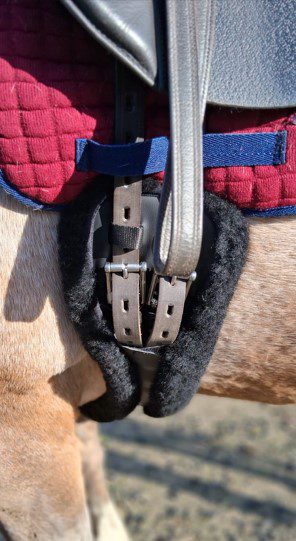
This does not mean that every girthy horse needs a different girth. However, when medical, saddle-related and other potential causes have been investigated, it demonstrates why the shape and fit of the girth itself are worth examining.
If you are considering a different girth, our guide to choosing the best horse girth explains the main shapes, materials and fitting considerations.
There is no single solution because there is no single cause.
A sensible approach is to work through the possibilities methodically.
That usually gives you much more useful information than simply replacing the girth and hoping the problem disappears.
There is no single girth that will suit every girthy horse.
If the problem is caused by ulcers, back pain or another medical issue, changing the girth may make little or no difference.
However, if other causes have been investigated and the evidence points towards the girth itself, then changing the length, shape or material may improve the horse’s comfort considerably.
The key is identifying what the existing girth is doing wrong before deciding what should replace it.
If you have investigated the other possible causes and think the girth may be contributing to the problem, we offer a free girth consultation.
Send us photographs of your horse saddled and girthed and we can look at the horse’s conformation, girth groove, current girth position, length and available elbow clearance.
We cannot diagnose medical conditions, but we can help assess whether the current girth may be contributing to the problem and suggest a more suitable shape if necessary.
There is no obligation to buy anything.
If you prefer to speak to someone, feel free to call us on 01386 833050 or message us on WhatsApp – we’re happy to walk you through it.
📲 Message us on WhatsApp
