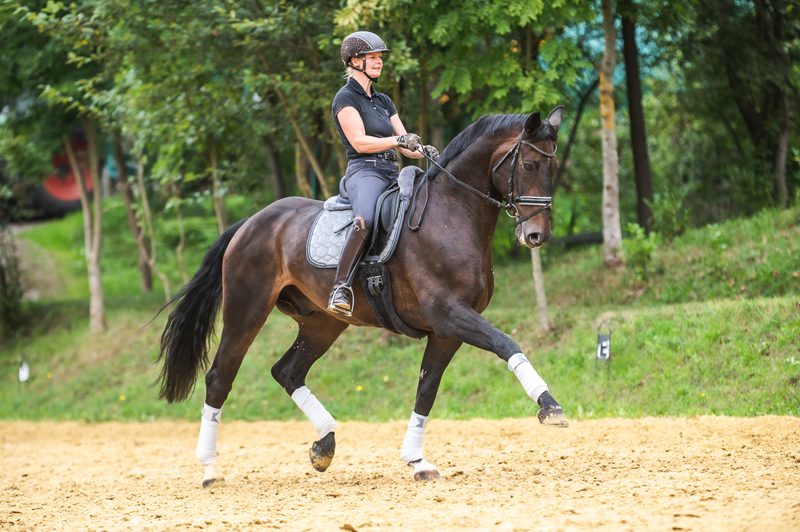
A correctly fitted horse girth should hold the saddle securely while allowing the horse to move comfortably. It should sit in the horse’s natural girthing area, provide sufficient clearance behind the elbows and avoid creating concentrated pressure, rubbing or interference with the horse’s movement.
That sounds relatively straightforward, but there is no single girth position or measurement that is correct for every horse.
The horse’s conformation, natural girth groove, the type of saddle being used and whether the horse wears a long or short girth can all affect what a good fit looks like.
It is also important to assess a girth after the horse has been ridden, not just while standing in the stable. A girth that appears to fit perfectly when first tightened may move forwards or backwards once the horse starts working.
In this guide, we will look at how a horse girth should fit, what to check before and after riding, and some of the signs that the girth may not be right for your horse.
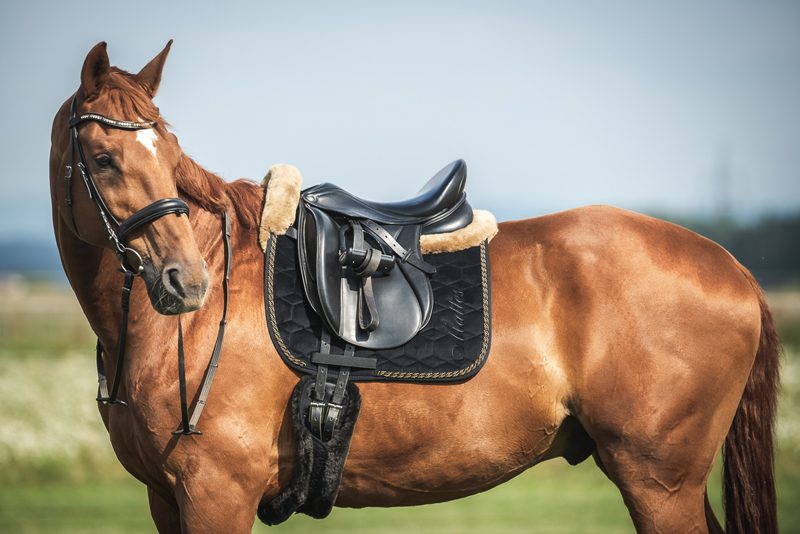
A correctly fitted girth should work with the horse’s natural shape and allow sufficient room for the elbow to move freely.
A horse girth should sit in the horse’s natural girthing area. This is sometimes referred to as the girth groove.
One of the most important things to understand is that the girth groove is determined largely by the horse’s conformation. It is not necessarily directly underneath the centre of the saddle, and it will not be in exactly the same place on every horse.
Some horses have a relatively neutral girth groove, while others have a girth groove that lies noticeably further forwards towards the elbows. Other horses, particularly some more athletic or wedge-shaped horses, may encourage the girth to move backwards.
This matters because simply positioning the girth where we would like it to sit does not mean it will stay there.
Once the horse begins moving, the girth will often migrate towards the position dictated by the shape of the horse’s ribcage and girth groove. If the girth and saddle arrangement is fighting against that natural position, the result can be movement, rubbing, pressure or instability.
We explain this in much more detail in our guide to what a horse’s girth groove is and why it matters.
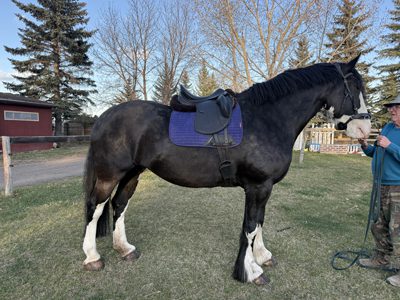
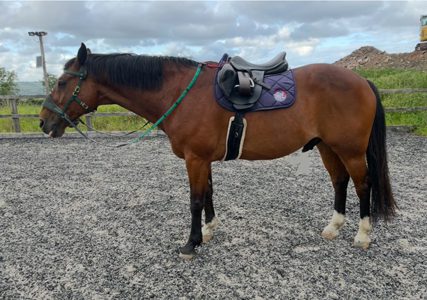
The natural girthing area can vary considerably between horses, which is why girth position cannot be judged by one fixed measurement.
There should be sufficient space between the girth and the horse’s elbow for the foreleg to move backwards freely without the elbow striking or being restricted by the girth.
You will sometimes see this expressed as a fixed measurement, such as a hand’s width behind the elbow. While measurements can be useful as a general guide, we prefer to look at the individual horse and how the elbow actually moves.
A large horse with a long ribcage may naturally have considerably more room than a short-backed pony or a close-coupled horse. Trying to achieve the same fixed distance on both does not necessarily produce a better fit.
What matters is whether the girth provides adequate clearance for that particular horse.
This is an important point because elbow clearance can be misleading when the horse is simply standing square.
When the horse takes the foreleg backwards, the elbow moves backwards too. A girth that appears to have enough clearance while the horse is standing still may suddenly be much closer to the elbow when the leg is moved.
We have seen exactly this during girth consultations. Owners sometimes tell us that the girth appears to be in the right position when the horse is standing, but when the horse moves its leg backwards the edge of the girth comes into contact with the elbow.
This can contribute to rubbing, pinching, hair loss and, in more severe cases, broken skin or girth galls.
When checking your own horse, look at the space behind the elbow and then watch what happens when the horse walks or moves the foreleg backwards. The elbow should be able to move without being obstructed by the girth or its buckles.
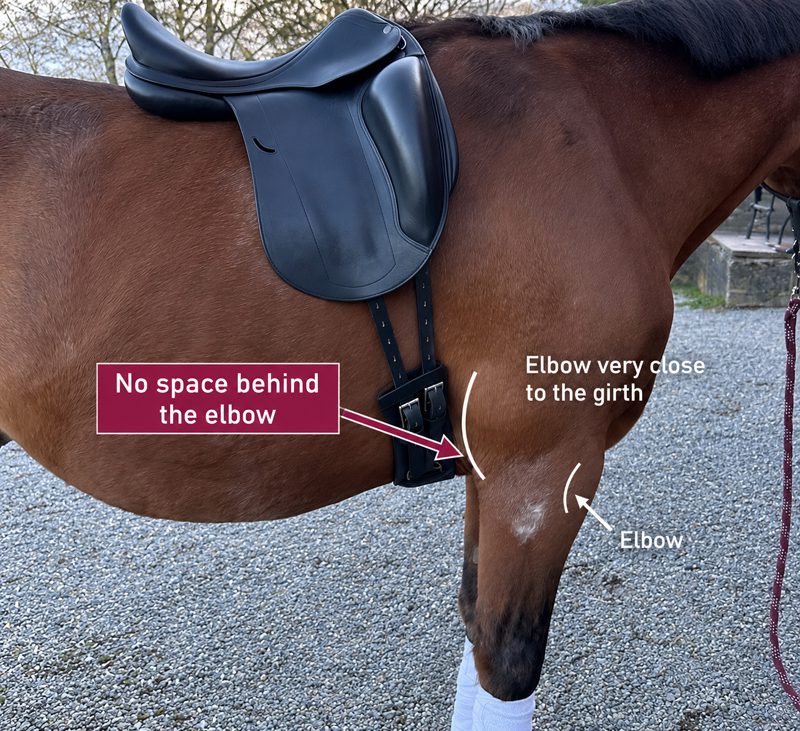
A girth can appear to have sufficient elbow clearance while the horse is standing square, so it is important to consider what happens when the foreleg moves backwards.
Short girths are commonly used with dressage saddles and other saddles with long billets.
With a short girth, it is particularly important that the girth is long enough for the buckles and associated bulk to sit well clear of the horse’s elbow.
A common mistake is assuming that because it is called a “short girth”, it should finish as low down the horse’s side as possible. In reality, a girth that is unnecessarily short can place the buckles and straps in an area where they may interfere with the elbow or create concentrated pressure.
When assessing a short girth, check:
Girth width also needs to be considered. Two girths of exactly the same length can provide very different amounts of elbow clearance if one is considerably wider than the other.
This is one reason why girth length should never be considered completely independently of the horse’s conformation and the design of the girth.
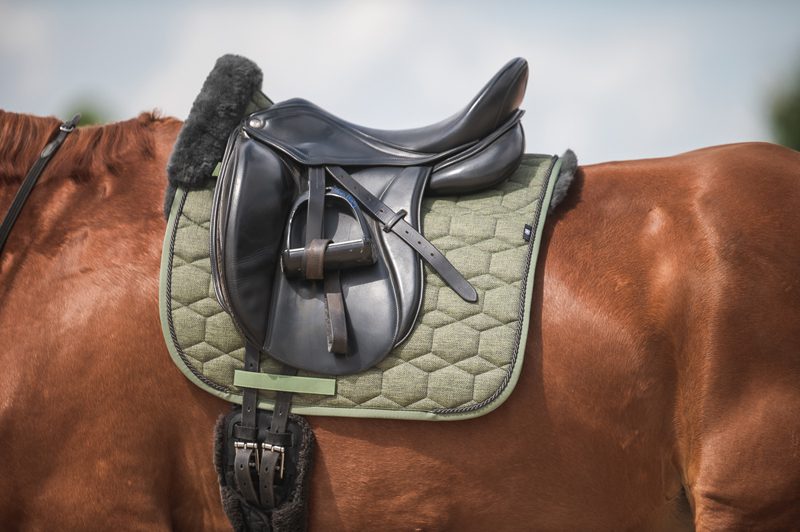
With a short girth, check both the position of the buckles and the clearance available behind the elbow.
Long girths are generally used with GP, jumping and many monoflap saddles with shorter billets.
The principles are similar: the girth should follow the horse’s natural girthing area, the elbow should be able to move freely and the buckles should sit in an appropriate position beneath the saddle flap rather than creating pressure lower down the horse’s side.
There should also be enough adjustment available to tighten or loosen the girth appropriately. A girth that can only be fastened on the very first or very last holes gives little room for adjustment and may indicate that another size would be more appropriate.
When viewed from the side, look at the complete relationship between the saddle, billets, girth and horse, rather than judging the girth in isolation.
If the billets are continually pulling the girth away from the position in which it naturally wants to settle, that is something worth investigating.
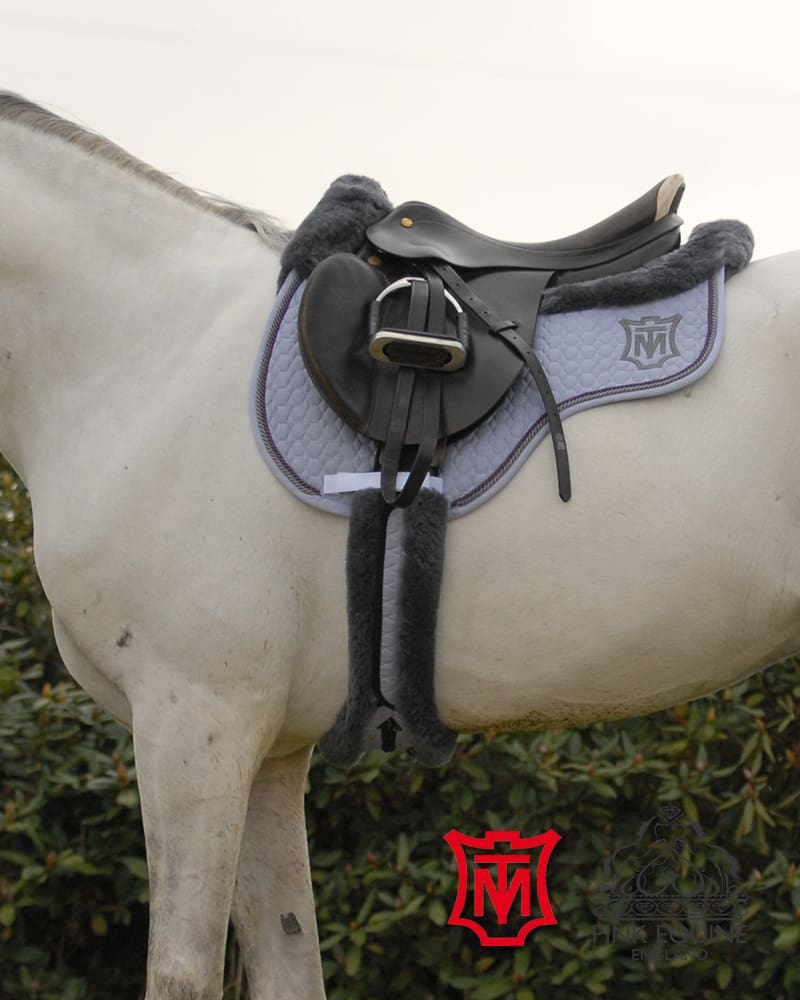
Assess a long girth as part of the complete saddle and girthing arrangement rather than looking at the girth in isolation.
Ideally, the girth should be adjusted reasonably evenly on both sides of the horse, but the number printed beside a billet hole is not in itself a measure of correct fit.
Horses are not perfectly symmetrical, billets can stretch with use and different saddles have different billet arrangements. A difference of one hole does not automatically mean that something is wrong.
However, a significant or increasing difference between the two sides is worth investigating.
Rather than trying to force both sides onto identical holes, look at whether the saddle is sitting centrally, whether the girth is being pulled towards one side, whether the billets have stretched unevenly and whether there is any obvious asymmetry in the horse or saddle.
The aim is a stable and balanced arrangement, not simply matching numbers.
An anatomical girth should do more than simply have a curved or shaped appearance. The shaping needs to correspond with the horse’s anatomy.
For example, a girth designed to provide additional elbow clearance only provides that benefit if the relieved section actually sits where the horse requires the extra room.
If the girth is the wrong size, positioned incorrectly or the wrong shape for the horse, its anatomical features may not sit in the intended position.
Different anatomical girth shapes are designed to accommodate different conformations and patterns of girth movement. A horse with a forward girth groove and a round ribcage may require something quite different from an athletic horse whose girth naturally moves backwards.
We explain the different designs and when they may be useful in What Is an Anatomical Girth?.
You will often hear that you should be able to fit two fingers between the girth and the horse. While this can provide a quick indication of how tight the girth feels, we don’t think the two-finger test is a reliable way of determining whether a girth is correctly fitted.
There are several reasons for this.
People have different-sized fingers and apply different amounts of pressure. Girths also vary considerably in width, construction, elasticity and padding. A thick sheepskin-lined girth will feel very different beneath your fingers from a thinner leather or synthetic girth.
More importantly, the two-finger test tells you very little about where the girth is sitting or what happens when the horse moves.
You may be able to comfortably place two fingers beneath a girth that is too close to the elbow, is the wrong length, is being pulled forwards into the horse’s natural girth groove or is simply the wrong shape for the horse.
We therefore regard the two-finger method as a rough tightness check, not a girth-fitting test.
Correct girth fit needs to be assessed by looking at the girth’s position, length, elbow clearance and stability, together with what happens to both the girth and saddle when the horse is working.
We cover the separate question of girth tension in our guide to how tight a horse girth should be.
This is perhaps one of the most useful things you can do when assessing your horse’s girth.
A horse changes shape as it moves. The ribcage expands and contracts, muscles work beneath the saddle and girth, and the forelegs repeatedly move backwards past the girthing area.
The girth and saddle may also settle into a different position during exercise.
For this reason, a girth that looks perfectly acceptable immediately after tacking up does not necessarily remain in that position throughout the ride.
After riding, and before loosening the girth, take a moment to look at the horse from the side.
Ask yourself:
A photograph taken at this point can be extremely useful. In our girth consultations, post-exercise photographs can reveal movement that simply isn’t apparent from a photograph taken when the horse is first tacked up.
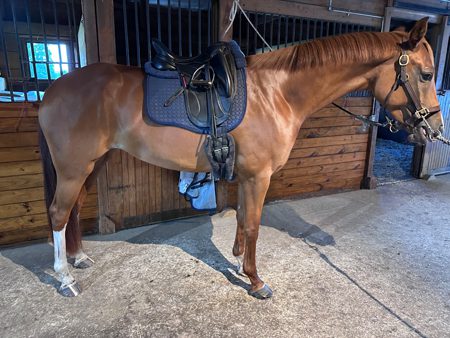
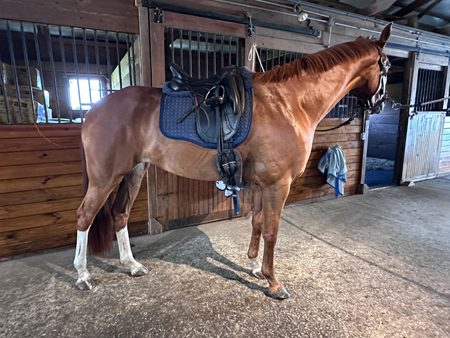
Before and after exercise. Comparing photographs taken from the same side can help reveal changes in the position of the girth and saddle that may not be obvious when the horse is first tacked up. Always take the post-ride photograph before loosening the girth.
The examination shouldn’t stop when you remove the saddle and girth.
Look at the horse’s coat and skin immediately after riding. Things worth noticing include:
One unusual mark after a ride does not necessarily mean that the girth is unsuitable, but repeated marks in the same place deserve attention, particularly if they are accompanied by sensitivity, rubbing or changes in the way the horse behaves when being girthed.
If rubbing or soreness is occurring behind the elbow, the answer is not necessarily simply to choose a softer material. Girth position, length, width, shape and the horse’s conformation should all be considered.
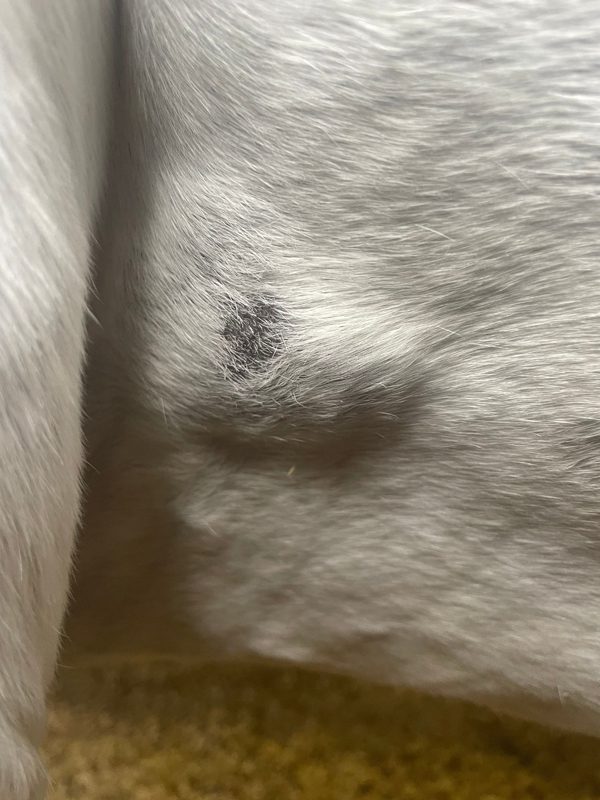
Repeated rubbing or soreness in the same area can provide useful clues about girth position and fit.
Some fitting problems are obvious, while others only become apparent after repeated use. Signs worth investigating include:
If the girth repeatedly moves towards the elbows, look at the horse’s conformation and natural girth groove rather than simply repositioning the girth before every ride.
Round horses and horses with a forward girth groove are among those where we commonly see this pattern.
Some athletic or more wedge-shaped horses encourage the girth to migrate backwards. If the saddle follows the girth, this can contribute to saddle instability.
Repeated rubbing behind the elbow can be associated with insufficient clearance, inappropriate girth length or width, forward girth movement, girth shape, friction or a combination of these factors.
It is therefore better to investigate why the rubbing is occurring rather than automatically changing to a softer girth.
The girth connects the saddle to the horse, so movement of one can affect the other.
If your saddle repeatedly moves forwards, backwards or sideways, the girth may be part of the picture, but it should not automatically be assumed to be the cause. Saddle fit, horse asymmetry, changes in condition and rider balance may also need to be considered.
Our guide to the best girths for slipping saddles explains the different movement patterns and what they may tell us.
Changes in behaviour when the girth is tightened should not simply be dismissed as the horse being difficult.
Girth fit is one possible cause, but sensitivity can also be associated with saddle fit, skin irritation, musculoskeletal discomfort or other physical problems. Sudden or significant changes in behaviour warrant appropriate professional investigation.
For horses where the girth itself appears to be contributing to discomfort, our guide to choosing the best girth for sensitive horses looks at shape, material, positioning and friction in more detail.
If the existing girth is the wrong length, copying its measurement simply reproduces the problem. Different designs and manufacturers may also fit differently.
The horse’s natural girth groove may not lie directly beneath the billets. If the girth continually moves to another position once the horse starts working, there is usually a reason.
A shorter girth is not necessarily a better-fitting short girth. If the buckles finish too low, they may sit close to the elbow and create unnecessary bulk or pressure in a sensitive area.
“Anatomical” does not describe one universal shape. A design that works beautifully for one conformation may be unsuitable for another.
If a girth repeatedly migrates because of the horse’s conformation, making it progressively tighter does not address the underlying reason for that movement.
This is one of the easiest mistakes to make. What matters is not only where the girth starts, but where it ends up once the horse has been working.
You can learn a surprising amount by spending a few minutes checking the girth before and after an ordinary ride.
If you repeatedly see the same movement, rubbing or pressure pattern, it is worth investigating rather than simply accepting it as normal.
A well-fitting horse girth should work with the horse’s anatomy rather than against it.
It should sit in an appropriate position for the horse’s natural girth groove, allow the elbows to move freely, place the buckles away from areas where they may interfere with movement and remain reasonably stable during exercise.
Most importantly, don’t judge girth fit using one rule in isolation.
A hand behind the elbow, two fingers beneath the girth or matching billet holes can all provide information, but none of them proves that a girth fits correctly.
The complete picture comes from looking at the horse’s conformation, girth position, elbow clearance, girth length, saddle relationship and what actually happens when the horse moves.
If you are unsure about your horse’s current girth, we offer a free girth consultation.
We look at your horse’s conformation, current saddle and girth, any problems you are experiencing and photographs showing how the girth sits. Where possible, a photograph taken immediately after riding is particularly useful because it allows us to see where the saddle and girth naturally settle during exercise.
If you prefer to speak to someone, feel free to call us on 01386 833050 or message us on WhatsApp. We’re happy to talk through the fit with you.
There is no single distance that is correct for every horse. The important consideration is that there is sufficient clearance for the elbow to move backwards freely without striking or being restricted by the girth or buckles. The horse’s conformation and natural girth groove influence how much space is realistically available.
A short girth should be long enough for the buckles to sit well clear of the horse’s elbow while still leaving appropriate space between the top of the girth and the saddle or saddle pad. If the buckles finish very low on the horse’s side, the girth may be unnecessarily short.
Signs can include buckles sitting low and close to the elbow, very little adjustment available on the billets or excessive bulk in a sensitive area behind the foreleg. The correct length also depends on the saddle and girth design.
A girth may be too long if it has to be tightened close to the top of the billets with little or no further adjustment available, or if the buckle area finishes in an inappropriate position beneath the saddle.
Reasonably even adjustment is desirable, but identical hole numbers are not a fitting rule. Billets can stretch and horses and saddles are not always perfectly symmetrical. A large or increasing difference between the two sides is worth investigating rather than simply trying to make the hole numbers match.
Not on its own. The two-finger test can provide a rough indication of girth tension, but finger size, girth construction and padding all affect how it feels. More importantly, it tells you nothing about elbow clearance, girth length, movement or whether the girth is the correct shape. We regard it as a rough tightness check rather than a reliable girth-fitting test.
Some settling can occur as the horse begins working, but a girth that repeatedly travels a significant distance forwards or backwards deserves investigation. The movement may relate to the horse’s natural girth groove, conformation, girth shape, saddle arrangement or a combination of these factors.
Standing still does not show us how the horse’s body and equipment interact during exercise. As the horse moves, the girth may migrate towards its natural girthing area and the saddle may move with it. This is why checking and photographing the girth immediately after riding, before loosening it, can be so useful.
