How much space should there be between a horse’s girth and its elbow? It sounds like a question that should have a simple answer, but horses vary too much in their conformation for one measurement to work for every horse.
You will find plenty of rules online. Some recommend a certain number of fingers between the girth and elbow, others suggest a hand’s width or a particular distance in inches. These can be useful visual guides, but we don’t believe they should be treated as universal girth-fitting rules.
What really matters is whether your horse has enough room for the elbow to move freely without repeatedly coming into contact with the girth. To assess that properly, you need to consider the horse’s conformation, natural girth groove, the width and position of the girth, and what happens when the horse actually moves.
Elbow clearance is simply the space available between the back of the horse’s elbow and the front edge of the girth.
This area matters because the elbow does not remain in one position. As the horse moves, the foreleg travels backwards and forwards and the elbow moves with it. A girth that appears to have plenty of clearance when the horse is standing square may be much closer to the elbow when the horse is walking, trotting or cantering.
That is why we prefer to think about functional clearance rather than trying to achieve a particular gap while the horse is standing still.
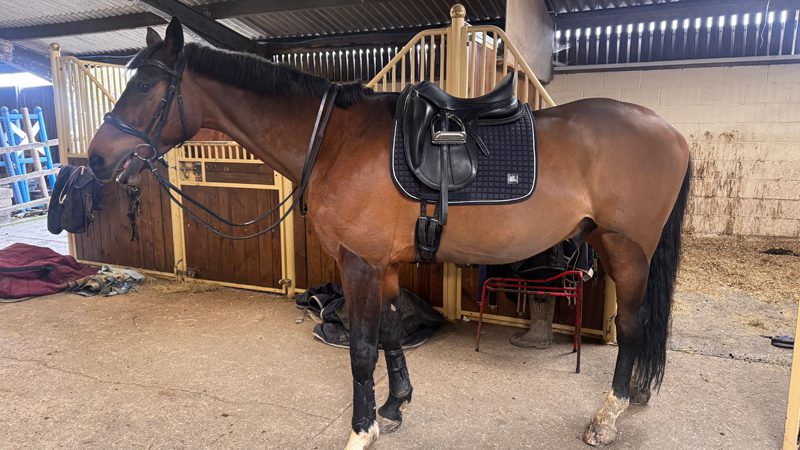
Elbow clearance is the space between the back of the horse’s elbow and the front edge of the girth. This horse has a clearly visible gap, but not every horse will have this much space available.
There isn’t one distance that is correct for every horse.
A hand’s width behind the elbow is often quoted as a general guide, while other fitting advice uses fingers or a fixed measurement. The difficulty with all of these rules is that they don’t take account of the enormous differences between individual horses.
A broad horse with a well-sprung ribcage may have a very different natural girthing area from a narrower, more athletic horse. One horse may have plenty of space behind the elbow, while another may have a very narrow girth groove that naturally places the girth extremely close to it.
We see this regularly through our girth consultations. Some horses simply do not have the physical space to achieve the textbook gap sometimes recommended online.
In those horses, trying to position the girth further backwards purely to create more elbow clearance can mean placing it away from the horse’s natural girth groove. Once the horse starts moving, the girth is then likely to seek the position dictated by the horse’s conformation anyway.
Horse owners will encounter a surprising amount of conflicting advice about where a girth should sit.
Some traditional fitting rules also developed when girth designs were generally much simpler than the range available today. Modern girths can differ considerably in their width, shape and construction, so measuring only the distance between the elbow and the centre of the girth doesn’t tell us very much about the space actually available to the horse.
For example, two girths may be exactly the same length but have very different widths through the area behind the elbow. The same horse could therefore have adequate clearance in one and considerably less in the other.
Rather than concentrating on achieving a predetermined number of inches or fingers, we think it is more useful to ask a simpler question: can the horse’s elbow move freely without interfering with the girth?
This is probably the most important part of assessing elbow clearance.
Stand beside your horse and look at where the girth sits in relation to the elbow. Then watch what happens as the horse walks and the foreleg travels backwards. The elbow will move backwards towards the girth and the apparent gap may reduce considerably.
A horse can therefore look perfectly comfortable when first tacked up but have much less room once it starts moving.
This is one reason we don’t believe girth fit should be assessed entirely from a stationary photograph or by applying a fixed measurement. In our guide to how a horse girth should fit, we explain why it is useful to assess the girth both before and immediately after exercise.
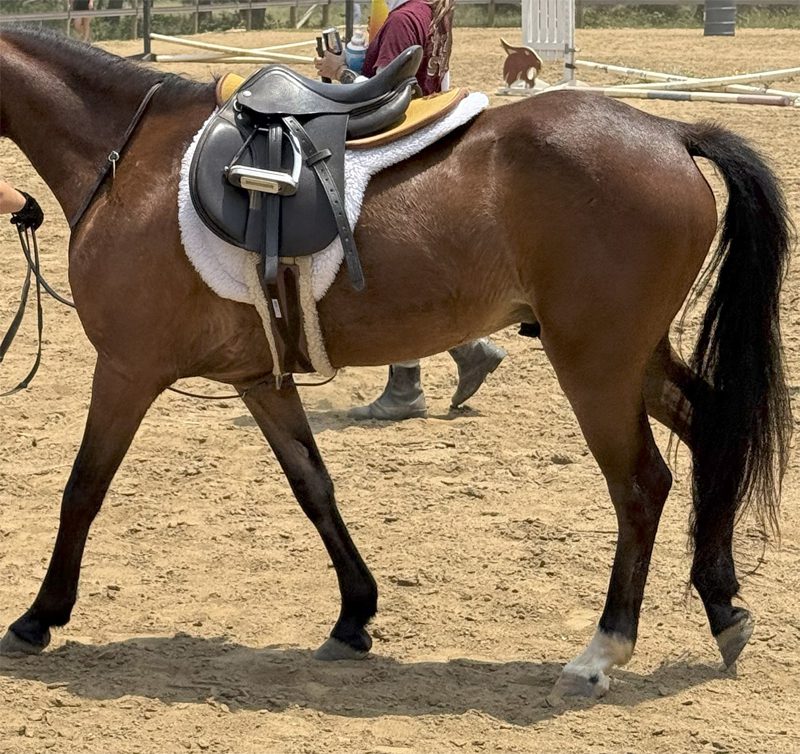
As the foreleg travels backwards, the elbow moves closer to the girth. This is why elbow clearance should not be assessed only while the horse is standing still.
Sometimes limited elbow clearance is simply a consequence of the horse’s conformation.
Horses with a forward natural girthing area may have relatively little space between the elbow and the position in which the girth naturally wants to sit. Some round or barrel-shaped horses can also have a girthing area that lies well forward, although being round does not automatically mean that a horse has a forward girth groove.
Other horses are relatively compact through this area and simply have less physical space available for a girth.
This is why looking at the whole horse is more useful than measuring the gap behind the elbow in isolation.
If your horse’s girth continually moves forwards towards the elbow, it is worth establishing whether this is actually where the horse’s natural girth groove lies. Our guide to forward girth grooves explains how to recognise one and why repeatedly trying to push the girth further backwards may not solve the problem.
For naturally broad horses, our guide to girth fit for round and barrel-shaped horses looks more closely at how ribcage shape can affect the relationship between the horse, girth and saddle.
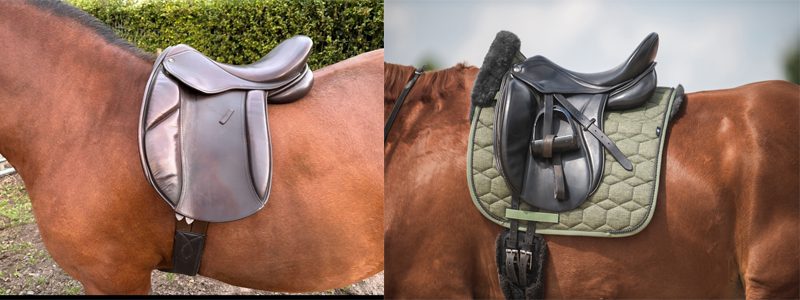
Two horses with very different amounts of space available behind the elbow. The horse on the right has considerably more natural clearance, while the horse on the left has a much narrower space for the girth. This is why a fixed measurement cannot be applied to every horse.
Yes. Girth width is particularly relevant when a horse has limited space behind the elbow.
A wider girth occupies more of the available girthing area. On a horse with plenty of room this may present no difficulty, but on a horse with a narrow space between its natural girth position and elbow, the front edge of a wide girth may extend into an area needed by the elbow during movement.
This is why the idea that a wider girth is automatically more comfortable is too simplistic. Width is only one part of girth fit and needs to be considered in relation to the individual horse.
Again, the important question isn’t whether the girth conforms to a particular width measurement. It is whether its width works within the space that particular horse actually has available.
Yes, and this can also affect the area around the elbow.
A short girth isn’t correctly sized simply because the buckles can be fastened. If it is unnecessarily short, the buckles, straps and additional bulk at the ends of the girth can sit relatively low against the horse.
Ideally, the ends of a short girth should sit high enough that the buckles and associated bulk are away from the sensitive area immediately behind the elbow.
We will look at this in much more detail in our separate guide to how to measure a horse for a girth.
If the elbow repeatedly contacts the girth during movement, you may notice disturbed or broken hair, rubbing or soreness around the area behind the elbow. In some horses the first indication may simply be that they become uncomfortable when being girthed or ridden.
However, it is important not to assume that every rub or sore behind the elbow is caused by insufficient clearance. Girth movement, fit, material, sweat, dirt and other factors can all contribute.
We look at these problems separately in Horse Girth Galls & Sores: Causes, Treatment and Prevention and Why Does My Horse’s Girth Rub Behind the Elbow?
The purpose of checking elbow clearance is therefore not to diagnose every possible cause of soreness. It is to establish whether the horse has enough physical room for the elbow and girth to function together comfortably.
Before loosening the girth, take a moment to look at where everything has finished after exercise.
Check whether the girth has remained where you originally positioned it or moved forwards or backwards. Look at the area behind both elbows and compare the two sides. Pay attention to disturbed hair, compressed hair, damp patches or any obvious sign that the edge of the girth has been repeatedly contacting the horse.
Also look at the relationship between the girth and saddle rather than assessing either in isolation.
If the girth has moved substantially during exercise, that is useful information. It may tell you more about the horse’s natural girthing position than where you placed the girth when you first tacked up.
Enough for the elbow to move freely without repeatedly interfering with the girth.
For some horses that may leave an obvious gap behind the elbow. For others, particularly horses with a very forward or narrow girthing area, the girth may naturally sit much closer.
Rather than trying to achieve a fixed number of fingers or inches, consider:
Those observations give a much more useful picture of elbow clearance than a single measurement taken while the horse is standing still.
If you are unsure whether your horse’s girth is sitting too close to the elbow, our free girth consultation allows us to look at your horse’s conformation, natural girth position and current girth fit from photographs.
We specialise in girth fit rather than saddle fitting. If there are concerns about the fit or stability of the saddle itself, we would always recommend having the saddle assessed by a suitably qualified saddle fitter first. Once the saddle is correctly fitted, we can look at how the girth works with the individual horse and the saddle’s girthing arrangement.
If you prefer to speak to someone, feel free to call us on 01386 833050 or message us on WhatsApp. We’re happy to talk it through. 📲 Message us on WhatsApp
There is no single distance that suits every horse. A hand’s width is sometimes used as a general guide, but the horse’s conformation and natural girth groove determine how much space is actually available. The important consideration is whether the elbow can move freely without repeatedly contacting the girth.
Not necessarily. It can be a useful visual guide on some horses, but it should not be treated as a universal fitting rule. Some horses naturally have considerably less room behind the elbow.
Yes. Horses with a forward or narrow girthing area may naturally carry the girth quite close to the elbow. Close proximity does not automatically mean poor fit, provided the elbow can move freely and there are no signs of interference.
Yes. If a horse has limited space behind the elbow, a very wide girth may occupy more of the available area and reduce functional clearance. Girth width should therefore be considered in relation to the individual horse rather than assuming wider is always better.
The girth may be moving towards the horse’s natural girth groove during exercise. If it repeatedly moves forwards after being positioned further back, the horse may have a forward girthing area. Assessing where the girth finishes after exercise can therefore provide useful information about where it naturally wants to sit.
Repeated contact between the elbow and girth can contribute to rubbing or soreness, but it is only one possible cause. Girth movement, material, sweat, dirt and other fitting issues may also be involved.
