A horse girth rub behind the elbow is a common problem, particularly when the girth sits very close to the horse’s front legs. What begins as slightly ruffled hair can quickly develop into hair loss, sore skin or a more serious girth gall if the source of the friction is not addressed.
It is tempting to assume that the girth material is the problem, but rubbing behind the elbow is often caused by where the girth naturally wants to sit. Girth length, girth shape, the horse’s conformation and the position of the girth groove can all contribute.
Understanding why the girth is rubbing is therefore more useful than simply changing to a softer girth.
A girth rub usually develops when there is repeated friction between the horse’s skin and the girth as the front leg moves.
Ideally, there should be enough space behind the elbow for the leg to move freely without repeatedly coming into contact with the girth.
Some horses naturally have plenty of room here. Others have very little.
If your horse has limited space between the elbow and the natural girth position, even a relatively small movement of the girth can cause rubbing.
Our guide to horse girth and elbow clearance explains how to assess this area and what adequate clearance actually looks like.
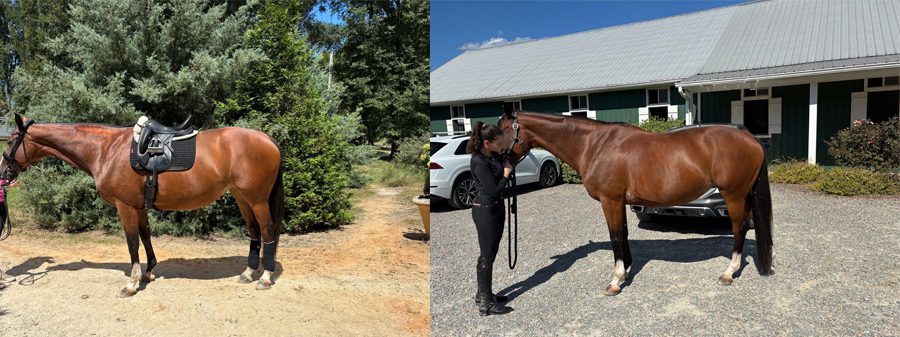
When the natural girth position sits close behind the elbow, repeated contact as the horse moves can lead to rubbing and hair loss.
This is one of the first things we would check.
Every horse has a natural girth groove, which is the area around the ribcage where the girth naturally wants to settle.
On some horses this groove sits well behind the elbow. On others it is much further forward.
If the girth groove is forward of the position dictated by the saddle, the girth can gradually be pulled forwards towards the elbow as the horse moves.
You may put the girth on with reasonable clearance before riding, only to find that it is sitting immediately behind the elbow afterwards.
This can create repeated friction with every stride.
If this sounds familiar, our guide to what a forward girth groove is explains why it happens and how to recognise one.
Yes.
A straight girth does not necessarily suit every horse.
Different horses have very different ribcage and chest shapes. Some are relatively straight through the girth area, while others are rounder, narrower through the chest or have a girth groove positioned significantly forward.
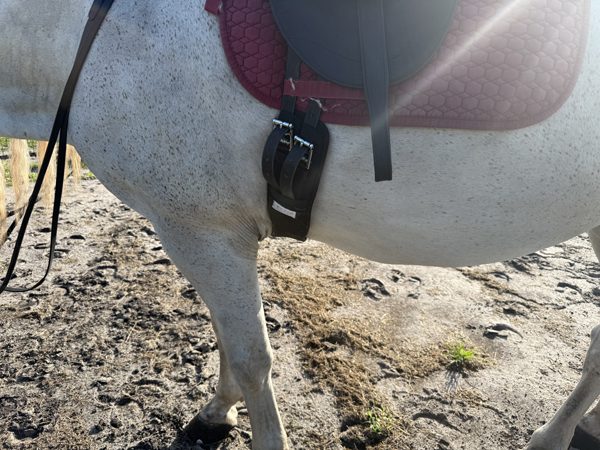
A girth that fights against the horse’s natural shape can be pulled into a different position once the horse starts moving.
This is why simply buying a heavily shaped or so-called anatomical girth does not automatically solve the problem. The shape needs to correspond with the individual horse.
In some cases, a girth designed to provide more room around the elbow can help. In others, the real requirement is a girth shape that accommodates a forward girth groove and remains more stable.
Girth length is another factor worth checking.
With a short girth, you do not want the buckles, straps or thicker edges of the girth sitting in an area where they interfere with the elbow.
A girth that is the wrong length can also position shaped sections of the girth somewhere other than where the manufacturer intended them to sit.
This does not mean that a longer girth is always better. The important thing is that the girth is correctly sized for both the horse and the saddle being used.
If you are unsure, our guide to how a horse girth should fit explains positioning, length and the main things to check when your horse is saddled.
It can, although we would still want to establish why the girth is rubbing in the first place.
Sweat, dirt and moisture can increase friction, while stiff or poorly positioned materials can make an existing problem worse.
For horses with particularly sensitive skin, genuine sheepskin can be helpful because the fibres provide a soft surface against the skin while also helping to manage moisture and heat.
However, putting a soft cover over a girth that is continually being pulled against the elbow may reduce the symptoms without addressing the underlying fitting problem.
We look at materials and other considerations in more detail in our guide to choosing the best girth for sensitive horses.
If the skin has become broken, swollen or painful, continuing to ride with the same girth can make the damage considerably worse.
The horse needs time for the affected area to recover, and significant or persistent skin damage should be assessed by an appropriate veterinary professional.
It is also important to establish why the injury happened before returning to the same equipment. Otherwise, the problem is likely to return.
Our guide to horse girth galls and sores covers the common causes, prevention and what to do when a horse has already developed a girth injury.
Rather than immediately buying another girth, look at the whole picture.
Check the girth before and after riding. Has it moved forwards? Look at how much clearance there is behind the elbow and whether the elbow contacts the girth when the horse moves.
Then check the girth length and where the buckles and edges are positioned. Finally, consider whether the shape of the girth actually matches the horse’s conformation and natural girth groove.
This often tells you considerably more than simply looking at the material from which the girth is made. If you are considering a different girth, our guide to choosing the best horse girth explains the different shapes, materials and fitting considerations in more detail.
If you cannot work out why your horse’s girth is rubbing, we offer a free girth consultation.
Send us some photographs of your horse saddled and girthed and we can look at the horse’s conformation, girth groove, current girth position and available elbow clearance. We can then suggest what we think may be causing the problem and which girth shape is likely to be most suitable.
There is no obligation to buy anything.
If you prefer to speak to someone, feel free to call us on 01386 833050 or message us on WhatsApp – we’re happy to walk you through it.
📲 Message us on WhatsApp
