Horses come in many different shapes, and their conformation can have a considerable influence on how a girth fits and whether a saddle remains stable during riding.
While rounder horses often present one set of girth-fitting challenges, athletic or wedge-shaped horses can present quite another. Some have a body shape that encourages the girth to move backwards, potentially pulling the saddle out of its intended position.
However, not every athletic horse has this problem, and not every saddle that slips backwards requires a different girth.
The right girth is not necessarily the one with the most elaborate anatomical design. It is the one whose shape works with the individual horse’s conformation.
In this article, we’ll explain what makes athletic and wedge-shaped horses different, the fitting problems they can experience and why a specially shaped girth, such as the Mattes Athletico, may be worth considering.
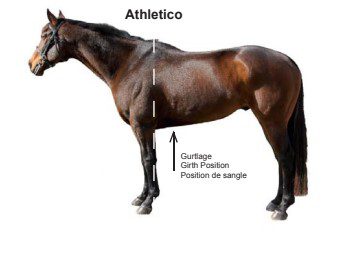
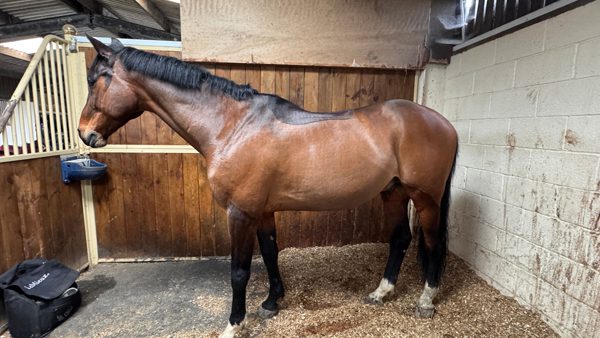
When we describe a horse as athletic or wedge-shaped, we’re referring to its body conformation rather than its ability or the discipline in which it competes.
These horses may have a relatively defined chest, a more angular body shape and a ribcage that changes noticeably in width or depth from front to back.
Unlike a round or barrel-shaped horse, whose ribcage may be relatively broad and rounded, an athletic horse can have a more pronounced taper through the body.
This conformation is sometimes seen in Thoroughbreds, warmbloods and other sport horses, although breed alone is never a reliable way of determining girth shape.
Two horses of the same breed and height can have very different girth grooves, chest shapes and saddle-fitting requirements.
The difficulty is not necessarily the size of the horse’s chest, but the relationship between its body shape, natural girth groove and the position of the saddle.
A horse’s girth groove is the area beneath the chest where the girth naturally tends to settle.
On some athletic or wedge-shaped horses, the contours of the ribcage can encourage the girth to move backwards as the horse walks or works.
If the girth moves backwards while attached to the saddle’s girth straps, it may exert a backwards pull on the saddle.
Other horses may have a perfectly stable girth despite looking similarly athletic.
For this reason, we should assess where the girth naturally sits and how it behaves during movement, rather than choosing a girth based on the horse’s appearance alone.
Our guide to horse girth grooves explains how the natural girthing position can influence girth and saddle fit.
When a horse has a body shape that encourages the girth to settle further back, a conventional straight girth may not always remain in the most suitable position.
During movement, the girth may gradually migrate towards the narrower or more natural resting area of the horse’s body.
This can create tension through the saddle’s girth straps and, in some cases, contribute to the saddle moving backwards.
Riders may notice that the saddle appears correctly positioned when first tacked up but has moved further back after riding.
However, backwards saddle movement can also be caused by an unsuitable saddle, incorrect balance, billet positioning or other fitting issues.
It is important to establish whether the girth is actually contributing to the problem before assuming that changing it will solve the issue.
No. A horse with an athletic build does not automatically need a specially shaped girth.
If the existing girth sits comfortably, remains stable and allows the saddle to stay in its correct position, there may be no reason to change it.
Equally, the word “anatomical” does not guarantee that a girth will suit every horse.
Anatomical girths come in many different shapes. Some are designed to provide additional elbow clearance, while others are intended to accommodate a forward girth groove or a particular ribcage shape.
A girth designed for one conformation problem may be unsuitable for another.
An anatomical girth is only beneficial when its shape is appropriate for the horse wearing it.
We explore these differences in our guide to anatomical horse girths.
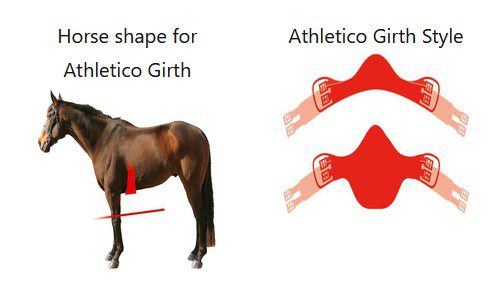
The Mattes Athletico was developed specifically for horses with an athletic, wedge-shaped physique where the girth and saddle have a tendency to move backwards.
Rather than using a conventional straight design, the Athletico has a distinctive shape intended to accommodate this conformation and help counteract backwards movement.
The aim is to allow the girth to sit more appropriately against the horse’s body while reducing the tendency for it to pull the saddle backwards.
This does not mean the Athletico will correct every backwards-slipping saddle. The saddle must still fit correctly, and the girth must be the appropriate length and positioned properly.
However, where the horse’s conformation and girth position are contributing to backwards movement, it can be a particularly useful design to consider.
The Athletico is available in different configurations, including short and long girths, allowing it to be used with different saddle types.
All Mattes girths are genuine sheepskin-lined versions, which can be particularly helpful for horses with sensitive skin.
The two features serve different purposes: the Athletico’s shape addresses the fitting geometry, while the sheepskin lining provides a soft, moisture-managing surface against the horse.
At Pink Equine, we regularly assess photographs of horses to help owners identify which girth shape may be most suitable.
Two of our consultations illustrate how the Athletico can be recommended for different combinations of conformation and fitting problems.
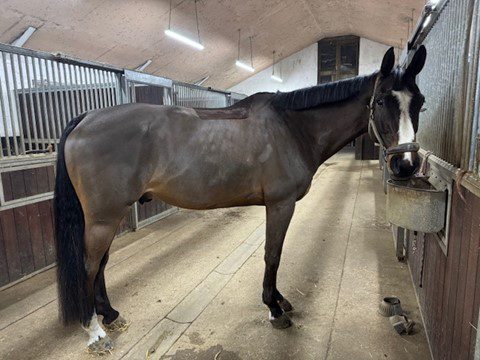
Jessica contacted us about her sensitive-skinned horse and supplied photographs showing its conformation, both without a saddle and fully tacked up.
Looking at the horse’s body shape and the position of the existing girth, we felt that the Mattes Athletico Girth would be an appropriate design.
We also recommended genuine sheepskin because of the horse’s skin sensitivity.
Jessica subsequently confirmed that our recommendation had been successful.
This is a useful example of why we don’t simply select a girth according to the problem a rider describes. We also consider the horse’s individual shape and how the girth is likely to sit against its body.
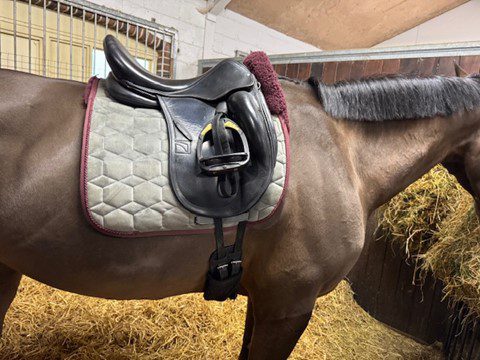
Suzanne approached us with a slightly different problem.
Her horse also had sensitive skin, but there was an additional concern: the saddle had been slipping backwards with the previous girth.
After examining the photographs of the horse’s conformation and the saddle and girth position, we recommended the Mattes Athletico with genuine sheepskin.
Our recommendation was successful, and Suzanne confirmed that the fitting problems had been resolved.
This consultation demonstrates the importance of considering the relationship between girth shape and saddle movement, rather than automatically tightening the existing girth further.
It also shows why a correctly selected girth can make a meaningful difference when the girth itself is contributing to the saddle’s instability.
Before choosing an Athletico, we would consider several factors:
Not every horse displaying these characteristics will need an Athletico, and in some cases another girth shape may be more appropriate.
For example, a round horse with a forward girth groove may be better suited to a Crescent design, while other horses may benefit from an Asymmetric girth.
The objective is not to choose the most unusual-looking girth, but to find the shape that best accommodates the individual horse.
If the saddle continues to move backwards despite using a correctly fitted girth, the problem may lie elsewhere.
Saddle balance, tree width, panel contact, billet arrangement and the horse’s changing musculature can all affect stability.
A different girth should never be used to disguise a saddle-fitting problem.
Our article on the best girths for slipping saddles explains how different girth designs may help with different types of movement.
It is also important not to compensate for a slipping saddle by repeatedly tightening the girth. As we explain in How Tight Should a Horse’s Girth Be?, the correct tension is the minimum needed to keep a properly fitted saddle secure.
Horses with athletic or wedge-shaped conformation can present particular girth-fitting challenges, but there is no single girth that suits every horse of this type.
The Mattes Athletico is designed to address the tendency for the girth and saddle to move backwards on certain body shapes, and our own consultations have shown how useful it can be when recommended for an appropriate horse.
However, successful girth fitting depends on understanding the individual horse, the position of its girth groove and how the saddle and girth work together.
The right girth is the one that suits your horse’s shape, not simply the one described as anatomical.
If your horse has an athletic build, sensitive skin or a saddle that tends to move backwards, we can help you assess whether a Mattes Athletico or another girth shape may be suitable.
Through our free girth consultation, we can examine photographs of your horse with and without the saddle, looking at conformation, girth position, buckle height and elbow clearance.
We can then recommend the most appropriate girth shape and size based on what we can see and the problems you’re experiencing.
There is no obligation to purchase anything.
If you prefer to speak to someone, feel free to call us on 01386 833050 or message us on WhatsApp – we’re happy to walk you through it. 📲 Message us on WhatsApp
