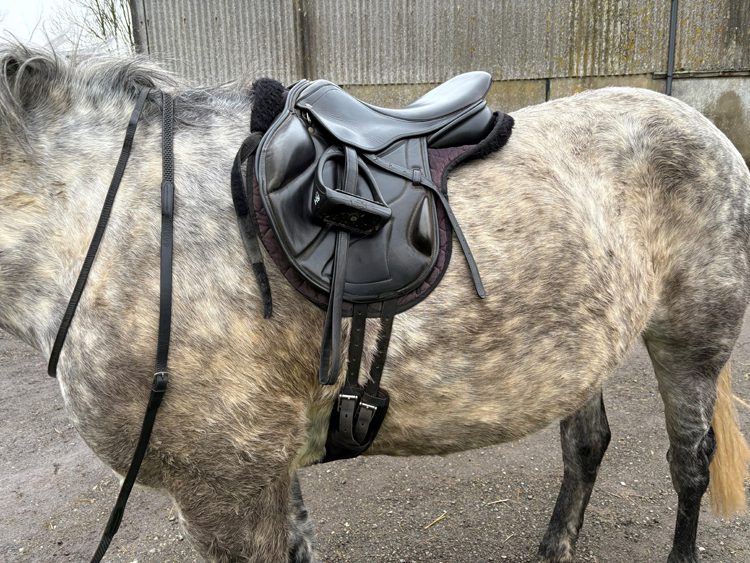
If your horse’s girth keeps sliding forwards towards the elbows, you’re not alone. It’s a common fitting problem, particularly in horses with a forward girth groove or a rounder body shape.
A horse’s girth often slides forwards because it is moving towards the horse’s natural girth groove, which may sit further forwards than the saddle’s girth straps. The shape of the horse’s ribcage, the position of the saddle and the design of the girth can all influence where it settles.
However, there’s an important distinction between a girth moving forwards and a saddle slipping forwards. Although the two problems can be connected, they don’t always have the same cause or solution.
Understanding why the girth is moving is the first step towards choosing the right solution.
Every horse has a natural girth groove, the area beneath the chest where the girth tends to settle when the horse moves.
On some horses, this groove sits relatively close to the elbows. On others, it is positioned further back.
If the horse’s natural girth groove is further forwards than the position of the saddle’s girth straps, the girth may gradually migrate forwards as the horse walks or works.
This can happen even when the girth was correctly positioned before riding.
The girth is not necessarily slipping because it is loose. It may simply be following the contours of the horse’s body towards its natural resting position.
Trying to force the girth to remain further back by tightening it more firmly may create additional pressure without addressing the underlying problem.
We explain the relationship between conformation and girth position in our guide to forward girth grooves.
Although a forward-moving girth can occur on almost any horse, certain conformations can make the problem more likely.
Horses with a broad, rounded ribcage may have relatively little natural definition to help a conventional straight girth remain in its intended position.
As the horse moves, the girth may tend to settle towards the front of the ribcage, particularly if the natural girth groove is positioned close to the elbows.
This is a problem we frequently encounter when assessing cobs, native ponies and other rounder horses, although breed alone is not a reliable guide to girth shape.
Our article on girth fitting for round and barrel-shaped horses explains this conformation in greater detail.
Some horses have a clearly defined girth groove that lies further forwards than the position of the saddle’s girth straps.
Even if the horse is not particularly round, the girth may repeatedly move towards this natural position.
In these cases, simply choosing a wider or more padded girth may not solve the problem. The actual shape of the girth needs to accommodate the relationship between the girth groove and the saddle.
Some short-backed horses have relatively limited space between the elbows and the area where the saddle sits.
This can make the relationship between the saddle’s girth straps and the horse’s natural girth groove more challenging.
However, a short back does not automatically mean that a horse needs a particular girth shape. The position of the girth groove and the horse’s ribcage still need to be assessed individually.
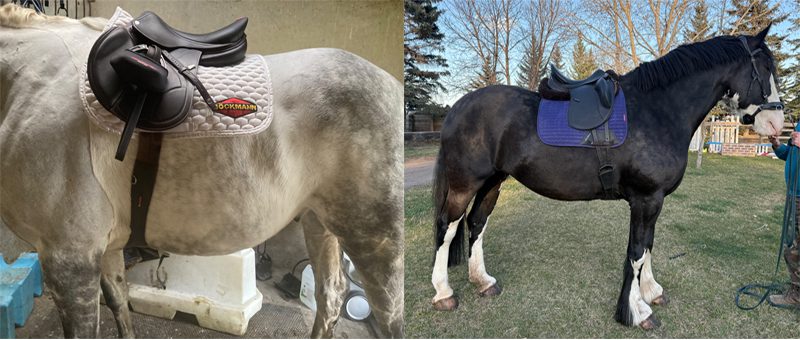
Two horses with different body conformations and girth positions. The grey horse has a rounder ribcage and is short backed, while the black horse shows a different body profile. These differences help explain why the same girth design may not suit every horse.
This is one of the most important questions to establish before changing your girth.
Although riders sometimes describe both situations as a slipping girth, there are three different problems to consider.
If the saddle remains in its correct position but the girth moves towards the elbows, the problem may be related to the horse’s natural girth groove, the girth’s shape or the alignment of the saddle’s girth straps.
You may notice that the girth straps angle forwards rather than hanging vertically once the girth has settled.
Some forward angling is not automatically a problem, but pronounced tension or an uncomfortable girth position deserves closer assessment.
In some cases, the girth settles forwards and creates a forward pull through the saddle’s girth straps.
This may contribute to the saddle moving towards the horse’s shoulders.
However, saddle fit and balance can also be contributing factors, so changing the girth alone may not be sufficient.
If the girth remains stable but the saddle moves forwards, the underlying problem may be primarily related to saddle fit, balance or stability rather than the girth itself.
In this situation, a qualified saddle fitter should assess the saddle before attempting to solve the problem with a different girth.
The important point is that a forward-moving girth and a forward-moving saddle are related problems, but they are not necessarily the same problem.
A girth that appears correctly positioned while the horse is standing may settle differently once the horse starts moving.
Walking, trotting and cantering all involve movement of the ribcage, shoulders and muscles around the girthing area.
As the horse moves, the girth may gradually settle into the position encouraged by the shape of the chest and ribcage.
This is why photographs taken before and after riding can be particularly useful when assessing girth-fitting problems.
We often ask customers to provide photographs of their horse without tack, with the saddle and girth fitted, and after riding. Comparing these images can help us understand the horse’s conformation and whether the girth is changing position.
Photographs cannot reveal every pressure or saddle-fitting problem, but they can provide useful information about the position and alignment of the girth.
One of the most common recommendations for a girth that keeps sliding forwards is to try an anatomical girth.
Unfortunately, that advice isn’t specific enough to be particularly helpful.
The term anatomical girth covers a wide variety of designs, many of which have quite different shapes and purposes.
Some anatomical girths are designed primarily to provide additional elbow clearance. Others are shaped to accommodate a forward girth groove, a rounded ribcage or a horse whose girth tends to move backwards.
Although they may all be described as anatomical, they are not interchangeable.
For example, a girth designed to address backwards movement on an athletic, wedge-shaped horse is unlikely to be the most appropriate choice for a round horse whose girth continually migrates forwards towards the elbows.
Even two girths that look broadly similar may have different contours, buckle positions and fitting characteristics.
The important question isn’t whether a girth is anatomical, but whether its particular shape addresses the reason your horse’s girth is moving forwards.
This is why we assess the horse’s conformation, natural girth groove and saddle position before recommending a specific design.
Our guide to anatomical horse girths explains why different designs are intended for different fitting problems.
When the horse’s conformation is contributing to forward girth movement, a differently shaped girth may help it sit more appropriately.
Two designs we regularly consider during our free girth consultations are the Mattes Crescent and Mattes Asymmetric.
Although both can be suitable for horses with a forward girth position, they are designed to accommodate different conformations.
The Mattes Crescent is designed for horses with a rounded ribcage and a forward girth groove, where a conventional girth may have difficulty remaining in a suitable position.
Its distinctive curved shape is intended to accommodate this conformation and help the girth sit more comfortably in relation to the horse’s body.
We frequently recommend the Crescent for rounder horses whose girths migrate forwards, particularly when the natural girth groove sits close to the elbows.
However, the Crescent is not automatically the correct choice for every horse with a forward girth groove.
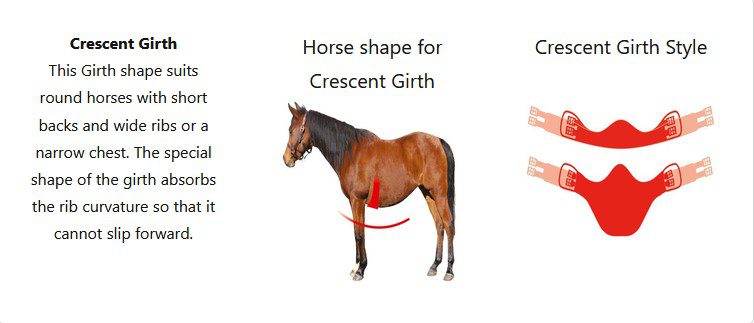
Mattes Crescent anatomical sheepskin girth designed for round horses with forward girth grooves
The Mattes Asymmetric is designed to accommodate horses whose girth position is further forwards, but whose overall body shape may not be best suited to the Crescent.
Its asymmetric design provides a different relationship between the girth’s front and rear edges, allowing it to accommodate particular chest shapes and girth positions.
For some horses, particularly those with a forward girth groove but a less rounded ribcage, the Asymmetric may be a more appropriate choice.
We also consider it for certain close-coupled horses, depending on the individual conformation and saddle arrangement.
The important point is that the Crescent and Asymmetric are not simply two versions of the same girth.
Choosing between them requires an assessment of the horse’s body shape and the position in which the girth naturally settles.
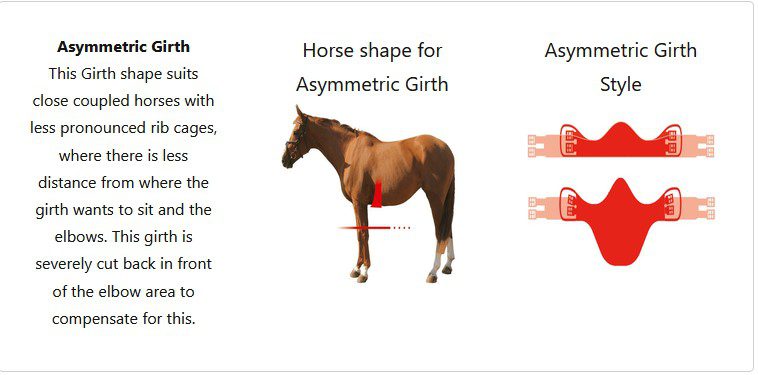
Mattes Asymmetric sheepskin girth showing its anatomical asymmetric shape
At Pink Equine, we’ve carried out more than 150 individual girth consultations, helping owners assess their horses’ conformation and identify potentially suitable girth designs.
In our experience, the Mattes Crescent is frequently an appropriate recommendation for horses whose girths move forwards, particularly those with a rounded ribcage and a forward girth groove.
However, we also recommend the Mattes Asymmetric where the horse’s individual conformation makes it more suitable.
That doesn’t mean one design works for every horse, or that every recommendation can be guaranteed to succeed. It reinforces why we assess horses individually instead of recommending the same anatomical girth for every problem.
We also place considerable importance on selecting the correct length, because even an appropriately shaped girth can cause difficulties if the buckles sit too close to the elbows.
Before buying a replacement girth, there are several practical checks worth making.
Look at where the girth naturally settles when your horse is standing and after a short period of movement.
Does it move forwards towards the elbows? Is there an obvious difference between where the girth starts and where it finishes?
Understanding this natural position is more useful than repeatedly pushing the girth backwards without considering why it moves.
Make sure the saddle is correctly positioned and has been assessed for fit and balance.
If the saddle is moving forwards independently of the girth, a different girth may not solve the problem.
Look at the angle of the saddle’s girth straps once the girth has settled.
If they are pulling sharply forwards, there may be a mismatch between the natural girth groove and the position of the saddle’s billets.
Some saddles have alternative girthing arrangements, but changes to billet selection should be discussed with a qualified saddle fitter rather than made by trial and error.
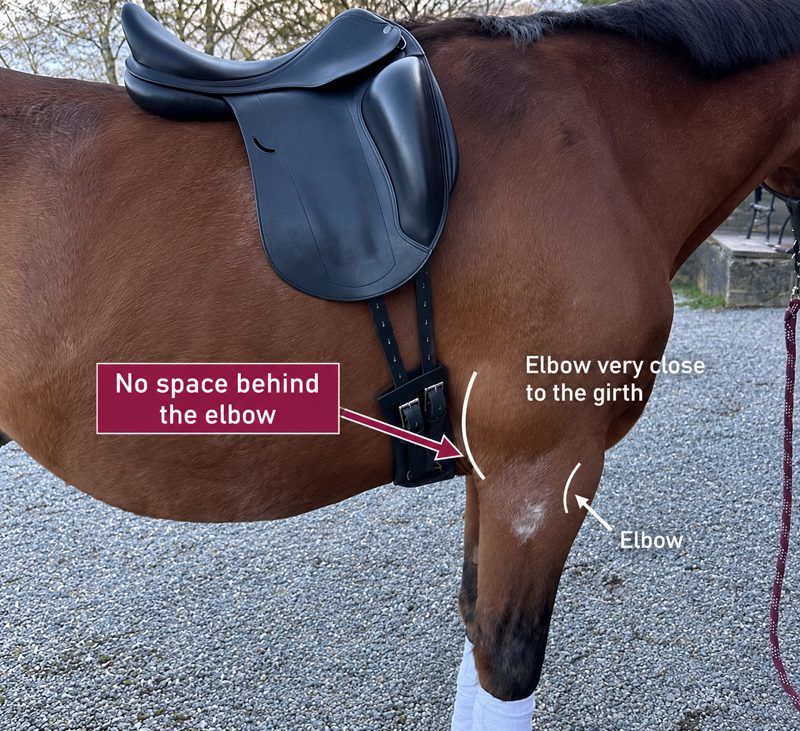
A girth that is too short may leave the buckles sitting too low, potentially bringing them into an area where they interfere with the horse’s elbows.
A girth that is too long can create different fitting difficulties, including insufficient adjustment or unsuitable buckle positioning.
The correct length depends on the saddle, girth type and individual horse.
Our guide to measuring a horse for a girth explains what to consider before ordering.
If the horse’s conformation is encouraging the girth to migrate forwards, changing to a suitably shaped girth may be more effective than simply replacing a straight girth with another straight design.
However, the choice should be based on the horse’s actual conformation, not simply on whether a girth is marketed as anatomical.
Not necessarily.
If a girth is moving forwards because it is following the horse’s natural girth groove, tightening it more firmly does not change the horse’s conformation.
Excessive tightening may increase pressure and discomfort without preventing the girth from settling into its preferred position.
A girth must be secure enough to help keep a correctly fitted saddle stable, but it should not be tightened excessively in an attempt to overcome a shape or fitting problem.
As we explain in How Tight Should a Horse’s Girth Be?, the correct tension is the minimum needed to keep a properly fitted saddle secure.
Yes. If a girth repeatedly moves towards the elbows, it may reduce the available clearance and create friction or pressure in a sensitive area.
This can be particularly troublesome when the girth’s edge or buckles sit close to the movement of the elbow.
Some horses may develop rubbed hair, skin irritation or girth sores, especially if the problem continues over time.
However, rubbing is not always caused by girth movement. Material, fit, cleanliness, skin sensitivity and other factors may also contribute.
If your horse is developing irritation, our guides to girth and elbow clearance and girth rubbing behind the elbow explain what to look for.
Where the skin is broken or painful, avoid continuing to ride with equipment that aggravates the area and seek veterinary advice where appropriate.
A small amount of settling can be normal as the horse moves, particularly when the natural girth groove is positioned forwards. However, repeated movement into the elbows, rubbing or excessive tension through the girth straps suggests that the fit should be assessed.
A straight girth may be unsuitable for some horses whose conformation encourages the girth to settle further forwards. However, straight girths work perfectly well for many horses, and the shape alone does not determine whether a girth will move.
A Crescent girth is itself a type of anatomical girth. Its particular curved design is intended for certain conformations, especially rounder horses with forward girth grooves. Other anatomical shapes may be more suitable for different horses.
Yes, in some cases. If the girth settles forwards and creates a forward pull through the saddle’s girth straps, it may contribute to saddle movement. However, saddle fit and balance must also be considered.
If your horse’s girth repeatedly slides forwards, the most important thing is to establish why it is moving.
For some horses, the natural girth groove is positioned further forwards than the saddle’s girth straps. For others, a rounded ribcage, unsuitable girth shape or saddle-fitting issue may be contributing.
Choosing an anatomical girth can help, but only when the particular design is appropriate for the horse.
A girth that repeatedly slides forwards may be following the horse’s natural girth groove rather than simply being too loose. Tightening it further does not correct a mismatch between the horse’s conformation and the girth’s design.
Understanding the individual horse’s shape is the key to choosing a girth that fits appropriately and remains comfortable during movement.
At Pink Equine, we offer a free Mattes girth consultation to help you choose the most suitable shape and size for your horse.
We can assess photographs of your horse without tack and with its saddle and current girth fitted, looking at conformation, girth position, buckle height and elbow clearance.
Whether your horse has a forward girth groove, a rounded ribcage or a girth that continually moves towards the elbows, we’ll help you understand which design may be most appropriate.
There is no obligation to purchase.
If you prefer to speak to someone, feel free to call us on 01386 833050 or message us on WhatsApp – we’re happy to walk you through it. 📲 Message us on WhatsApp
