If your horse’s saddle keeps slipping forward towards the shoulders, the cause could be incorrect saddle fit, the position of the girth groove, the alignment of the girth straps or your horse’s conformation. Although some horses are more prone to this problem than others, a saddle slipping forward can occur on almost any horse, regardless of breed, size or body shape.
Sometimes the girth is pulling the saddle forwards as it settles into the horse’s natural girthing area. In other cases, the saddle itself may be too wide, incorrectly balanced or simply unsuitable for the horse’s back.
The important thing is to establish why the saddle is moving before trying to stop it. A different girth may help in certain circumstances, but it cannot correct a poorly fitting saddle.
Yes. Although forward saddle movement is often associated with round, barrel-shaped horses or those with low withers, it can happen to horses of almost any conformation.
For example, a round cob with a broad ribcage and relatively little definition behind the shoulders may have difficulty keeping a saddle stable. A more athletic horse might have a pronounced forward girth groove that encourages the girth to settle towards the elbows, potentially pulling the saddle with it.
However, even a horse with a fairly conventional body shape can experience forward saddle movement if the saddle is incorrectly fitted or has become unsuitable following changes in muscle development or condition.
This is why we wouldn’t recommend choosing a new girth simply because your horse belongs to a particular breed or has a certain body shape. The saddle, girth and horse need to be considered together.
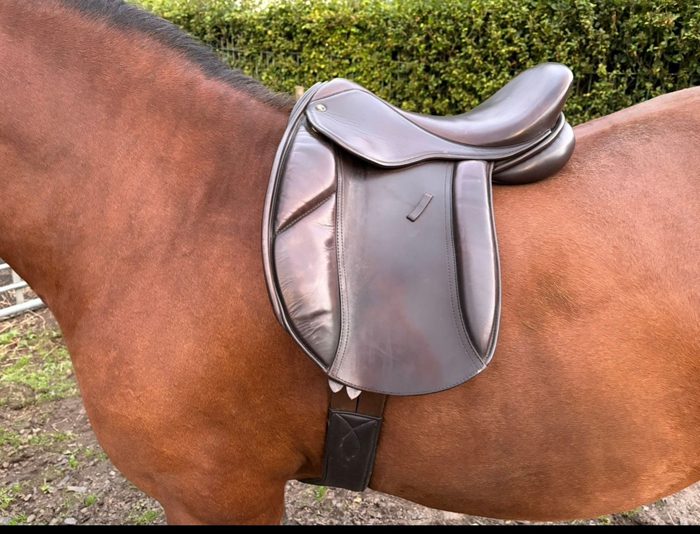
A saddle that moves forwards can interfere with the horse’s shoulder movement and create unwanted pressure. The underlying cause should be investigated rather than simply tightening the girth.
Saddle fit should always be the first consideration when a saddle repeatedly moves forwards.
A saddle that is too wide, incorrectly balanced or unsuitable for the shape of the horse’s back may be unstable during movement. In some cases, the back of the saddle may lift or rock, while the front gradually moves towards the shoulders.
Even a saddle that fitted well previously can become unsuitable as the horse changes shape. Young horses developing muscle, horses returning to work and those gaining or losing weight can all experience changes that affect saddle stability.
If your saddle is slipping forwards, particularly if it is lifting at the back or tipping towards the shoulders, arrange for a qualified saddle fitter to assess it before trying to correct the movement with additional equipment.
Every horse has a natural area where the girth tends to settle, commonly called the girth groove.
On some horses, this area is positioned further forwards, close to the elbows. When the girth settles into this position, it may pull the saddle forwards through the girth straps.
This can happen even when the saddle has initially been placed correctly behind the shoulder.
One indication is when the girth straps angle noticeably forwards from the saddle towards the girth. However, the angle alone doesn’t establish the cause, and the saddle’s fit and girthing arrangement should be assessed together.
We’ve explained this in more detail in our guide to horses with a forward girth groove.
The position of the girth straps, also called billets, influences how the girth and saddle work together.
Ideally, the girthing arrangement should allow the girth to sit comfortably in the horse’s natural girthing area without creating an excessive forward or backward pull on the saddle.
If the girth straps are positioned significantly behind the natural girth groove, the girth may pull forwards as the horse moves, potentially taking the saddle with it.
Some saddles have different girthing arrangements designed to accommodate particular body shapes. However, moving or altering girth straps should only be considered with a qualified saddle fitter, as changes can affect saddle balance and pressure distribution.
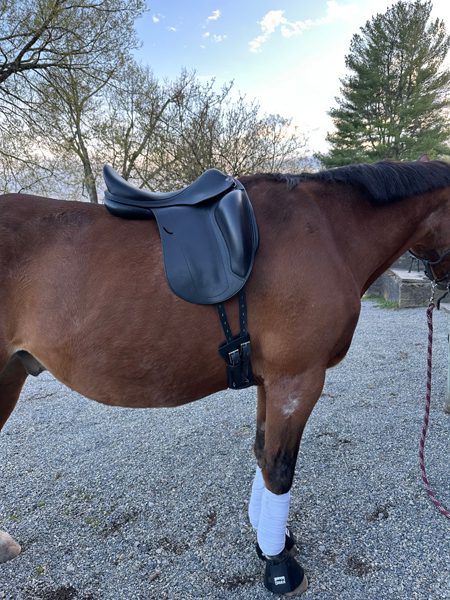
When the natural girth groove sits further forwards than the saddle’s girth straps, the resulting pulling angle can contribute to saddle movement.
Some body shapes make saddle stability more challenging.
Round or barrel-shaped horses may have broad ribcages, relatively flat backs and less pronounced withers, giving the saddle less natural definition to sit behind.
Horses that are higher behind than in front, sometimes described as croup-high, may also present particular saddle-fitting challenges, depending on their overall back shape and saddle balance.
However, conformation is only one part of the picture. A horse with prominent withers can still experience forward saddle movement if the saddle doesn’t fit correctly.
For horses with a particularly round body shape, our article on choosing a girth for round and barrel-shaped horses explains how conformation can affect girth position.
If your saddle has only recently started slipping forwards, it’s worth considering what has changed.
Has your horse gained or lost weight? Have they developed more muscle through training? Have they returned to work after a break, or has their saddle padding changed?
Even relatively modest changes in body shape can affect how a saddle sits.
Changes in movement, discomfort or asymmetry may also influence saddle stability. If your horse has become reluctant to move forwards, shows signs of pain or has developed an unusual gait, veterinary assessment may be appropriate alongside a saddle-fitting check.
One of the most useful things you can do is establish exactly what is moving.
Start by placing the saddle correctly and taking a clear photograph from the side before riding. If it is safe to do so, take another photograph immediately afterwards, before adjusting the saddle or girth.
Compare the photographs and look for the following:
If the girth moves forwards and the saddle follows, the girthing arrangement may be contributing to the problem.
If the saddle moves forwards while the girth remains in its natural position, saddle fit and stability become particularly important considerations.
These observations won’t replace a professional saddle-fitting assessment, but they can provide useful information about what is happening.
We’ve also written a separate guide explaining why a horse’s girth keeps sliding forwards, which looks specifically at movement of the girth itself.
Possibly, but only if the girthing arrangement is contributing to the problem and the saddle itself fits correctly.
One mistake we frequently see in discussions about girth problems is the suggestion to simply try an anatomical girth.
The difficulty with that advice is that not all anatomical girths are designed for the same horse shapes or fitting problems.
For example, the Mattes Crescent girth is often considered for rounder horses with a forward girth groove, while the Mattes Asymmetric may be more appropriate for certain horses with a different relationship between their elbows, girth groove and saddle position.
Neither is automatically the correct choice simply because the saddle moves forwards.
At Pink Equine, we look at the horse’s body shape, existing girth, saddle and girth strap alignment before recommending a particular design.
Our guide to the best girths for slipping saddles explains the different options and when they may be appropriate.
Non-slip saddle pads and other accessories are sometimes suggested as quick solutions to saddle movement.
Although additional equipment may have a place in a properly assessed tack arrangement, it shouldn’t be used to conceal an underlying saddle-fitting problem.
A non-slip pad may reduce visible movement without addressing uneven pressure or poor saddle balance. Similarly, a breastplate is not a substitute for a correctly fitted saddle, and it should not be relied upon to force an unstable saddle to remain in position.
Tightening the girth excessively is also unlikely to correct an unsuitable saddle and may create additional discomfort.
The priority should always be to identify why the saddle is moving.
There isn’t one solution that works for every horse, but we would recommend the following approach:
Importantly, if the saddle is repeatedly moving onto the shoulders or becoming unstable during riding, don’t continue riding in the hope that tightening the girth will solve it. Have the problem assessed before using the saddle again.
Although we specialise in horse girths rather than saddle fitting, we regularly help customers whose horses have girth-related fitting problems.
Through our free Mattes girth consultation service, we can review photographs of your horse, existing girth and saddle to help establish whether the girth shape or girthing arrangement may be contributing to the problem.
If we believe the issue is more likely to involve saddle fit, we’ll recommend having the saddle professionally assessed rather than suggesting that purchasing a new girth will necessarily solve it.
Our aim is to help you find the right solution for your horse, whether that involves a different girth or addressing another aspect of the fitting problem.
If you prefer to speak to someone, feel free to call us on 01386 833050 or message us on WhatsApp – we’re happy to walk you through it. 📲 Message us on WhatsApp
